Crypto
Bitcoin ATM
Bitcoin ATM (Mario Tama/Getty Images)
Bitflation

Hot inflation report cools bitcoin price, but not for long

“This reaction is antithetical to BTC’s narrative as an inflation hedge.”

Yaël Bizouati-Kennedy

The US Consumer Price Index rose by more than expected in January — 0.5% month on month versus the consensus estimate of 0.3% — signaling that the country is not out of the woods with inflation. Along with the overall stock market, the report brought bitcoin’s price crashing down, with the price dropping to about $94,000 minutes after the report was released, though it has since recovered to $95,500 as of 11:15 a.m ET.

Bitcoin dived after the hot inflation print

[image or embed]

— Joe Weisenthal (@weisenthal.bsky.social) February 12, 2025 at 9:17 AM

Bitcoin’s price drop today is also reviving the age-old debate about whether bitcoin is or is not an inflation hedge.

Historically, CPI reports have actually had little effect on bitcoin’s price. A CoinGecko analysis found that its “price falls or rises regardless of the direction of the inflation rate shift.” The report noted:

“For instance, when the CPI report showed a drop from 8.5% to 8.3% (annualized) between March and April 2022, Bitcoin price dropped -11%. Vice versa, Bitcoin’s price went up 9.68%, following a CPI report showing an inflation decrease from 8.2% to 7.7% (annualized) between September and October 2022.”

The inflation report also signals that the Fed might not cut rates as much or as soon as previously anticipated.

“Not only will this create tremendous psychological damage to investors, but the market will likely have a negative knee-jerk reaction to the increasing risks of higher-for-longer or even higher-from-here, so caution is warranted,” Chris Zaccarelli, CIO of Northlight Asset Management, said.

So what does it mean for bitcoin?

Alan Orwick, cofounder of Quai Network, told Sherwood News that the report, which suggests tighter monetary policy, drove the sell-off. “However, there’s optimism for a rebound if inflation cools or liquidity returns to the market,” he said. “This reaction is antithetical to BTC’s narrative as an inflation hedge.”

Other experts echoed the sentiment, noting that the prospect of US interest rates being cut anytime soon has faded, and bitcoin is almost entirely correlated with risk assets.

Nic Puckrin, financial analyst and founder of Coin Bureau, said that though bitcoin was designed to be a hedge against inflation, its adoption by some of the biggest institutions in the world means it moves with stock markets. 

“However, tomorrow, we will likely see bitcoin stabilize as long-term holders take advantage of the dip to buy into what is the best store of long-term value currently available,” Puckrin said.  

In contrast, some see this as a harbinger of more downward pressure for bitcoin in the foreseeable future.

Jim Flint, founder of Local Search Group and former CRO of the Texas Blockchain Council, said that for bitcoin to go significantly higher, there are typically two key steps. First, the cutting of Fed rates, which is highly unlikely due to today’s CPI. “Second, quantitative easing, or, better said, money printing,” he said. “This morning’s report pushes each of those two steps even further out.”


Yaël Bizouati-Kennedy is a financial journalist who’s written for Dow Jones, The Financial Times Group, and Business Insider.

More Crypto

See all Crypto
crypto

Altcoin trading activity has lost its mojo

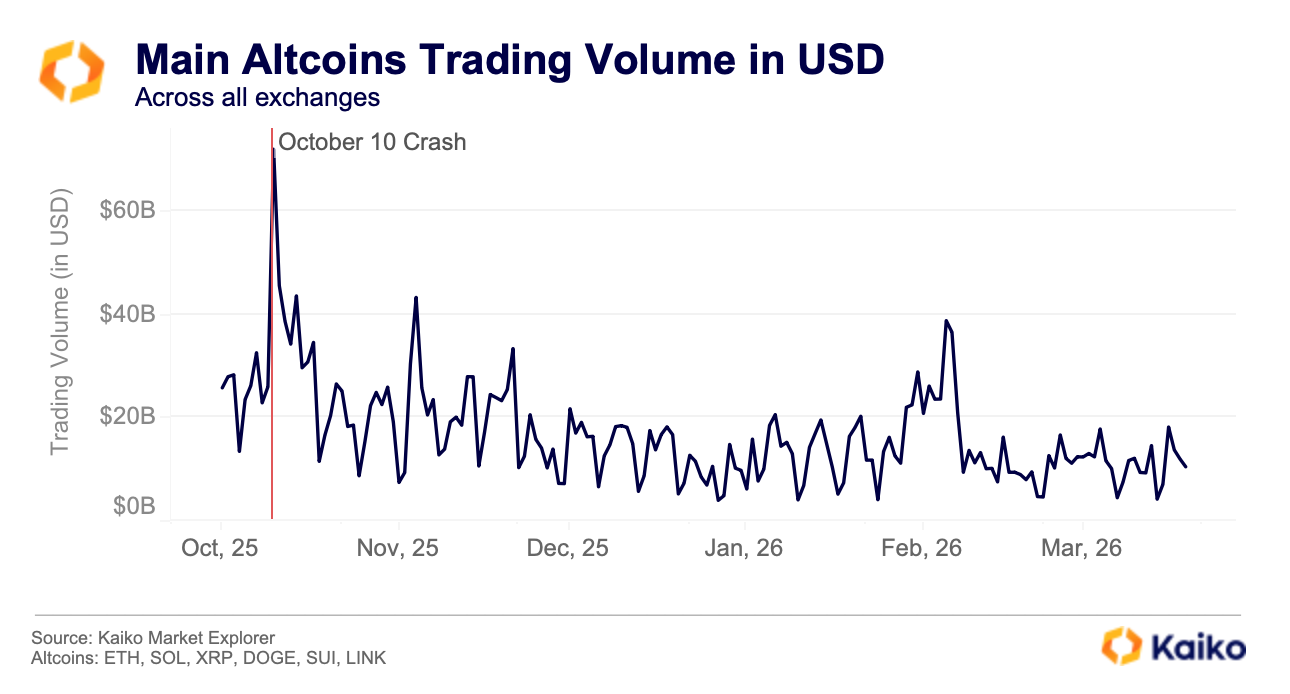
Non-bitcoin cryptocurrencies have seen their trading volume plummet in the past five months. The combined trading volume of ethereum, XRP, solana, dogecoin, SUI, and chainlink has decreased by 60% since crypto’s October 10 liquidation event, according to Thomas Probst, a research analyst at crypto markets data provider Kaiko.

Main Altcoins Trading Volume in USD
The trading volume of ETH, SOL, XRP, DOGE, SUI, and LINK.

For all altcoins, spot trading volume on Binance has declined between 80% and 85% to $7.7 billion, while altcoin volume on other exchanges has dropped to $18.8 billion, down from a range of $63 billion to $91 billion in October, a Friday report from Decrypt found, citing data from CryptoQuant.

“This trend may be explained by a contraction in market liquidity over the same period,” Probst told Sherwood News. “This phenomenon is also reflected in the average 1% market depth, which stood at approximately $2.6 million before the October 10 crash and is now closer to $1.7 million when aggregated across ETH, XRP, SOL, SUI, and LINK.” 

Market depth is used by investors and traders to gauge the scale of liquidity in a market. 1% market depth refers to the amount of liquidity needed to move the market by 1%. 

CoinGlass’s Altcoin Season Index, a measure to assess the performance of non-bitcoin cryptocurrencies, has been sitting above 50 this week, suggesting that the current market is neither in a bitcoin dominant phase nor an altcoin season.

Witch

“Triple witching” day may put further pressure on bitcoin’s price

This is not “a favorable environment for risk assets.”

crypto

Payward, parent company of crypto exchange Kraken, puts plans for IPO on hold

Payward, crypto exchange Kraken’s parent company, has paused its plans for an initial public offering until market conditions improve, according to a report from CoinDesk that cited two people with knowledge of the matter. 

Since the firm announced in November its preparation for an IPO of its common stock, the total market capitalization of the crypto industry has shed around $652.2 billion, from $3.2 trillion to $2.5 trillion as of Wednesday, data from CoinGecko shows. 

The news comes two weeks after Kraken received approval for a master account from the Federal Reserve Bank of Kansas City, allowing the crypto exchange to connect to the Fed’s payment infrastructure used by traditional banks and credit unions. 

Last year, Kraken raised $800 million at a $20 billion valuation from institutional investors such as Jane Street and Citadel Securities.

The news comes two weeks after Kraken received approval for a master account from the Federal Reserve Bank of Kansas City, allowing the crypto exchange to connect to the Fed’s payment infrastructure used by traditional banks and credit unions. 

Last year, Kraken raised $800 million at a $20 billion valuation from institutional investors such as Jane Street and Citadel Securities.

Latest Stories

Sherwood Media, LLC produces fresh and unique perspectives on topical financial news and is a fully owned subsidiary of Robinhood Markets, Inc., and any views expressed here do not necessarily reflect the views of any other Robinhood affiliate, including Robinhood Markets, Inc., Robinhood Financial LLC, Robinhood Securities, LLC, Robinhood Crypto, LLC, Robinhood Derivatives, LLC, or Robinhood Money, LLC. Futures and event contracts are offered through Robinhood Derivatives, LLC.