Crypto
Eth treasury firms
(Sherwood Media)

Ethereum treasury firms are having a “bad time” as many fall below the value of their stockpile

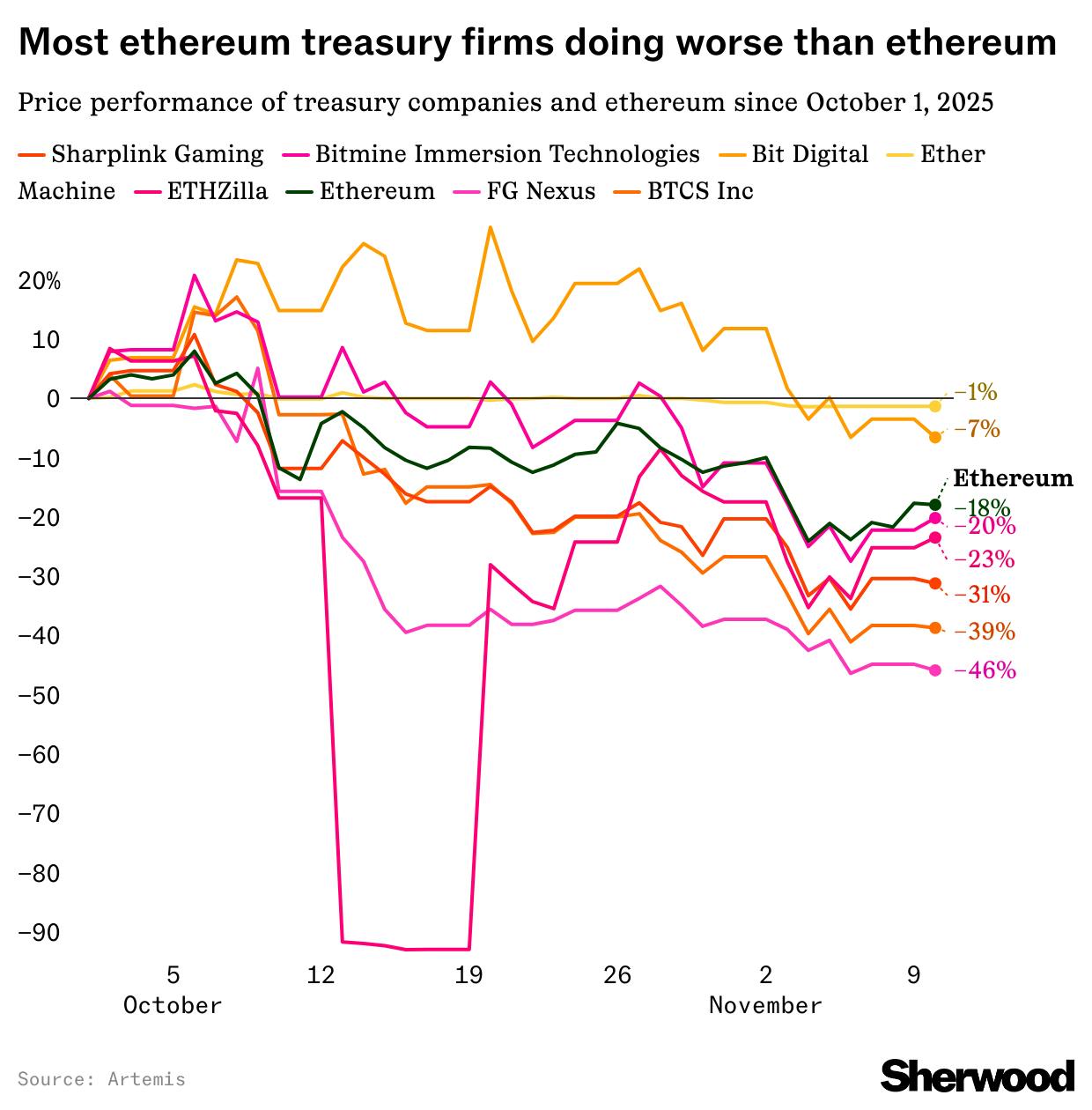
Since October, BitMine, ETHZilla, SharpLink Gaming, and several other treasury firms’ stock prices have performed worse than ethereum itself.

Sage D. Young

The overall performance of digital asset treasury firms (DATs) focused on ethereum has been significantly down as shares of these firms are performing worse than their underlying asset in Q4. 

Since October, the price of ethereum has dropped 18% to under $3,500 as of Tuesday morning. 

Shares of BitMine Immersion Technologies and SharpLink Gaming — the two largest ethereum stockpiling companies — have fallen 20.2% and 31.2%, respectively, in the period. ETHZilla has slid 23.5%, BTCS Inc. has slumped 38.7%, and FG Nexus has decreased nearly 46%, data from crypto analytics firm Artemis shows. 

The price action comes as their basic mNAV — a metric that refers to the market capitalization of these firms relative to the value of their crypto asset holdings — is below 1, according to Blockworks Research. 

“An mNAV under one limits the ability for DATs to perform accretive dilution, which is the principle that permits DATs to purchase more underlying assets and fulfill their mandate of increasing the asset value per share,” per Gurnoor Narula, a research analyst at Placeholder VC. 

Narula told Sherwood News, “DATs start showing cracks when they aren’t able to close that mNAV gap, either because they’ve run out of funds to do so, or the underlying asset is distressed such that investor confidence has waned.”

Bitcoin powerhouse Strategy has also suffered, declining 26% since October 1, though its mNAV stands just above 1. 

Optimism remains, but not deploying any more capital

Kenetic, a blockchain venture capital firm that invested $5 million in ETHZilla, is not deploying more funds at this point, the investment firm’s founder and managing partner, Jehan Chu, said to Sherwood. 

However, Chu remains confident in the digital asset treasury model and is “optimistic that when interest rates are lowered and crypto experiences a push, we will see a corresponding surge in DATs including ETHZilla.” 

Chu continued, “DATs provide leverage on the underlying assets. In good times it’s great and in bad times it’s terrible — we’re just passing through a bad time.”


More Crypto

See all Crypto
crypto

Payward, parent company of crypto exchange Kraken, puts plans for IPO on hold

Payward, crypto exchange Kraken’s parent company, has paused its plans for an initial public offering until market conditions improve, according to a report from CoinDesk that cited two people with knowledge of the matter. 

Since the firm announced in November its preparation for an IPO of its common stock, the total market capitalization of the crypto industry has shed around $652.2 billion, from $3.2 trillion to $2.5 trillion as of Wednesday, data from CoinGecko shows. 

The news comes two weeks after Kraken received approval for a master account from the Federal Reserve Bank of Kansas City, allowing the crypto exchange to connect to the Fed’s payment infrastructure used by traditional banks and credit unions. 

Last year, Kraken raised $800 million at a $20 billion valuation from institutional investors such as Jane Street and Citadel Securities.

The news comes two weeks after Kraken received approval for a master account from the Federal Reserve Bank of Kansas City, allowing the crypto exchange to connect to the Fed’s payment infrastructure used by traditional banks and credit unions. 

Last year, Kraken raised $800 million at a $20 billion valuation from institutional investors such as Jane Street and Citadel Securities.

crypto

SEC and CFTC issue new guidance on how securities laws apply to crypto assets

On Tuesday, the US Securities and Exchange Commission, together with the Commodity Futures Trading Commission, issued an interpretation clarifying how federal securities law applies to crypto assets, a first step toward developing a clearer regulatory framework. 

The interpretive guidance introduces a token taxonomy for different types of cryptocurrencies, with SEC Chairman Paul S. Atkins adding that “most crypto assets are not themselves securities.”

Examples of a digital commodity, “a crypto asset that is intrinsically linked to and derives its value from the programmatic operation of a crypto system that is ‘functional,’” include:

The guidance also includes definitions of digital collectibles (such as NFTs), stablecoins, digital tools, and digital securities (such as tokenized real-world assets and stocks).

This is a monumental step in the mainstream adoption of the industry and clears a hurdle in how crypto can operate going forward, according to David Pakman, head of venture investments at CoinFund. “This will allow new token designs with the confidence that their existence does not require registration with the SEC, etc.,” Pakman told Sherwood News.

Despite the clarification efforts from the two organizations, the market capitalization of the crypto industry has dropped about 2% in the last 24 hours as each of the tokens mentioned in the guidance are trading lower in the period, data from CoinGecko shows.

The joint agency action also complements congressional efforts to turn a crypto market structure framework into law. With the goal of providing regulations on the offer and sale of digital commodities, the CLARITY Act passed the House of Representatives last year and is now sitting in the Senate.

crypto

Bitcoin sees 8 consecutive days of gains, a streak not seen in 4 years

Bitcoin is on a winning streak. The cryptocurrency has generated eight straight days of positive returns, a rare phenomenon that has occurred only 15 times since Satoshi Nakamoto created it, according to a CoinDesk report.  

In the 30 days after posting an eight-day streak, bitcoin traded higher nine times and lower six times. The median return in the period is roughly 19%. Despite the historical gains that followed, the last time bitcoin had such a rally, four years ago, it dropped roughly 30%. 

Most recently, bitcoin climbed from below $66,000 on March 8 to over $75,000 yesterday before settling around $73,800 on Tuesday morning.

Traders remain modestly bullish on the likelihood of further gains, though the sentiment is fading: prediction market-implied odds of bitcoin trading above $77,500 in the month stand at 54%, a decrease from 73% on Monday. 

(Event contracts are offered through Robinhood Derivatives, LLC — probabilities referenced or sourced from KalshiEx LLC or ForecastEx LLC.)

Loading...
 

Most recently, bitcoin climbed from below $66,000 on March 8 to over $75,000 yesterday before settling around $73,800 on Tuesday morning.

Traders remain modestly bullish on the likelihood of further gains, though the sentiment is fading: prediction market-implied odds of bitcoin trading above $77,500 in the month stand at 54%, a decrease from 73% on Monday. 

(Event contracts are offered through Robinhood Derivatives, LLC — probabilities referenced or sourced from KalshiEx LLC or ForecastEx LLC.)

Loading...
 
crypto

Another miner sells its bitcoin

Despite bitcoin being on the rebound, another bitcoin miner sold a chunk of its holdings to further its pivot to AI. In February, Cango, a former automotive service, said it sold 4,451 bitcoin in favor of AI, just a year after becoming a miner. The company said it used the proceeds of the sale to pay down long-term debt and “reduce the overall finance leverage and strengthen the balance sheet,” according to its fourth-quarter and full-year earnings release.

Shares were up 4.5% in premarket trading. 

Cango recorded a net loss from continuing operations of $452.8 million in 2025, “primarily due to non-recurring transformation costs and market-driven fair-value adjustments,” it said.

Its “adjusted bitcoin treasury policy” will “provide the financial flexibility needed to navigate volatility and invest in high-potential areas like AI infrastructure,” Cango said.

Bitcoin’s earlier downward trajectory has pressured several miners, which are choosing to pivot to AI and sell their assets or exit the business entirely.  

Cango’s move follows Core Scientific, which sold over 1,900 bitcoin for $175 million in January as it shifts even more of its focus to the AI data center boom.

Shares were up 4.5% in premarket trading. 

Cango recorded a net loss from continuing operations of $452.8 million in 2025, “primarily due to non-recurring transformation costs and market-driven fair-value adjustments,” it said.

Its “adjusted bitcoin treasury policy” will “provide the financial flexibility needed to navigate volatility and invest in high-potential areas like AI infrastructure,” Cango said.

Bitcoin’s earlier downward trajectory has pressured several miners, which are choosing to pivot to AI and sell their assets or exit the business entirely.  

Cango’s move follows Core Scientific, which sold over 1,900 bitcoin for $175 million in January as it shifts even more of its focus to the AI data center boom.

Latest Stories

Sherwood Media, LLC produces fresh and unique perspectives on topical financial news and is a fully owned subsidiary of Robinhood Markets, Inc., and any views expressed here do not necessarily reflect the views of any other Robinhood affiliate, including Robinhood Markets, Inc., Robinhood Financial LLC, Robinhood Securities, LLC, Robinhood Crypto, LLC, Robinhood Derivatives, LLC, or Robinhood Money, LLC. Futures and event contracts are offered through Robinhood Derivatives, LLC.