Citi analysts cut 12-month bitcoin projection to $112,000 from $143,000
The analysts’ bear-case scenario is $57,537, based on “recessionary macro-factors, especially weak equity markets,” which could cause ETF flows to stall.
Citi analysts significantly cut their 12-month bitcoin projection to $112,000 from $143,000, saying in a research note that the passage of crypto legislation “remains key to galvanizing interest,” but “the window of opportunity for US legislation this year is narrowing.”
On Tuesday, the SEC and the CFTC released joint guidance on crypto classification, an effort that failed to buoy bitcoin. The asset, which topped $74,000 on Tuesday, is down 2% in the past 24 hours.
The analysts’ bear-case scenario is $57,537, based on “recessionary macro-factors, especially weak equity markets,” which could cause ETF flows to stall. The bull case scenario is $165,959, based on increased “end-investor demand as adoption by financial advisors and brokerage firms continues.”
They also noted that bitcoin ETF flows remain a key driver, and “despite the lackluster performance, have picked up recently even with geopolitical uncertainty.”
Amid their less optimistic outlook for bitcoin, Citi analysts also cut the price target of bitcoin mega stockpiler Strategy, to $260 from $325, as well as crypto exchange Gemini Space Station, to $5.50 from $13.00, both stocks falling in early trading.
So far this month, bitcoin ETFs have recorded $1.74 billion, and Tuesday marked the seventh consecutive day of inflows, the longest inflow streak since early October, according to SoSoValue.
Shawn Young, chief analyst at MEXC Research, told Sherwood News that Citi has every reason to doubt bitcoin’s midterm potential, given the market volatility to date.
“However, the timing of the revised forecast may be premature, as bitcoin has already navigated some of its strongest price headwinds over the past six months,” Young said, adding that institutions have continued to buy more bitcoin than is mined, setting the stage for a supply squeeze that can ultimately push the price higher.
Meanwhile, CryptoQuant Head of Research Julio Moreno said in a report that perpetual futures traders have turned more bullish. That’s further confirmed by funding rates, which have shifted from strongly negative to positive.
Moreno said that bitcoin could first find resistance at $75,000, a level representing the lower band of the Traders’ On-chain Realized Price, “which historically acts as price resistance in bear markets.”
He said the next resistance level is near $85,000, which corresponds to the Traders’ On-chain Realized Price.
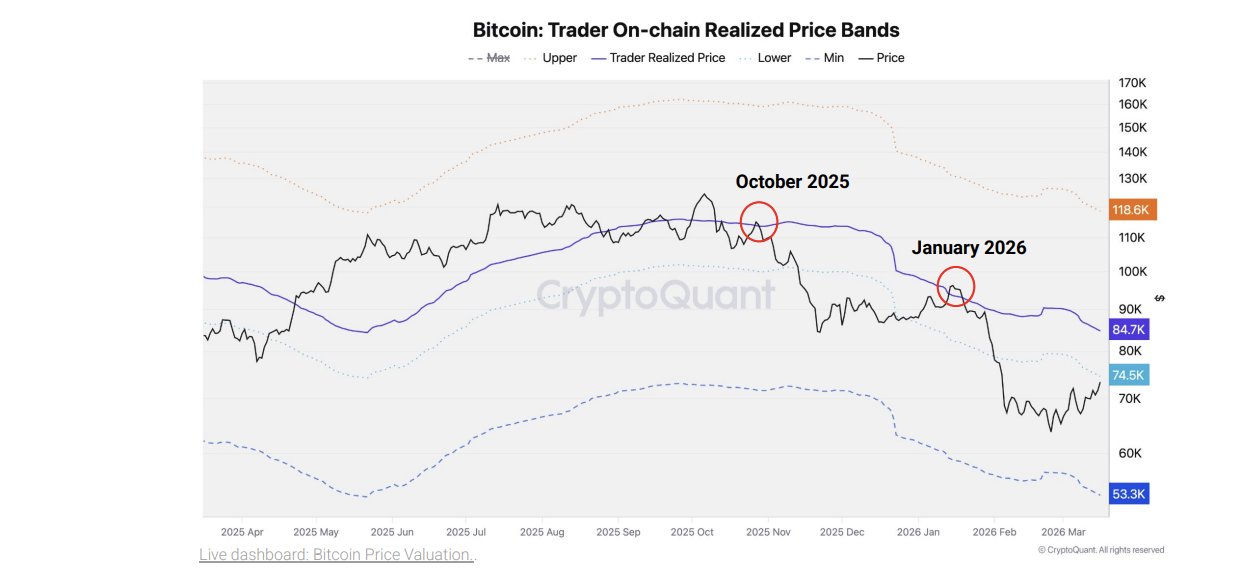
“This band acted as resistance in mid-January, after bitcoin rallied from $80K to $98K, and in October 2025,” Moreno said.
In terms of open interest (OI), CoinGlass analysts said on X that it’s back to “fresh local highs.”
“Not a clean breakout yet. But more crowded positioning at the highs. Flat price + rising OI = compression with leverage building. Volatility is coming,” they wrote.
Finally, while bitcoin has been decoupling from equities and gold, which is down 4.26% in the past week, it’s not yet clear whether it has regained safe haven status.
Stan Low, operations and research lead at Grvt, told Sherwood that the Iran war, the main driver of recent fear and uncertainty, remains, and any major and shocking developments in the conflict could silence any potential narrative of bitcoin as a safe haven asset.
“Although BTC is showing signs of regaining its status as a safe haven asset and global geopolitical hedge, we need to see this narrative prevail more broadly before we can confirm that BTC has indeed transitioned from its status of a risk asset to a global geopolitical hedge,” Low said.
The sentiment was echoed by several experts, who said that geopolitical factors, such as inflation fears and oil prices, still weigh on bitcoin. The Producer Price Index released this morning came in hotter than anticipated, rising 0.7% in February, and oil prices are surging again.
Dean Chen, a Bitunix analyst, told Sherwood that the key shift to monitor is the evolving pricing framework. If elevated energy prices continue to suppress expectations of monetary easing, bitcoin will increasingly behave as a risk asset rather than a hedge.
“Conversely, a reintroduction of liquidity conditions could transform the current high-range consolidation into a launchpad for expansion,” Chen said.
Bitfinex analysts agreed, saying that while there is a decoupling, the context is significant: bitcoin’s rally occurred while the S&P 500 registered its lowest level since November 2025, West Texas Intermediate crude sat at $98.71, Brent was at $103.14, and the US 10-year yield held at 4.14%.
“The price action doesn’t fit a general risk-on narrative; it suggests either a nascent decoupling or a temporary supply squeeze within the cryptocurrency asset itself,” they said.