Bitcoin treasury firm Nakamoto bought high and sold much, much lower as bitcoin suffers another bad quarter
Bitcoin is on track to close the first quarter of 2026 down more than 24%.
Things are looking bleak for bitcoin again, as it’s down 1.8% in the past 24 hours and on track to close the first quarter of 2026 down more than 24%, its worst quarter since 2022, CoinGlass data shows.
On Tuesday morning, bitcoin saw a tiny bump following reports that President Trump intended to end the conflict in the Middle East, but it quickly lost those gains, and as of writing, it’s down 0.57% for the month, setting it up for its sixth consecutive month in the red and its first-ever triple red start of the year.
Things are looking bleak too for bitcoin treasury firm Nakamoto, which has failed to rise above $1 a share since it got a delisting warning notice from Nasdaq in December. In March, it sold 284 bitcoin for $20 million, at $70,422, well below its $118,171 average cost (a 40% cut), according to a 10-K filing yesterday. The company, which went public in August, said it plans to use the proceeds “to invest further in our businesses as well [as] replenish our working capital for costs associated with the recent mergers.” Investors seemed to like the move, as shares were up about 2% in early trading. But the shares are down over 41% year to date.
Nic Puckrin, cofounder and CEO of Coin Bureau, told Sherwood News that cracks are beginning to show in the digital asset treasury (DAT) market, and Nakamoto may be the first of many to offload some of its bitcoin at a loss as the bear market drags on.
“There is real contagion risk here,” Puckrin said, adding that bitcoin’s ongoing weakness would put further pressure on DATs, which could in turn exacerbate the sell-off.
Meanwhile, macro and geopolitical drivers continue to shape bitcoin’s trajectory, still stuck in a tight range and seemingly unable to break either way.
Kyle Rodda, senior market analyst at Capital.com, told Sherwood that the technicals don’t look great yet, as the downtrend is still intact “and it looks like bitcoin wants to break lower.”
Key levels Rodda is watching remain $60,000 and $74,000.
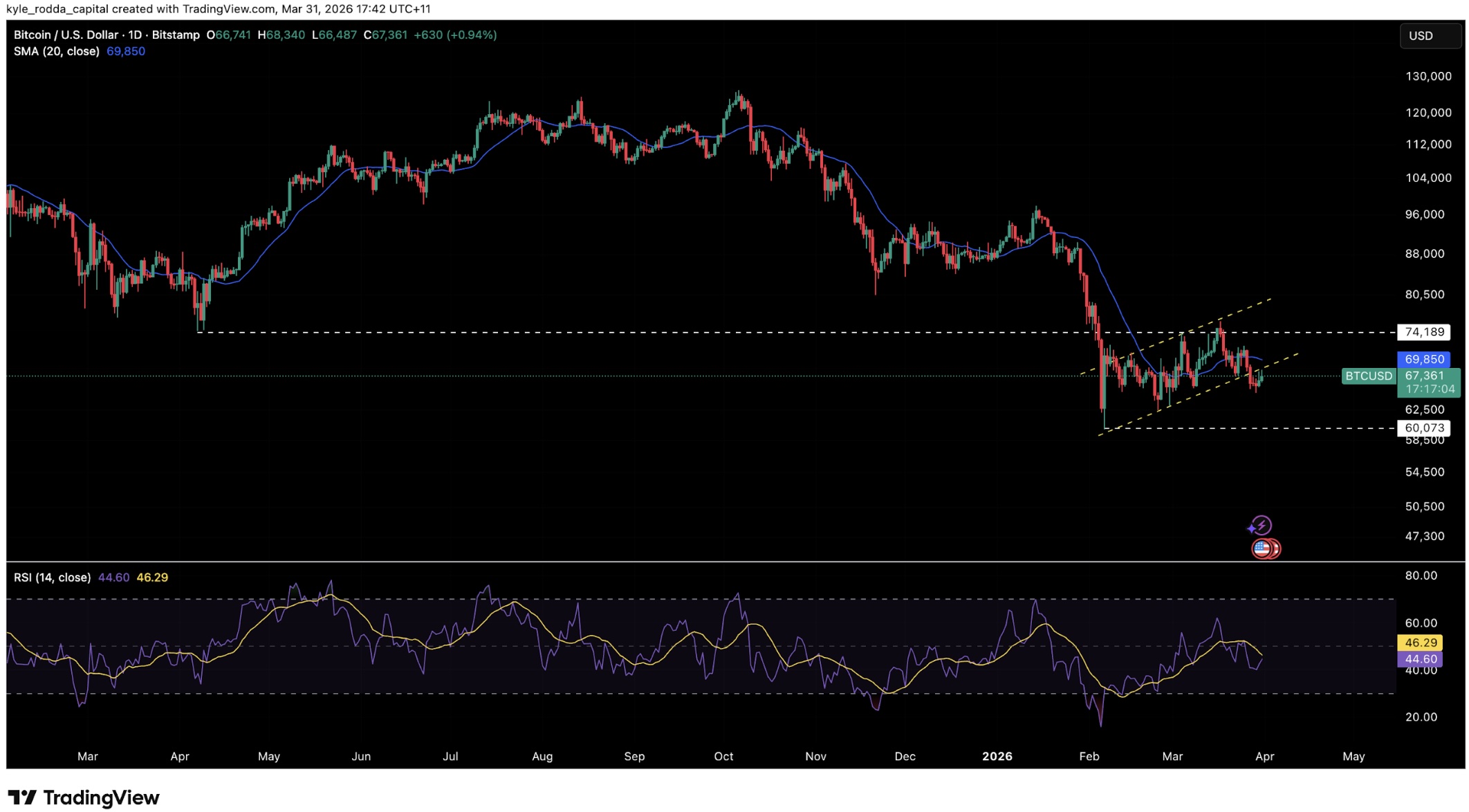
“We need a decisive break and hold above that level before feeling more confident the bottom is in,” Rodda said.
Andri Fauzan Adziima, research lead at Bitrue, said that key levels he’s watching this week include immediate support between $65,500 and $67,800 (Fibonacci retracements and recent lows) and stronger defense near $65,000.
Meanwhile, he said that resistance looms at the $69,800 to $70,000 level, then $71,500 to $72,500 (former support now overhead and 50-day exponential moving average zone), but failure to hold $66,000 risks a deeper correction in the current neutral to cautious setup.
In a bit of a silver lining, bitcoin ETFs saw (minuscule) inflows, registering $69.4 million in inflows on Monday, bringing the overall month to $1.2 billion, per SoSoValue.
Finally, another optimistic factor is that one month into the Iran war, bitcoin performed better than gold (down 13% this month) and the S&P 500 (down 6.2%).
Justin D’Anethan, head of research at Arctic Digital, told Sherwood that the current range feels tighter than it looks when you factor in thin weekend liquidity and how it absorbed the latest Iran escalation — “with retracement, sure, but without cracking like equities did.”
“The mid-60s seem to be like an accumulation level. Realistically, this is still macro-driven. Unless this is a major bluff by the US, with troops landing in Iran, it feels unlikely that this conflict will get resolved soon, and that will keep investors sober,” D’Anethan said.