Crypto
crypto

Bitcoin holds the line after bumpy week

Much has been said about bitcoindecoupling” from risk assets amid the tariff war thats wreaking havoc on markets globally, with Grayscale going so far as to say tariffs and inflation could be positive for bitcoin

This week bitcoin felt very coupled, as it continued to seesaw amid global economic uncertainty, dropping to $75,000 on Tuesday and then soaring to $82,000 following President Trump’s announcement of a 90-day pause on most tariffs. Then it dropped with the rest of the market yesterday. This morning, it’s back to hovering around $82,000, basically where it was last Friday.

Companies with bitcoin corporate reserves, which have been on a buying spree in the past few months, largely took a breather. 

Strategy, the largest corporate holder at 528,285 bitcoin, has not made any purchases since March 31, despite the dip.

The company released a regulatory filing on April 7, which triggered an avalanche of rumors about whether it would be forced to sell its bitcoin.

“As bitcoin constitutes the vast bulk of assets on our balance sheet, if we are unable to secure equity or debt financing in a timely manner, on favorable terms, or at all, we may be required to sell bitcoin to satisfy our financial obligations,” the filing said.

Strategy has never sold a single bitcoin since it started buying it in 2020. Cofounder Michael Saylor, at least on social media, remains unbothered by outside factors, tariffs or otherwise.

“Bitcoin is powered by Chaos,” he posted on X, as well as, “Bitcoin is the Best Idea. There is no Second Best.” 

Companies that did update their bitcoin holdings include CleanSpark, which produced 706 bitcoin in March and now holds 11,869 in its reserve. Mining company Bitfufu also increased its bitcoin holdings, adding 47 bitcoin in the month to bring its total to 1,847.
More Crypto

See all Crypto
crypto

Altcoin trading activity has lost its mojo

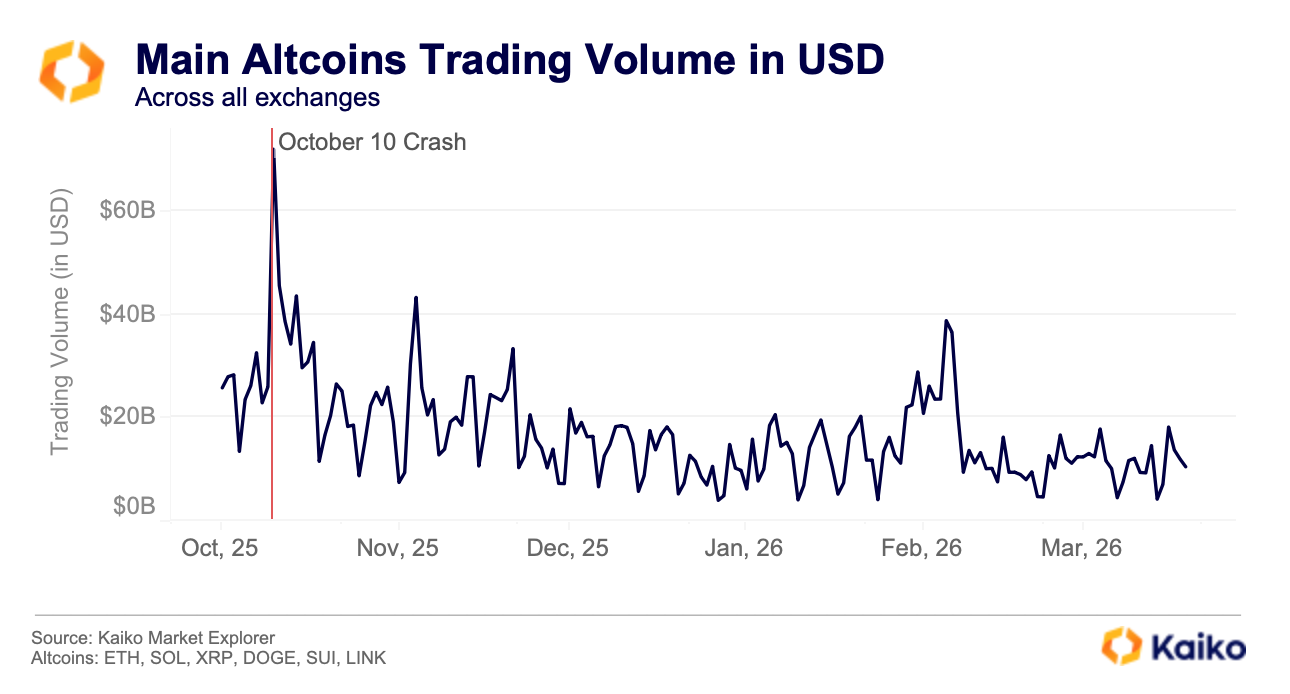
Non-bitcoin cryptocurrencies have seen their trading volume plummet in the past five months. The combined trading volume of ethereum, XRP, solana, dogecoin, SUI, and chainlink has decreased by 60% since crypto’s October 10 liquidation event, according to Thomas Probst, a research analyst at crypto markets data provider Kaiko.

Main Altcoins Trading Volume in USD
The trading volume of ETH, SOL, XRP, DOGE, SUI, and LINK.

For all altcoins, spot trading volume on Binance has declined between 80% and 85% to $7.7 billion, while altcoin volume on other exchanges has dropped to $18.8 billion, down from a range of $63 billion to $91 billion in October, a Friday report from Decrypt found, citing data from CryptoQuant.

“This trend may be explained by a contraction in market liquidity over the same period,” Probst told Sherwood News. “This phenomenon is also reflected in the average 1% market depth, which stood at approximately $2.6 million before the October 10 crash and is now closer to $1.7 million when aggregated across ETH, XRP, SOL, SUI, and LINK.” 

Market depth is used by investors and traders to gauge the scale of liquidity in a market. 1% market depth refers to the amount of liquidity needed to move the market by 1%. 

CoinGlass’s Altcoin Season Index, a measure to assess the performance of non-bitcoin cryptocurrencies, has been sitting above 50 this week, suggesting that the current market is neither in a bitcoin dominant phase nor an altcoin season.

crypto

Payward, parent company of crypto exchange Kraken, puts plans for IPO on hold

Payward, crypto exchange Kraken’s parent company, has paused its plans for an initial public offering until market conditions improve, according to a report from CoinDesk that cited two people with knowledge of the matter. 

Since the firm announced in November its preparation for an IPO of its common stock, the total market capitalization of the crypto industry has shed around $652.2 billion, from $3.2 trillion to $2.5 trillion as of Wednesday, data from CoinGecko shows. 

The news comes two weeks after Kraken received approval for a master account from the Federal Reserve Bank of Kansas City, allowing the crypto exchange to connect to the Fed’s payment infrastructure used by traditional banks and credit unions. 

Last year, Kraken raised $800 million at a $20 billion valuation from institutional investors such as Jane Street and Citadel Securities.

The news comes two weeks after Kraken received approval for a master account from the Federal Reserve Bank of Kansas City, allowing the crypto exchange to connect to the Fed’s payment infrastructure used by traditional banks and credit unions. 

Last year, Kraken raised $800 million at a $20 billion valuation from institutional investors such as Jane Street and Citadel Securities.

Latest Stories

Sherwood Media, LLC produces fresh and unique perspectives on topical financial news and is a fully owned subsidiary of Robinhood Markets, Inc., and any views expressed here do not necessarily reflect the views of any other Robinhood affiliate, including Robinhood Markets, Inc., Robinhood Financial LLC, Robinhood Securities, LLC, Robinhood Crypto, LLC, Robinhood Derivatives, LLC, or Robinhood Money, LLC. Futures and event contracts are offered through Robinhood Derivatives, LLC.