Crypto
Bitcoin medal manufactured at Sakamoto Metal
A metal mold for a bitcoin medal (Tomohiro Ohsumi/Getty Images)
The greater fool’s gold

Bitcoin ETFs lose $5.5 billion in outflows in five weeks as investors pour into gold

Gold ETFs’ assets under management have regained the crown.

Yaël Bizouati-Kennedy

Spot bitcoin ETFs celebrated their first birthday in January, and while investors initially poured millions into them, the enthusiasm is fizzling. Some firms are even deciding to shed some crypto ETFs amid a broader tepid crypto market.

Gold and bitcoin (and by extension, gold and bitcoin ETFs) are often pitted against each other in an age-old debate about which asset is a better inflation hedge. With worries around inflation, recession, tariffs, and potential rate hikes, the debate is back. What’s more, the postelection crypto craze and the slew of pro-crypto steps the administration has taken have failed to sustain the initial optimism.

Bitcoin ETFs have seen significant outflows recently, with Bloomberg reporting the funds “recorded their longest run of weekly net outflows since listing in January last year.” Investors pulled over $5.5 billion in total over the past five weeks.

Gold ETFs, meanwhile, have reclaimed the crown as holding the most assets under management between the two. Some of those bitcoin ETF outflows have also rotated right into the shiny metal funds.

The numbers speak for themselves. On Election Day, spot bitcoin ETFs’ assets under management stood at about $53 billion. These funds saw huge wins in the months that followed, with nearly $10 billion in inflows during the one month following the election and major gains in bitcoin’s price. On Inauguration Day, BTC rose to an all-time high of $109,114, boosting bitcoin ETFs’ AUM to about $123 billion. As of today, the funds’ totals are down to $95 billion and bitcoin’s price seems stuck around $83,000.

Meanwhile, gold ETFs totaled more than $167 billion in assets under management as of March 15. The price of gold has hit record highs lately, breaking the $3,000 an ounce mark last week.

Put simply: gold is up 13.3% in the past three months, while bitcoin is down 21% over the same time period. 

Todd Ruoff, CEO of Autonomys, said that the surge in gold ETFs is due to heightened geopolitical tensions and economic uncertainties, prompting investors to seek the asset’s stability.

He added that some analysts caution that the same factors could sink the price of bitcoin to $73,000.

“This volatility has led to notable outflows from bitcoin ETFs, further widening the gap between gold and bitcoin ETFs,” Ruoff said. “These developments highlight a broader market trend where investors gravitate toward traditional safe-haven assets like gold in response to economic and geopolitical uncertainties.”

Against this backdrop, 21Shares said it would liquidate two bitcoin futures and ethereum futures ETFs on March 28, due to a “routine review... and a maturing digital assets landscape.”

More Crypto

See all Crypto
crypto

Altcoin trading activity has lost its mojo

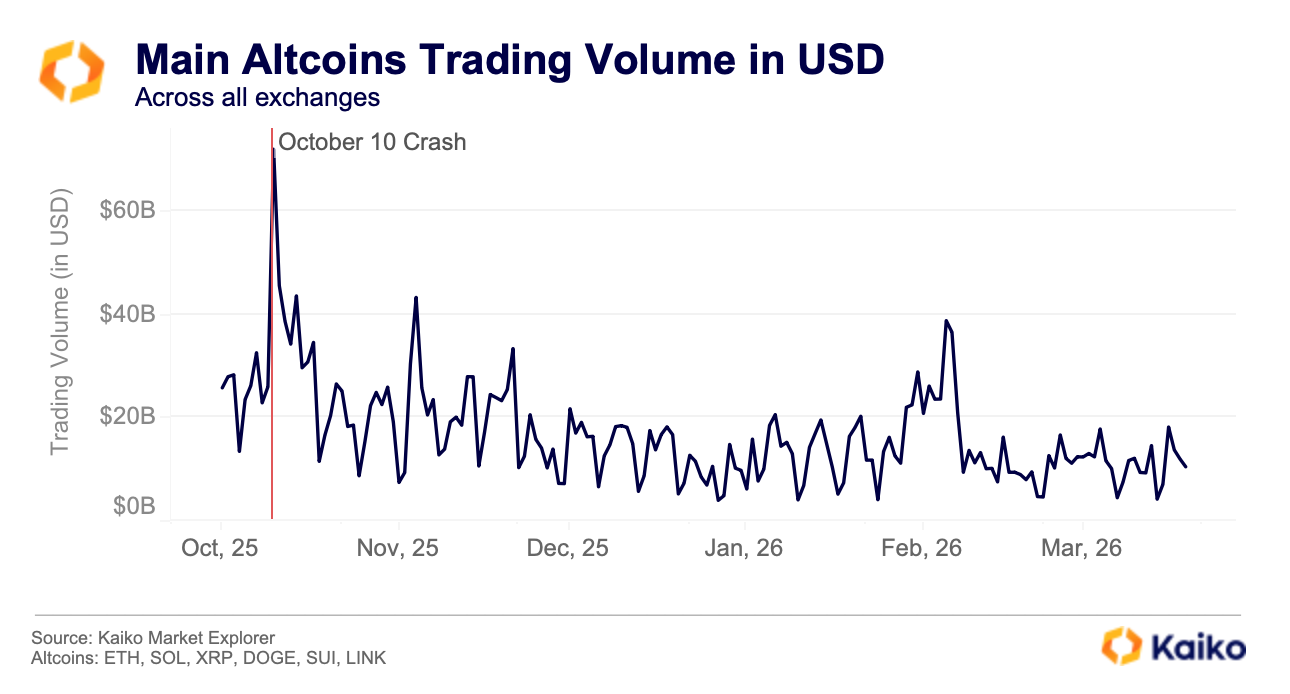
Non-bitcoin cryptocurrencies have seen their trading volume plummet in the past five months. The combined trading volume of ethereum, XRP, solana, dogecoin, SUI, and chainlink has decreased by 60% since crypto’s October 10 liquidation event, according to Thomas Probst, a research analyst at crypto markets data provider Kaiko.

Main Altcoins Trading Volume in USD
The trading volume of ETH, SOL, XRP, DOGE, SUI, and LINK.

For all altcoins, spot trading volume on Binance has declined between 80% and 85% to $7.7 billion, while altcoin volume on other exchanges has dropped to $18.8 billion, down from a range of $63 billion to $91 billion in October, a Friday report from Decrypt found, citing data from CryptoQuant.

“This trend may be explained by a contraction in market liquidity over the same period,” Probst told Sherwood News. “This phenomenon is also reflected in the average 1% market depth, which stood at approximately $2.6 million before the October 10 crash and is now closer to $1.7 million when aggregated across ETH, XRP, SOL, SUI, and LINK.” 

Market depth is used by investors and traders to gauge the scale of liquidity in a market. 1% market depth refers to the amount of liquidity needed to move the market by 1%. 

CoinGlass’s Altcoin Season Index, a measure to assess the performance of non-bitcoin cryptocurrencies, has been sitting above 50 this week, suggesting that the current market is neither in a bitcoin dominant phase nor an altcoin season.

Witch

“Triple witching” day may put further pressure on bitcoin’s price

This is not “a favorable environment for risk assets.”

crypto

Payward, parent company of crypto exchange Kraken, puts plans for IPO on hold

Payward, crypto exchange Kraken’s parent company, has paused its plans for an initial public offering until market conditions improve, according to a report from CoinDesk that cited two people with knowledge of the matter. 

Since the firm announced in November its preparation for an IPO of its common stock, the total market capitalization of the crypto industry has shed around $652.2 billion, from $3.2 trillion to $2.5 trillion as of Wednesday, data from CoinGecko shows. 

The news comes two weeks after Kraken received approval for a master account from the Federal Reserve Bank of Kansas City, allowing the crypto exchange to connect to the Fed’s payment infrastructure used by traditional banks and credit unions. 

Last year, Kraken raised $800 million at a $20 billion valuation from institutional investors such as Jane Street and Citadel Securities.

The news comes two weeks after Kraken received approval for a master account from the Federal Reserve Bank of Kansas City, allowing the crypto exchange to connect to the Fed’s payment infrastructure used by traditional banks and credit unions. 

Last year, Kraken raised $800 million at a $20 billion valuation from institutional investors such as Jane Street and Citadel Securities.

Latest Stories

Sherwood Media, LLC produces fresh and unique perspectives on topical financial news and is a fully owned subsidiary of Robinhood Markets, Inc., and any views expressed here do not necessarily reflect the views of any other Robinhood affiliate, including Robinhood Markets, Inc., Robinhood Financial LLC, Robinhood Securities, LLC, Robinhood Crypto, LLC, Robinhood Derivatives, LLC, or Robinhood Money, LLC. Futures and event contracts are offered through Robinhood Derivatives, LLC.