
Business
Time use survey

Many pandemic-era trends faded. WFH is holding up.

Homework club

The pandemic turned the world upside down. People stockpiled toilet paper, did yoga over Zoom, baked banana bread, bought Pelotons, went crazy for online shopping, and anyone who was even thinking about buying a pool went and got one. Pretty much all of those trends have since returned to normal, but a major one has remained: working from home.

According to new data published in the Bureau of Labor Statistics’ Time Use Survey for 2023, ~35% of all employed persons in the US spent the average working day doing at least some of their work from home — up from the previous year, which saw a slight downturn after peaking at ~38% in 2021, and 16% more than two decades ago.

Time use survey

Universal remote

While employees initially had to create home office setups by necessity, factors like work-life balance, reduced time spent commuting, and generally becoming accustomed to the comforts of their own desks (and/or couches) left many with a taste for the hybrid 9-5 model that still lingers today… despite mounting pressure from businesses trying to clamp down on remote working.

Indeed, the desire to WFH remains strong: research cited by The Economist indicates that the typical worker worldwide wants 2 days at home — an entire day more than the actual average — and a LinkedIn survey in January found that now only 39% of US employees want a fully in-person job.

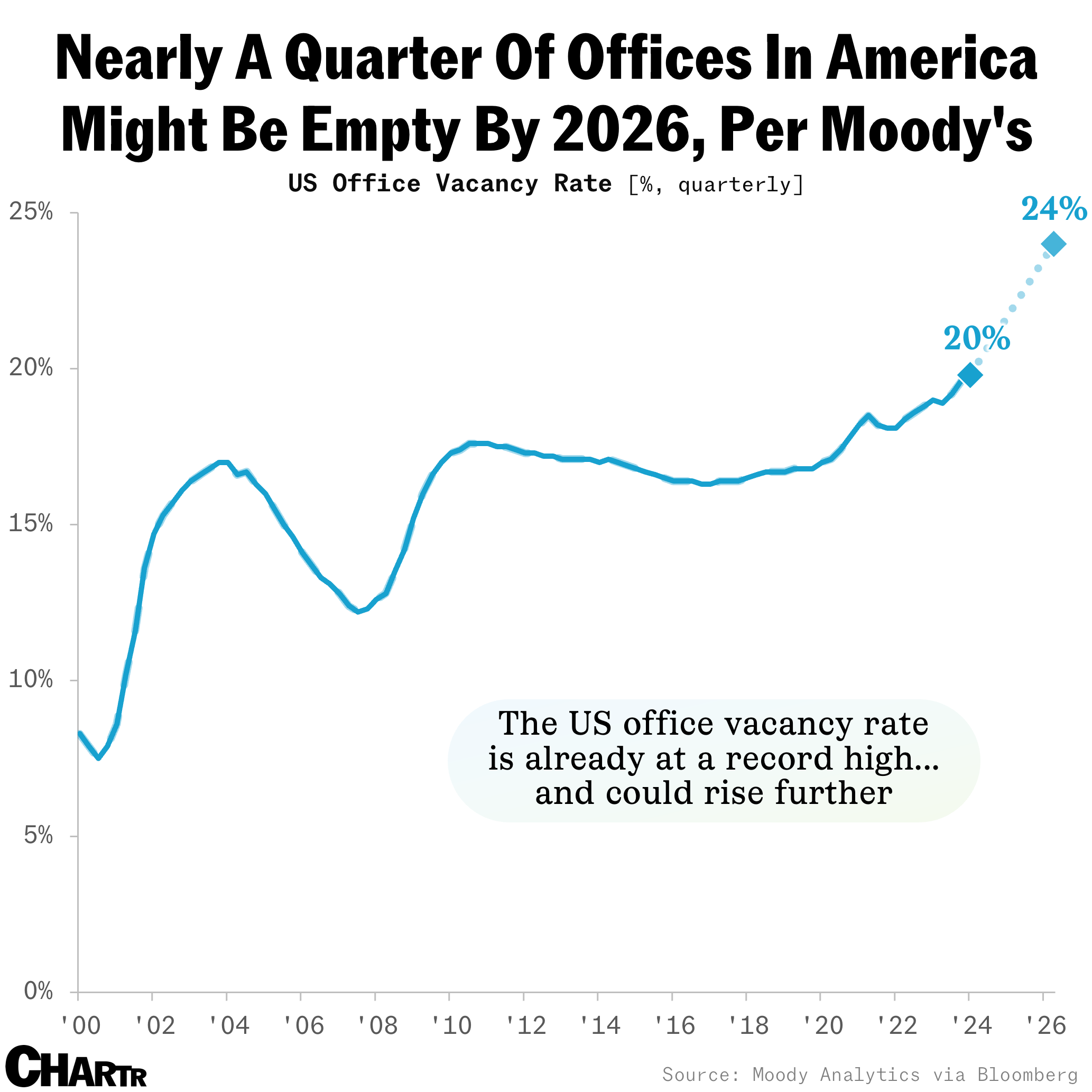
With WFH looking increasingly established, one sector in particular is struggling to adjust to the new normal: commercial real estate. In fact, although US office vacancy rates are already at record highs, according to a report from Moody’s published yesterday, they are set to continue rising up to 24% by early 2026, driven by the expiration of leases and an influx of new office buildings onto the market.
Office vacancies

As we noted earlier this week, the pressures on the commercial real estate sector are weighing heavily on REITs and other real estate-exposed stocks… but, while there might be short-term pain, the outlook is not entirely bleak. Moody's foresees vacancy rates eventually stabilizing as redundant offices are either demolished or repurposed into warehouses and residential properties.

More Business

See all Business
business

Netflix is down amid reports it’s leading the Warner Bros. bidding war as Paramount cries foul

Netflix’s charm offensive appears to be working.

Netflix is reportedly emerging as the leader in the bidding war for Warner Bros. Discovery after second-round bids this week, edging out entertainment juggernaut rivals Comcast and Paramount Skydance.

Investors don’t appear psyched by the streaming leader’s turn of fortune: the stock is down on Thursday morning, a day after closing down nearly 5% following reports that scooping up HBO Max wouldn’t necessarily result in a big market share boost.

Paramount, which has reportedly made five bids for Warner Bros. Discovery, doesn’t love the current state of play, either. The company sent WBD a letter questioning the “fairness and adequacy” of the process, highlighting reports that WBD’s board favors Netflix and is resisting Paramount.

Any offer would be subject to regulatory approval — a fact that may have weighed against Netflix’s offer given that cofounder Reed Hastings’ politics are vocally to the left, very much at odds with the current regulatory regime. Paramount seems confident in its ability to get approval, reportedly boosting its breakup fee to $5 billion should its potential acquisition fall apart in the regulatory process.

Investors don’t appear psyched by the streaming leader’s turn of fortune: the stock is down on Thursday morning, a day after closing down nearly 5% following reports that scooping up HBO Max wouldn’t necessarily result in a big market share boost.

Paramount, which has reportedly made five bids for Warner Bros. Discovery, doesn’t love the current state of play, either. The company sent WBD a letter questioning the “fairness and adequacy” of the process, highlighting reports that WBD’s board favors Netflix and is resisting Paramount.

Any offer would be subject to regulatory approval — a fact that may have weighed against Netflix’s offer given that cofounder Reed Hastings’ politics are vocally to the left, very much at odds with the current regulatory regime. Paramount seems confident in its ability to get approval, reportedly boosting its breakup fee to $5 billion should its potential acquisition fall apart in the regulatory process.

business

Delta says the government shutdown will cost it $200 million in Q4

The 43-day government shutdown that ended last month will result in a $200 million ding for Delta Air Lines, the airline said in a filing on Wednesday.

That’s about $100,000 per shutdown-related canceled flight. (Delta previously said it canceled more than 2,000 flights due to FAA flight reductions.) When the company reports its fourth-quarter earnings, the shutdown will lop off about $0.25 per share.

Delta initially stayed calm about the shutdown, with CEO Ed Bastian stating in early October that the company was running smoothly and hadn’t seen any impacts at all. One historically long shutdown later, Delta wasn’t able to remain untouched.

The skies have since cleared, though, and Delta’s filing states that booking growth has “returned to initial expectations following a temporary softening in November.”

Delta’s shares were up over 2% as of Wednesday’s market open.

Delta initially stayed calm about the shutdown, with CEO Ed Bastian stating in early October that the company was running smoothly and hadn’t seen any impacts at all. One historically long shutdown later, Delta wasn’t able to remain untouched.

The skies have since cleared, though, and Delta’s filing states that booking growth has “returned to initial expectations following a temporary softening in November.”

Delta’s shares were up over 2% as of Wednesday’s market open.

Latest Stories

Sherwood Media, LLC produces fresh and unique perspectives on topical financial news and is a fully owned subsidiary of Robinhood Markets, Inc., and any views expressed here do not necessarily reflect the views of any other Robinhood affiliate, including Robinhood Markets, Inc., Robinhood Financial LLC, Robinhood Securities, LLC, Robinhood Crypto, LLC, or Robinhood Money, LLC.