
Business
Private equity dry powder
Sherwood News

The NFL just opened itself up to some very deep-pocketed investors

After all, there are only so many billionaires to buy teams

Yesterday, a special meeting of the 32 NFL team owners approved a measure allowing select private equity firms to purchase up to a 10% stake in a team, loosening a long-standing ownership restriction.

The move comes as NFL franchises reach stratospheric valuations, with the Dallas Cowboys — a team that hasn't clinched a Super Bowl since 1996 — recently becoming the first team to reach a $10 billion valuation, per Sportico.

Allowing pooled institutional investment seems like a no-brainer. After all, there are only so many billionaires capable of buying teams, with the average NFL franchise now worth a staggering ~$6 billion.

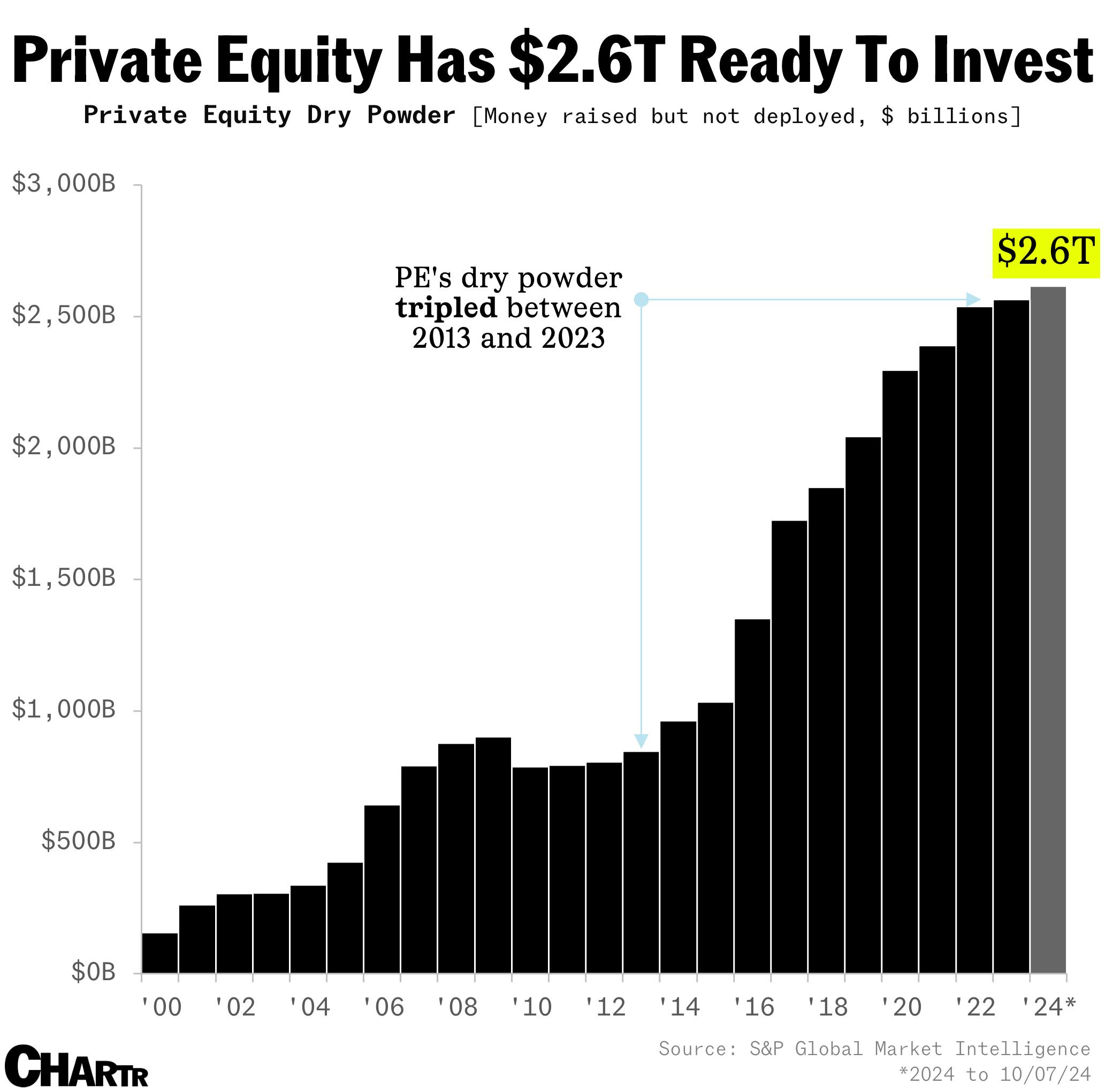
By opening the doors to private equity, the NFL is unlocking a treasure trove of capital: according to data compiled by S&P Global, private equity and venture capital funds currently hold a record $2.6 trillion in uncommitted capital, often referred to as "dry powder".

This enormous sum is burning a hole in the pockets of some firms. After convincing investors to entrust them with their money, which many PE shops did very successfully during massive fundraising efforts in 2020-2021, they then have to actually do something with it — people don’t typically like paying management fees while their money is parked on the sidelines.

However, faced with only being able to build a 10% stake in a team, a hypothetical investment of ~$600 million would barely scratch the surface for the largest funds. Investing in multiple teams might help them deliver the impact they want, with the new NFL rules allowing funds to invest in up to 6 individual teams.

More Business

See all Business
9.3%

As the war with Iran produces the biggest spike in US gas prices since Hurricane Katrina, car retailer CarMax is continuing to see heightened interest in EVs, hybrids, and plug-in hybrids.

“From Feb 1st - March 1st (inclusive), compared to March 2nd to March 15th (inclusive), we saw a 9.3% lift in page views for these vehicles,” a spokesperson for the company told Sherwood News.

As industry insiders recently told us, EV interest climbs when gas prices rise. That appears to be holding true even without EV tax credits, which the Trump administration ended under its new budget package.

CarMax also saw EV searches spike in 2022, amid Russia’s invasion of Ukraine and the resulting oil price spike.

Walt Disney Chairman And CEO Bob Iger Rings Opening Bell At NY Stock Exchange

It’s the end of Disney’s Iger era (again)

Incoming CEO Josh D’Amaro is replacing Bob Iger on Wednesday, though Iger will remain a senior adviser through the end of the year.

$35.4B

The tariffs imposed by the Trump administration have cost automakers at least $35.4 billion since the start of 2025, according to a new analysis by Automotive News.

That total will continue to climb this year, since the Supreme Court’s February tariff ruling largely leaves the 25% levy on vehicles and auto parts untouched.

Toyota has taken the biggest hit, projecting more than $9 billion in tariff costs in its fiscal year ending this month, while Detroit’s big three automakers — Ford, GM, and Stellantis — were hit with a combined $6.5 billion tariff charge in 2025.

In the fourth quarter, automakers sold about 8% fewer imported vehicles in the US compared to the same period a year ago, per the Automotive News Research & Data Center.

Tariff charges come at a rough time for legacy carmakers, which are also scaling back EV plans following the Trump administration’s elimination of tax credits and fuel standard goals. According to Automotive News, the cost of EV write-downs and restructuring is, so far, nearly $70 billion.

Universal Studios Orlando Theme Park

Universal Studios is giving theaters a longer minimum exclusive run

Universal will now guarantee a minimum of five weekends before a movie hits home screens — which might help theater companies like AMC finally get back to profitability.

Latest Stories

Sherwood Media, LLC produces fresh and unique perspectives on topical financial news and is a fully owned subsidiary of Robinhood Markets, Inc., and any views expressed here do not necessarily reflect the views of any other Robinhood affiliate, including Robinhood Markets, Inc., Robinhood Financial LLC, Robinhood Securities, LLC, Robinhood Crypto, LLC, Robinhood Derivatives, LLC, or Robinhood Money, LLC. Futures and event contracts are offered through Robinhood Derivatives, LLC.