The economics of Instacart’s grocery delivery are pretty tight — AI might help, or hurt
AI proved to be a double-edged sword this week for Instacart, as the gains from a new ChatGPT integration were wiped out by an AI pricing allegation.
This week was a roller-coaster ride for Instacart investors. Traders loved the announcement on Monday that the grocery delivery app will be embedded in ChatGPT, becoming the “first company to offer [a] new instant checkout app experience” on the leading AI chatbot.
But AI can also be a double-edged sword.
A separate report released Wednesday took some of the shine off, with the company’s AI-enabled experiments accused of charging consumers different prices for the same items — by as much as 23% in one case. The e-commerce platform lost its OpenAI-driven gains on the news, with its parent company dropping some 6% in Wednesday trading.
Thought for food
Instacart, like so much of Corporate America, has been doubling down on an AI-centered strategy — offering personalized recommendations to consumers and time-saving and performance-driving tools for advertisers and retailers while deepening its partnership with OpenAI — all in the hope of improving the economics of a grocery delivery business that runs on pretty tight margins.
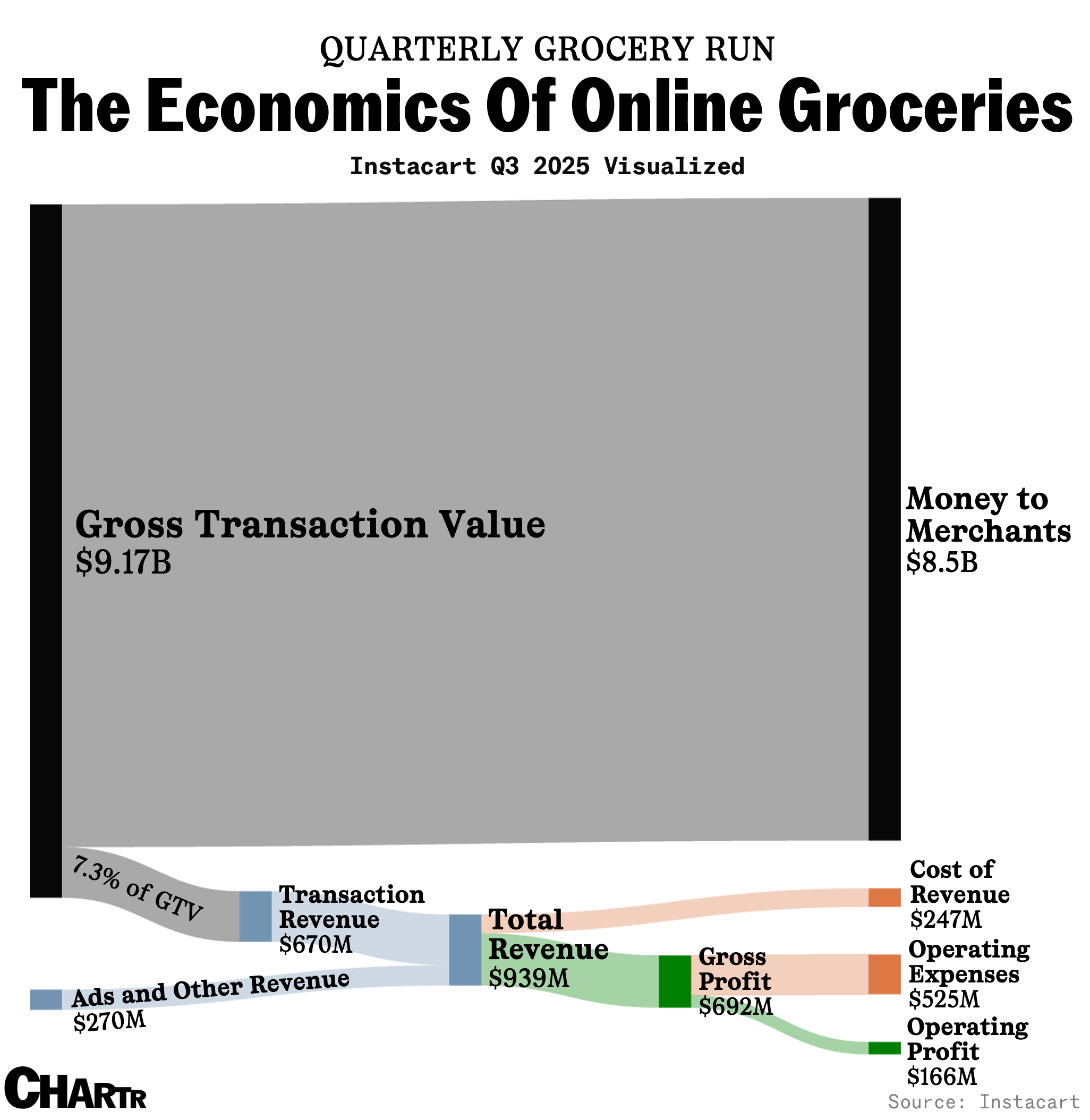
The company took a whopping $9.17 billion in orders through its marketplace, most of which is obviously passed through to merchants, with Instacart taking a ~7% slice, worth some $670 million in Q3. After operating costs, that revenue alone would probably not be enough to keep the company in the black — but Instacart also made a cool $270 million from advertising and other fees, services that are much higher-margin — helping it eke out a total of $166 million in operating profit, or 1.8% of its gross transaction value.
But profit growth has slowed at Instacart, and the company has some increasingly scary competitors, most notably Amazon, which is pushing into the on-demand online grocery space. The e-commerce giant announced this week it would expand its same-day delivery service to over 2,300 cities and towns in the US, leveraging millions of potential customers with a Prime membership through its free-for-Prime service.
With Amazon bearing down, it’s no wonder Instacart is looking to AI as a tool to fight back — but some on Wall Street think it will be a losing battle, with Wedbush Securities analysts including Instacart as one of 12 stocks in its “AI losers” basket, noting how AI’s automations of functions will improve delivery routing and cost efficiency in ecosystems with already established customer relationships like Amazon, moving customers away from intermediaries like Instacart.