Business
Tencent Spotify chart
Sherwood News

Tencent Music has enough users — it just needs them to start paying

The stock is down this morning, undoing some of its stunning year-to-date rise.

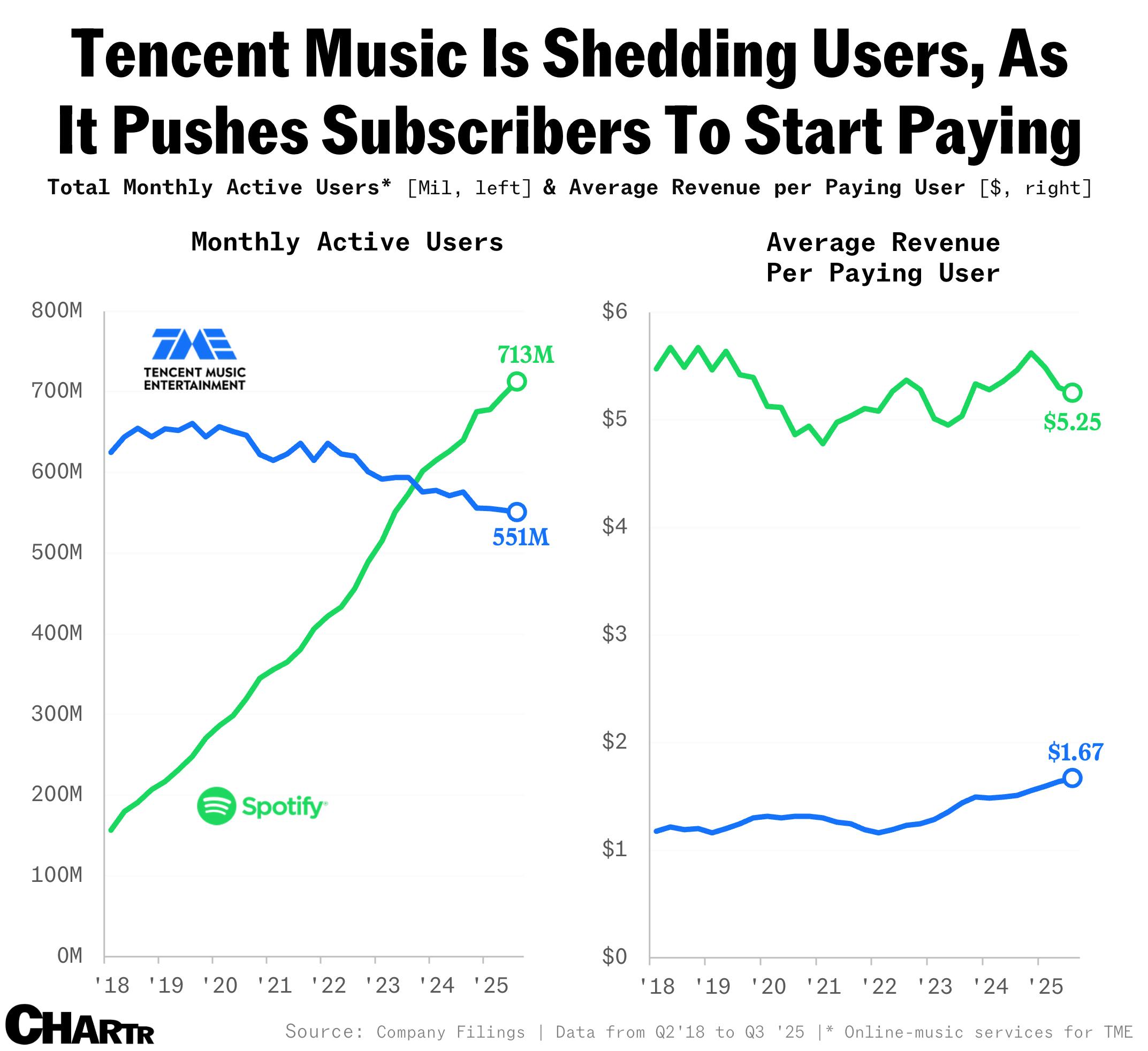
Tencent Music Entertainment (TME), China’s largest music streamer, is learning to make more from less — as its user base shrinks but paying listeners grow.

In Q3, the company posted a 27% year-over-year jump in online music revenue — which makes up over 80% of total sales — to $989 million, driven by what it called “solid growth” in subscription revenues. 

Indeed, TME has decided that it’s time to cash in, with its paying users for online music soaring to 125 million, more than 5x what it had when it went public in late 2018. Paying subscribers now account for nearly a quarter (23%) of its total monthly active users, up from just 4% seven years ago.

But that push has come at a cost: users are fleeing the platform.

Founded in 2016 through a Tencent-led merger combining three Chinese streaming giants, TME already boasted 644 million total online music users by its 2018 IPO, roughly 3x Spotify’s global count. But after peaking in early 2020, that number has slipped to 551 million, and it now sits below Spotify’s 713 million.

Even so, TME has been getting better at milking the users it has: average revenue per paying user has climbed about 40% since 2018, toward ~$1.70 a month — though its Swedish counterpart earns over 3x more per premium subscriber, at roughly $5.30.

While the two streaming giants operate in largely separate worlds — Spotify everywhere but China, and Tencent mostly within China — TME is seemingly vying for global relevance: last week, the company said it would share its streaming data with Luminate (the firm behind Billboard’s global charts), marking the first time Chinese listening trends will feed into international rankings.


More Business

See all Business
business

Netflix is down amid reports it’s leading the Warner Bros. bidding war as Paramount cries foul

Netflix’s charm offensive appears to be working.

Netflix is reportedly emerging as the leader in the bidding war for Warner Bros. Discovery after second-round bids this week, edging out entertainment juggernaut rivals Comcast and Paramount Skydance.

Investors don’t appear psyched by the streaming leader’s turn of fortune: the stock is down on Thursday morning, a day after closing down nearly 5% following reports that scooping up HBO Max wouldn’t necessarily result in a big market share boost.

Paramount, which has reportedly made five bids for Warner Bros. Discovery, doesn’t love the current state of play, either. The company sent WBD a letter questioning the “fairness and adequacy” of the process, highlighting reports that WBD’s board favors Netflix and is resisting Paramount.

Any offer would be subject to regulatory approval — a fact that may have weighed against Netflix’s offer given that cofounder Reed Hastings’ politics are vocally to the left, very much at odds with the current regulatory regime. Paramount seems confident in its ability to get approval, reportedly boosting its breakup fee to $5 billion should its potential acquisition fall apart in the regulatory process.

Investors don’t appear psyched by the streaming leader’s turn of fortune: the stock is down on Thursday morning, a day after closing down nearly 5% following reports that scooping up HBO Max wouldn’t necessarily result in a big market share boost.

Paramount, which has reportedly made five bids for Warner Bros. Discovery, doesn’t love the current state of play, either. The company sent WBD a letter questioning the “fairness and adequacy” of the process, highlighting reports that WBD’s board favors Netflix and is resisting Paramount.

Any offer would be subject to regulatory approval — a fact that may have weighed against Netflix’s offer given that cofounder Reed Hastings’ politics are vocally to the left, very much at odds with the current regulatory regime. Paramount seems confident in its ability to get approval, reportedly boosting its breakup fee to $5 billion should its potential acquisition fall apart in the regulatory process.

business

Delta says the government shutdown will cost it $200 million in Q4

The 43-day government shutdown that ended last month will result in a $200 million ding for Delta Air Lines, the airline said in a filing on Wednesday.

That’s about $100,000 per shutdown-related canceled flight. (Delta previously said it canceled more than 2,000 flights due to FAA flight reductions.) When the company reports its fourth-quarter earnings, the shutdown will lop off about $0.25 per share.

Delta initially stayed calm about the shutdown, with CEO Ed Bastian stating in early October that the company was running smoothly and hadn’t seen any impacts at all. One historically long shutdown later, Delta wasn’t able to remain untouched.

The skies have since cleared, though, and Delta’s filing states that booking growth has “returned to initial expectations following a temporary softening in November.”

Delta’s shares were up over 2% as of Wednesday’s market open.

Delta initially stayed calm about the shutdown, with CEO Ed Bastian stating in early October that the company was running smoothly and hadn’t seen any impacts at all. One historically long shutdown later, Delta wasn’t able to remain untouched.

The skies have since cleared, though, and Delta’s filing states that booking growth has “returned to initial expectations following a temporary softening in November.”

Delta’s shares were up over 2% as of Wednesday’s market open.

Latest Stories

Sherwood Media, LLC produces fresh and unique perspectives on topical financial news and is a fully owned subsidiary of Robinhood Markets, Inc., and any views expressed here do not necessarily reflect the views of any other Robinhood affiliate, including Robinhood Markets, Inc., Robinhood Financial LLC, Robinhood Securities, LLC, Robinhood Crypto, LLC, or Robinhood Money, LLC.