Business
Nike blazer mid vintage close up on their box package
Nike Blazers inside their box (Getty Images)
So Win.

Nike’s stock is dunking on the market this week as analysts anticipate new restocking cycle

The Shoe Dog is still chipping away at its inventory pile, while gently rebalancing away from direct-to-consumer.

Millie Giles

Companies with cultural cache like Nike are often in the spotlight. Right now, a much-hyped collaboration with Kim Kardashian, a viral marketing campaign, a top-prize Premier League payout, and, you guessed it, a series of train heists amounting to almost $2 million worth of sneakers being shoe-lifted in the US last year are all keeping the Swoosh in the headlines.

But there’s another reason the company is attracting attention this week. The footwear and apparel giant’s stock has been dunking on the wider market, just as fear has set into some investors’ minds, with Nike’s stock gaining 6% over the last five days while the S&P 500 Index has shed ~3%. That’s a welcome respite for Nike shareholders, who have endured the stock plummeting by more than 50% since peaking in November 2021, with its worst day ever in June 2024. 

Analysts cited by Barron’s on Monday raised their price target for Nike due to its “strong margin and earnings recovery opportunity,” off the back of the brand’s massive excess inventory pile being progressively cleared. Indeed, investors are hoping that the aggressive discounts in last year’s holiday sales will pave the way for a restocking cycle of more desirable new releases, by continuing to whittle down the mountain of unsold shoes that were once on its books.
Nike stockpile
Sherwood News

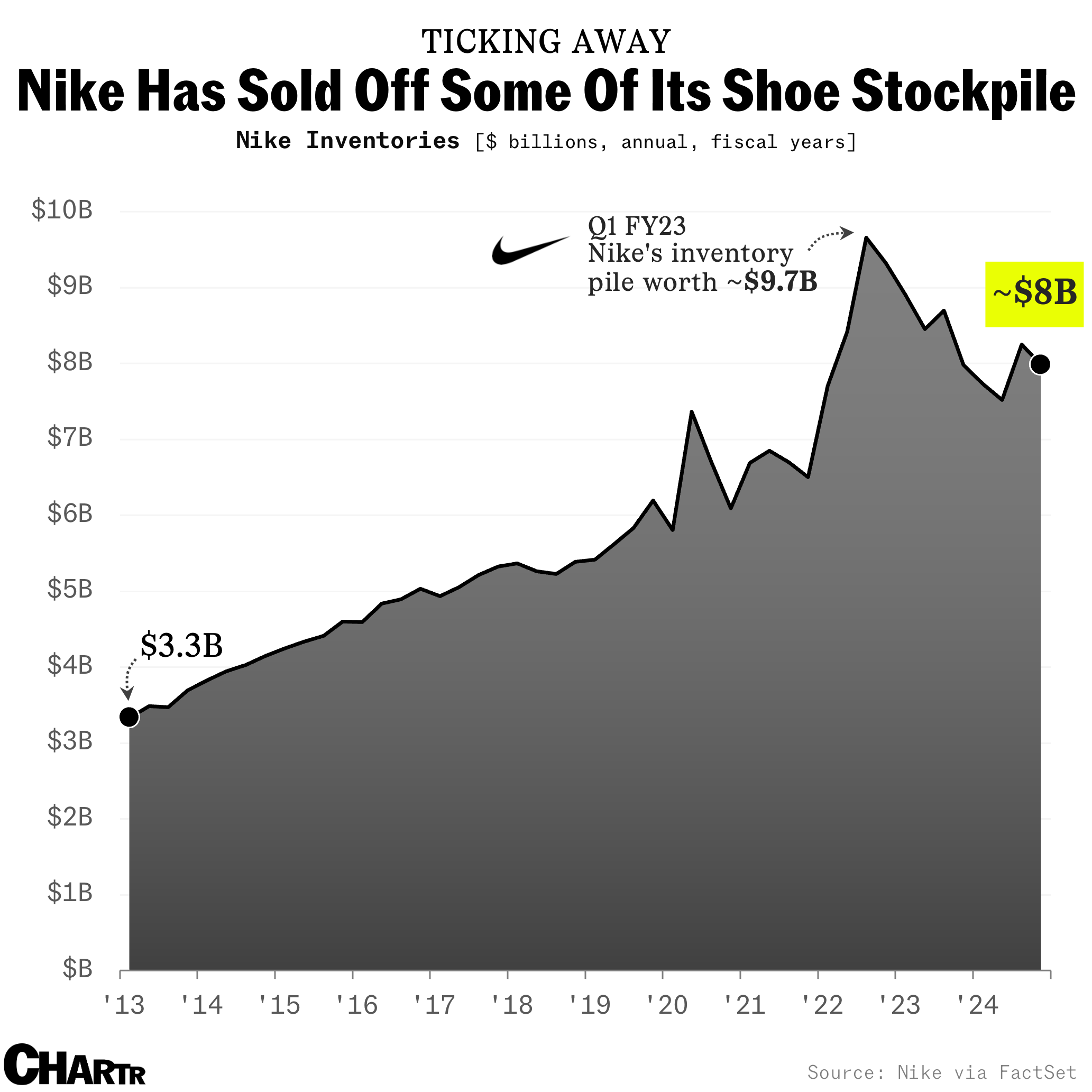
Last October, when Nike veteran Elliott Hill took the helm of the legacy sneaker brand, he had a mammoth task on his hands: not only keeping a lid on inventory — worth $8 billion at the latest count in Q2 FY25 — an issue that’s been plaguing the brand since 2022, when dwindling consumer demand for legacy designs like Jordans and Dunks flagged behind production… but also rebalancing the company’s direct-to-consumer push.

Just sell it

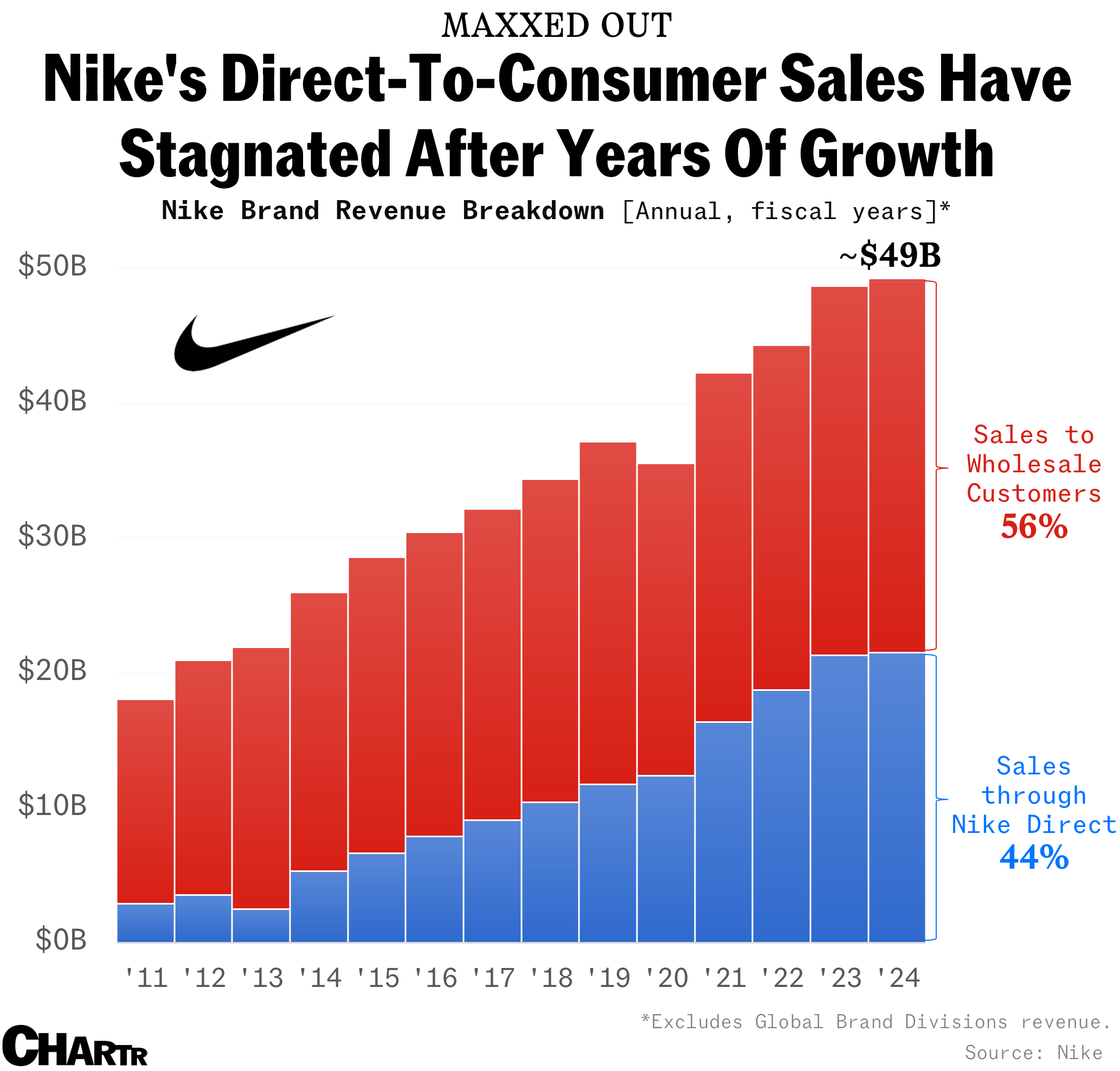
Back in 2017, Nike announced that it would be slashing a significant number of its retail partners to double down on its DTC offerings, which gave the brand higher profit margin than wholesalers, as well as better control over distribution. For a spell, the plan worked. DTC revenues more than doubled in the next five years, amounting to ~$19 billion in fiscal year 2022 (42% of total sales). Now, though, Nike’s direct sales have flatlined, and the company is hoping purchases made through retailers like Foot Locker and Dick’s Sporting Goods can pick up some of the slack.
Nike direct-to-consumer
Sherwood News

Nike failed to account for wholesale’s edge over DTC: pocket-squeezed shoppers love nothing more than a good deal, more often found away from Nike.com. With other running shoes like Hoka also catching up after a pandemic boost, the latest quarterly earnings call saw Hill outline the need for “unwavering commitment” to wholesale partners and providing a “more premium NIKE Direct” service — on top of chipping away at the inventory pile in order to deliver that all-important “newness in product.” This week, at least, investors are buying that story.


More Business

See all Business
business

Netflix is down amid reports it’s leading the Warner Bros. bidding war as Paramount cries foul

Netflix’s charm offensive appears to be working.

Netflix is reportedly emerging as the leader in the bidding war for Warner Bros. Discovery after second-round bids this week, edging out entertainment juggernaut rivals Comcast and Paramount Skydance.

Investors don’t appear psyched by the streaming leader’s turn of fortune: the stock is down on Thursday morning, a day after closing down nearly 5% following reports that scooping up HBO Max wouldn’t necessarily result in a big market share boost.

Paramount, which has reportedly made five bids for Warner Bros. Discovery, doesn’t love the current state of play, either. The company sent WBD a letter questioning the “fairness and adequacy” of the process, highlighting reports that WBD’s board favors Netflix and is resisting Paramount.

Any offer would be subject to regulatory approval — a fact that may have weighed against Netflix’s offer given that cofounder Reed Hastings’ politics are vocally to the left, very much at odds with the current regulatory regime. Paramount seems confident in its ability to get approval, reportedly boosting its breakup fee to $5 billion should its potential acquisition fall apart in the regulatory process.

Investors don’t appear psyched by the streaming leader’s turn of fortune: the stock is down on Thursday morning, a day after closing down nearly 5% following reports that scooping up HBO Max wouldn’t necessarily result in a big market share boost.

Paramount, which has reportedly made five bids for Warner Bros. Discovery, doesn’t love the current state of play, either. The company sent WBD a letter questioning the “fairness and adequacy” of the process, highlighting reports that WBD’s board favors Netflix and is resisting Paramount.

Any offer would be subject to regulatory approval — a fact that may have weighed against Netflix’s offer given that cofounder Reed Hastings’ politics are vocally to the left, very much at odds with the current regulatory regime. Paramount seems confident in its ability to get approval, reportedly boosting its breakup fee to $5 billion should its potential acquisition fall apart in the regulatory process.

business

Delta says the government shutdown will cost it $200 million in Q4

The 43-day government shutdown that ended last month will result in a $200 million ding for Delta Air Lines, the airline said in a filing on Wednesday.

That’s about $100,000 per shutdown-related canceled flight. (Delta previously said it canceled more than 2,000 flights due to FAA flight reductions.) When the company reports its fourth-quarter earnings, the shutdown will lop off about $0.25 per share.

Delta initially stayed calm about the shutdown, with CEO Ed Bastian stating in early October that the company was running smoothly and hadn’t seen any impacts at all. One historically long shutdown later, Delta wasn’t able to remain untouched.

The skies have since cleared, though, and Delta’s filing states that booking growth has “returned to initial expectations following a temporary softening in November.”

Delta’s shares were up over 2% as of Wednesday’s market open.

Delta initially stayed calm about the shutdown, with CEO Ed Bastian stating in early October that the company was running smoothly and hadn’t seen any impacts at all. One historically long shutdown later, Delta wasn’t able to remain untouched.

The skies have since cleared, though, and Delta’s filing states that booking growth has “returned to initial expectations following a temporary softening in November.”

Delta’s shares were up over 2% as of Wednesday’s market open.

Latest Stories

Sherwood Media, LLC produces fresh and unique perspectives on topical financial news and is a fully owned subsidiary of Robinhood Markets, Inc., and any views expressed here do not necessarily reflect the views of any other Robinhood affiliate, including Robinhood Markets, Inc., Robinhood Financial LLC, Robinhood Securities, LLC, Robinhood Crypto, LLC, or Robinhood Money, LLC.