Business
Kodak Charmera
A Kodak Charmera for sale on Amazon (Amazon)

Kodak’s new bet is the blind box boom as it faces doubts over its survival

The film giant once dominated photography. Now it’s banking on Gen Z’s latest obsession to stay relevant.

Kodak just had its own (brief) Kodak moment. Last week, the 133-year-old film icon — once so dominant that its name stood for a memory worth capturing — released a $29.99 retro digital camera that sold out within days. 

The new palm-sized “Charmera” comes in a blind box — meaning you won’t know which of the seven ’80s-inspired designs you get until you open it — tapping into younger consumers’ love of all things retro and mystery-fueled.

That’s a rare win for the company. Last month, Kodak reported a $26 million net loss for Q2, reversing from a profit a year earlier, warning that looming debt raises “substantial doubt” about its ability to keep operating. Shares tumbled as much as 25%, though Kodak later clarified it has no plans to shut down or file for bankruptcy.
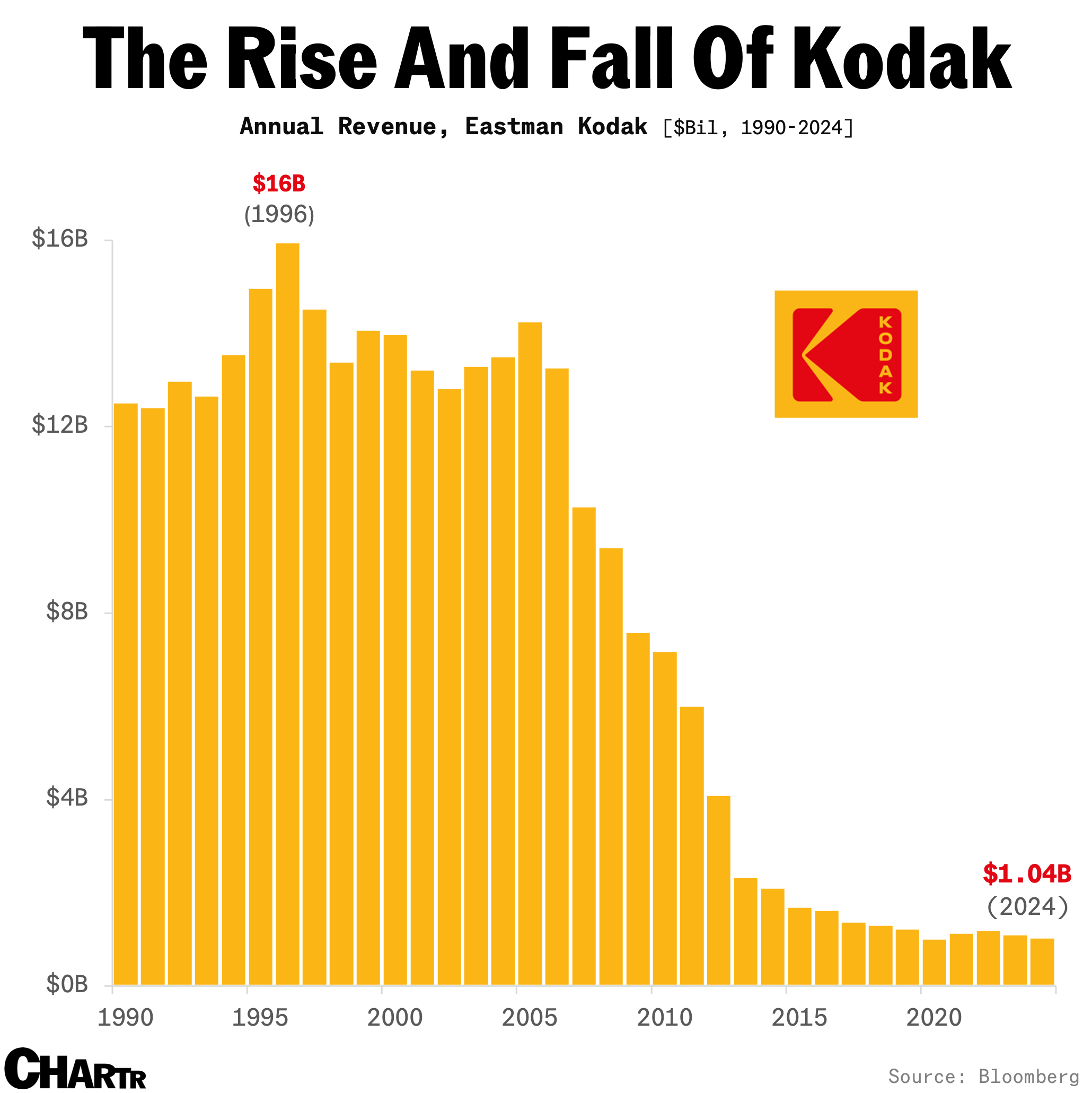
Kodak revenues
Sherwood News

In its heyday, Kodak was everywhere: in the 1970s, it commanded 90% of US film sales and 85% of camera sales, with revenues peaking at nearly $16 billion in 1996. 

Ironically, the company that invented the world’s first digital camera in 1975 missed the wave decades later. Executives feared a digital pivot would undercut Kodak’s lucrative film business, and kept doubling down on printing instead. As consumers shifted to digital cameras and then smartphones, film demand collapsed. Kodak was dropped from the Dow in 2004 after 78 years, filed for bankruptcy in 2012, and now generates just ~$1 billion in annual revenue, a fraction of its peak.

Think inside the box

Since reemerging as a smaller firm, Kodak has tested everything — from smartphones to crypto to pharma to apparel — over the past decade to stay relevant. Its latest move is tapping into the blind box boom: just this year, Pop Mart’s viral Labubu doll helped catapult the toy maker into a $44 billion juggernaut, while cult hits like Sonny Angel figurines and even Duolingo’s blind box owl collectibles show how far the craze has spread.


More Business

See all Business
business

OpenAI’s ARR reached over $20 billion in 2025, CFO says

Sam Altman’s $500 billion artificial intelligence behemoth hit a major financial milestone last year, according to a new blog post over the weekend from OpenAI CFO Sarah Friar, as the company confirmed it had hit a more than $20 billion annual revenue run rate at the end of 2025.

Elsewhere in the blog post, Friar spent time addressing the company’s shifting goals, referencing plans to “close the distance between where intelligence is advancing and how individuals, companies, and countries actually adopt and use it.” As has become customary in the AI company press release genre, the CFO was also keen to tout the unending growth of the business, writing:

  • Both our Weekly Active User (WAU) and Daily Active User (DAU) figures continue to produce all-time highs. This growth is driven by a flywheel across compute, frontier research, products, and monetization.

  • Compute grew 3X year over year or 9.5X from 2023 to 2025: 0.2 GW in 2023, 0.6 GW in 2024, and ~1.9 GW in 2025.

And, perhaps most importantly for current backers and those keeping an eye on the private company before its rumored mega IPO:

  • Revenue followed the same curve growing 3X year over year, or 10X from 2023 to 2025: $2B ARR in 2023, $6B in 2024, and $20B+ in 2025. This is never-before-seen growth at such scale.

That latest figure has certainly set tongues in the tech world wagging, just as the company announced it would begin rolling out ads to free and ChatGPT Go users. It also puts the chatbot giant a fair way ahead of competitors like Anthropic, the company behind Claude.

OpenAI Anthropic ARR race
Sherwood News

Elsewhere in the blog post, Friar spent time addressing the company’s shifting goals, referencing plans to “close the distance between where intelligence is advancing and how individuals, companies, and countries actually adopt and use it.” As has become customary in the AI company press release genre, the CFO was also keen to tout the unending growth of the business, writing:

  • Both our Weekly Active User (WAU) and Daily Active User (DAU) figures continue to produce all-time highs. This growth is driven by a flywheel across compute, frontier research, products, and monetization.

  • Compute grew 3X year over year or 9.5X from 2023 to 2025: 0.2 GW in 2023, 0.6 GW in 2024, and ~1.9 GW in 2025.

And, perhaps most importantly for current backers and those keeping an eye on the private company before its rumored mega IPO:

  • Revenue followed the same curve growing 3X year over year, or 10X from 2023 to 2025: $2B ARR in 2023, $6B in 2024, and $20B+ in 2025. This is never-before-seen growth at such scale.

That latest figure has certainly set tongues in the tech world wagging, just as the company announced it would begin rolling out ads to free and ChatGPT Go users. It also puts the chatbot giant a fair way ahead of competitors like Anthropic, the company behind Claude.

OpenAI Anthropic ARR race
Sherwood News
The Sphere In Las Vegas

Washington, DC, looks set to get America’s second Sphere

Revenue for the Las Vegas version of the big orb has soared, but the Sphere is still a money pit.

business

Ford reportedly in talks to buy hybrid vehicle batteries from Chinese auto giant BYD

Detroit’s Ford and China’s BYD are said to be in ongoing talks to partner on an agreement that would see Ford buy hybrid vehicle batteries from BYD, according to reporting from The Wall Street Journal.

The report comes just days after President Trump toured a Ford factory in Michigan and implied openness to Chinese automakers coming to the US.

“If they want to come in and build a plant... that’s great, I love that,” Trump said on January 13. “Let China come in, let Japan come in.”

Last week, China’s Geely Automobile Holdings said it expects to make an announcement about expanding into the US within the next three years. Chinese carmakers currently face huge tariffs and software restrictions, effectively barring their vehicles from the US.

Ford has doubled down on hybrid vehicles amid high EV costs and the end of federal EV tax credits. The automaker is currently building a battery plant in Michigan where it plans to use tech from Chinese battery maker CATL.

“If they want to come in and build a plant... that’s great, I love that,” Trump said on January 13. “Let China come in, let Japan come in.”

Last week, China’s Geely Automobile Holdings said it expects to make an announcement about expanding into the US within the next three years. Chinese carmakers currently face huge tariffs and software restrictions, effectively barring their vehicles from the US.

Ford has doubled down on hybrid vehicles amid high EV costs and the end of federal EV tax credits. The automaker is currently building a battery plant in Michigan where it plans to use tech from Chinese battery maker CATL.

Still life of Ozempic and Wegovy with weight scale.

Lawsuit alleges Lilly, Novo locked up telehealth to kill compounded GLP-1s

Novo Nordisk CEO Mike Doustdar estimated that around 1.5 million US patients are using compounded versions of the company’s drugs.

Latest Stories

Sherwood Media, LLC produces fresh and unique perspectives on topical financial news and is a fully owned subsidiary of Robinhood Markets, Inc., and any views expressed here do not necessarily reflect the views of any other Robinhood affiliate, including Robinhood Markets, Inc., Robinhood Financial LLC, Robinhood Securities, LLC, Robinhood Crypto, LLC, or Robinhood Money, LLC.