Business
Large group of graduation caps during commencement
Getty Images

The job market is tough for new graduates — even if you dropped $200,000 on an elite MBA

Top MBAs are struggling to land jobs; some are trying their hand at entrepreneurship instead.

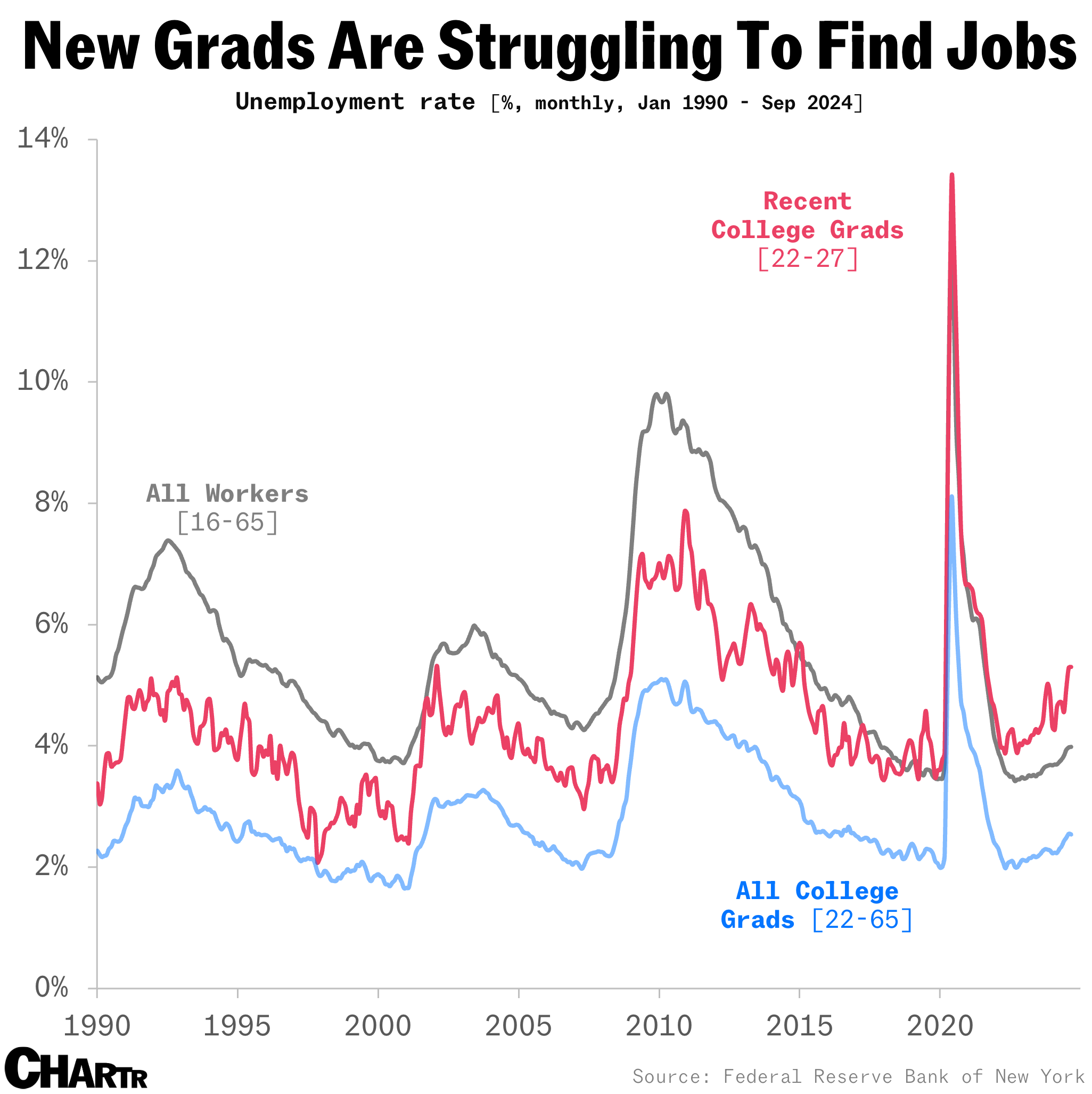
The US labor market is in decent shape: layoffs have been pretty limited, job growth has been solid, and unemployment remains near record lows. But that optimism doesn’t extend to fresh college grads, who are increasingly scrambling to break into the professional world.
New Grads unemployment rate
Sherwood News

According to the latest data from the New York Fed, the unemployment rate for recent college graduates (ages 22-27 with a bachelor’s degree or higher) has reached its highest level in two years. It’s also now higher than the overall workforce, breaking a multidecade trend where recent grads typically had lower unemployment rates.

Now, that strain is spilling over to those who spent over $200,000 on an elite MBA program. Once a predictable path to a lucrative job with a corner office — nearly half of Fortune 500 and S&P 500 CEOs have an MBA, mostly from top schools like Harvard or Wharton — the MBA has lost some of its shine, with even top-tier MBAs finding it hard to land jobs in 2024.

This year, 84% of job-seeking graduates from the top 15 US business schools secured jobs within three months of graduation, down from 92% in 2019, according to The Economist. Even at the so-called M7 schools — Harvard, Stanford, Columbia, UPenn Wharton, Chicago Booth, Northwestern Kellogg, and MIT Sloan — all but Columbia saw drops in job acceptance rates, per school employment reports, first reported by The Wall Street Journal.

So, what’s behind the slowdown?

Put simply, traditional powerpoint- and analysis-obsessed employers, consulting and tech, have significantly pulled back on hiring. Big Tech hires fell by over half at Chicago, Columbia, MIT Sloan, and NYU Stern last year, compared to the 2018-22 average, The Economist’s analysis found, while placements at the Big Three consultancies also dropped by a quarter.

These declines come after the tech and consulting pandemic hiring boom of 2021, a time when 91% of corporate recruiters planned to hire MBAs, up from 80% of actual hires in 2020, according to data from the Graduate Management Admission Council.

In short, they seem to have hired everyone they needed. Some employers even went the other way, with firms like Meta entering their “year of efficiency” — eliminating tens of thousands of jobs in the process.
MBA Ventures
Sherwood News

Degrees of risk

As corporate heavyweights hit the recruitment brakes, MBA grads are now turning to a previously underexplored path: entrepreneurship

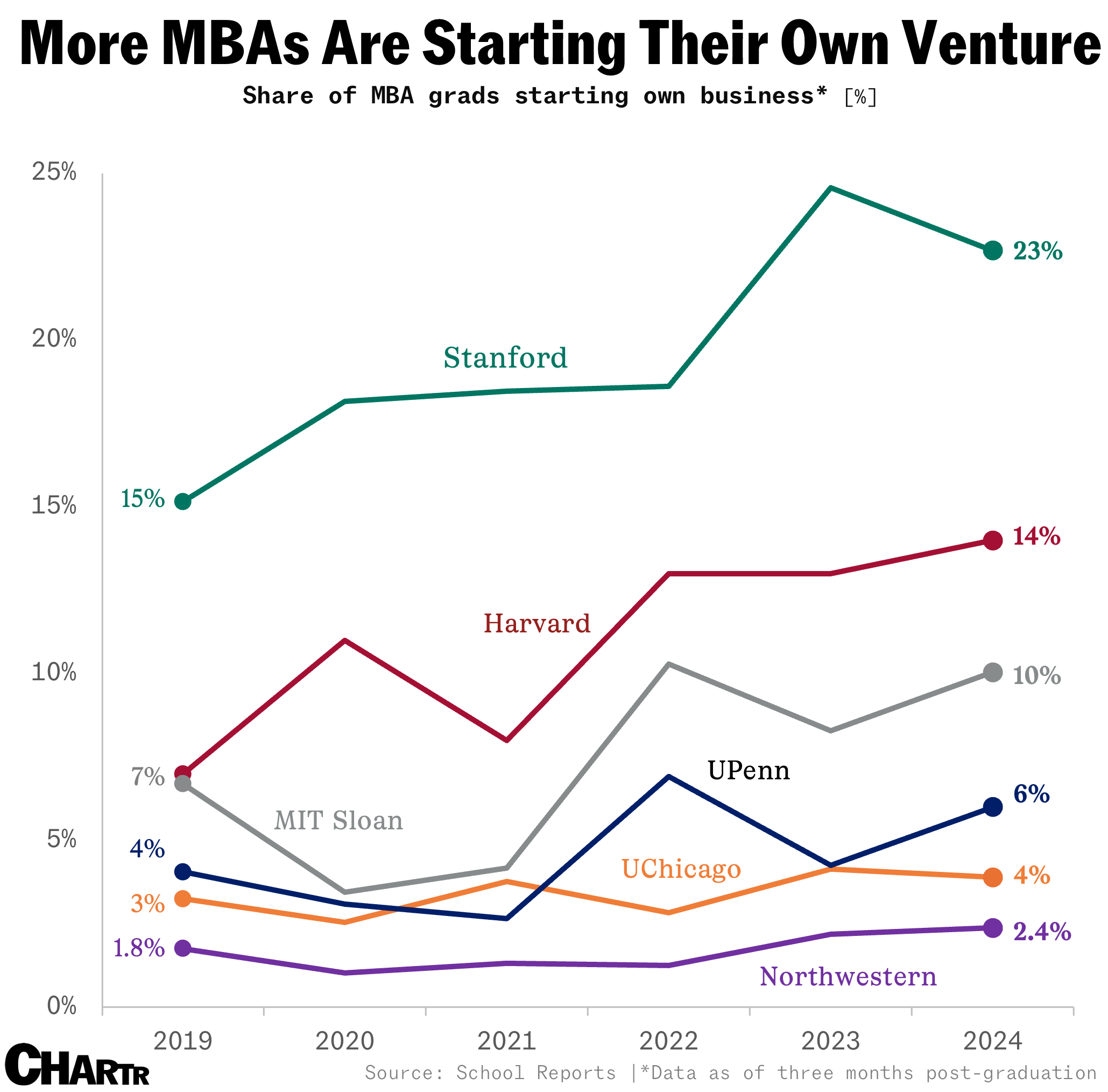
The share of students starting their own businesses has increased since 2019 at the M7 schools — except for Columbia, where data wasn’t available — with Stanford, already known for churning out ambitious young founders like Evan Spiegel (Snapchat) and Phil Knight (Nike), reaching an all-time high in 2023.

In particular, a growing number of these grads are exploring search funds, where they raise money to acquire and run already established businesses. According to Stanford’s research, a record 94 search funds were launched in 2023 in the US and Canada, up from ~60 the year before and fewer than 10 at the turn of the century.

So, what’s the appeal of a search fund for a top MBA grad?

In a world where landing a corporate gig is tougher than ever, no matter how shiny or expensive your diploma is, search funds give the opportunity to be a CEO from day 1. They also unlock the potential for big profits and offer something of a middle ground for aspiring founders — buying a company that’s already operating might scratch the entrepreneurial itch, while not requiring you come up with a new “zero-to-one” business venture.

More Business

See all Business
business

OpenAI’s ARR reached over $20 billion in 2025, CFO says

Sam Altman’s $500 billion artificial intelligence behemoth hit a major financial milestone last year, according to a new blog post over the weekend from OpenAI CFO Sarah Friar, as the company confirmed it had hit a more than $20 billion annual revenue run rate at the end of 2025.

Elsewhere in the blog post, Friar spent time addressing the company’s shifting goals, referencing plans to “close the distance between where intelligence is advancing and how individuals, companies, and countries actually adopt and use it.” As has become customary in the AI company press release genre, the CFO was also keen to tout the unending growth of the business, writing:

  • Both our Weekly Active User (WAU) and Daily Active User (DAU) figures continue to produce all-time highs. This growth is driven by a flywheel across compute, frontier research, products, and monetization.

  • Compute grew 3X year over year or 9.5X from 2023 to 2025: 0.2 GW in 2023, 0.6 GW in 2024, and ~1.9 GW in 2025.

And, perhaps most importantly for current backers and those keeping an eye on the private company before its rumored mega IPO:

  • Revenue followed the same curve growing 3X year over year, or 10X from 2023 to 2025: $2B ARR in 2023, $6B in 2024, and $20B+ in 2025. This is never-before-seen growth at such scale.

That latest figure has certainly set tongues in the tech world wagging, just as the company announced it would begin rolling out ads to free and ChatGPT Go users. It also puts the chatbot giant a fair way ahead of competitors like Anthropic, the company behind Claude.

OpenAI Anthropic ARR race
Sherwood News

Elsewhere in the blog post, Friar spent time addressing the company’s shifting goals, referencing plans to “close the distance between where intelligence is advancing and how individuals, companies, and countries actually adopt and use it.” As has become customary in the AI company press release genre, the CFO was also keen to tout the unending growth of the business, writing:

  • Both our Weekly Active User (WAU) and Daily Active User (DAU) figures continue to produce all-time highs. This growth is driven by a flywheel across compute, frontier research, products, and monetization.

  • Compute grew 3X year over year or 9.5X from 2023 to 2025: 0.2 GW in 2023, 0.6 GW in 2024, and ~1.9 GW in 2025.

And, perhaps most importantly for current backers and those keeping an eye on the private company before its rumored mega IPO:

  • Revenue followed the same curve growing 3X year over year, or 10X from 2023 to 2025: $2B ARR in 2023, $6B in 2024, and $20B+ in 2025. This is never-before-seen growth at such scale.

That latest figure has certainly set tongues in the tech world wagging, just as the company announced it would begin rolling out ads to free and ChatGPT Go users. It also puts the chatbot giant a fair way ahead of competitors like Anthropic, the company behind Claude.

OpenAI Anthropic ARR race
Sherwood News
The Sphere In Las Vegas

Washington, DC, looks set to get America’s second Sphere

Revenue for the Las Vegas version of the big orb has soared, but the Sphere is still a money pit.

business

Ford reportedly in talks to buy hybrid vehicle batteries from Chinese auto giant BYD

Detroit’s Ford and China’s BYD are said to be in ongoing talks to partner on an agreement that would see Ford buy hybrid vehicle batteries from BYD, according to reporting from The Wall Street Journal.

The report comes just days after President Trump toured a Ford factory in Michigan and implied openness to Chinese automakers coming to the US.

“If they want to come in and build a plant... that’s great, I love that,” Trump said on January 13. “Let China come in, let Japan come in.”

Last week, China’s Geely Automobile Holdings said it expects to make an announcement about expanding into the US within the next three years. Chinese carmakers currently face huge tariffs and software restrictions, effectively barring their vehicles from the US.

Ford has doubled down on hybrid vehicles amid high EV costs and the end of federal EV tax credits. The automaker is currently building a battery plant in Michigan where it plans to use tech from Chinese battery maker CATL.

“If they want to come in and build a plant... that’s great, I love that,” Trump said on January 13. “Let China come in, let Japan come in.”

Last week, China’s Geely Automobile Holdings said it expects to make an announcement about expanding into the US within the next three years. Chinese carmakers currently face huge tariffs and software restrictions, effectively barring their vehicles from the US.

Ford has doubled down on hybrid vehicles amid high EV costs and the end of federal EV tax credits. The automaker is currently building a battery plant in Michigan where it plans to use tech from Chinese battery maker CATL.

Still life of Ozempic and Wegovy with weight scale.

Lawsuit alleges Lilly, Novo locked up telehealth to kill compounded GLP-1s

Novo Nordisk CEO Mike Doustdar estimated that around 1.5 million US patients are using compounded versions of the company’s drugs.

Latest Stories

Sherwood Media, LLC produces fresh and unique perspectives on topical financial news and is a fully owned subsidiary of Robinhood Markets, Inc., and any views expressed here do not necessarily reflect the views of any other Robinhood affiliate, including Robinhood Markets, Inc., Robinhood Financial LLC, Robinhood Securities, LLC, Robinhood Crypto, LLC, or Robinhood Money, LLC.