Business
Red Lobster Files For Bankruptcy Protection
(Brandon Bell/Getty Images)

Casual dining is eating fast food’s lunch right now

Americans don’t see fast food as good value anymore. Now, even Red Lobster is feeling confident enough to try some old tricks.

After shelling out to the point of self-destruction on its $20 “Endless Shrimp” deal, and thus learning the true meaning of “all you can eat,” Red Lobster is back, having emerged from Chapter 11 bankruptcy last September.

This time, though, the company’s new management is betting on a different (limited) crustacean to lure consumers back, on Monday announcing the return of “Crabfest” following a four-year hiatus — not to be confused with “Endless Crab,” another financially devastating promotion that the company ran in 2003. 

But if ever there were a time to revive a casual dining business with a familiar playbook, it’s now.

As reported by The Wall Street Journal last Friday, brands like Red Lobster and Cracker Barrel that have seen traffic slump in recent years are planning to spend millions to overhaul their locations and offerings. Their goal? To emulate the success of some of their casual dining peers.

At breadstick-renowned Olive Garden, same-store sales were up 7% year over year in its most recent quarter. Over at Brinker, flagship brand Chili’s is red hot, with same-store sales up a whopping 32% in the first three months of the year. At McDonald’s, traffic is going the other way, with same-store sales dropping 3.6% last quarter.
Casual dining YouGov survey
Sherwood News

Dine a dozen 

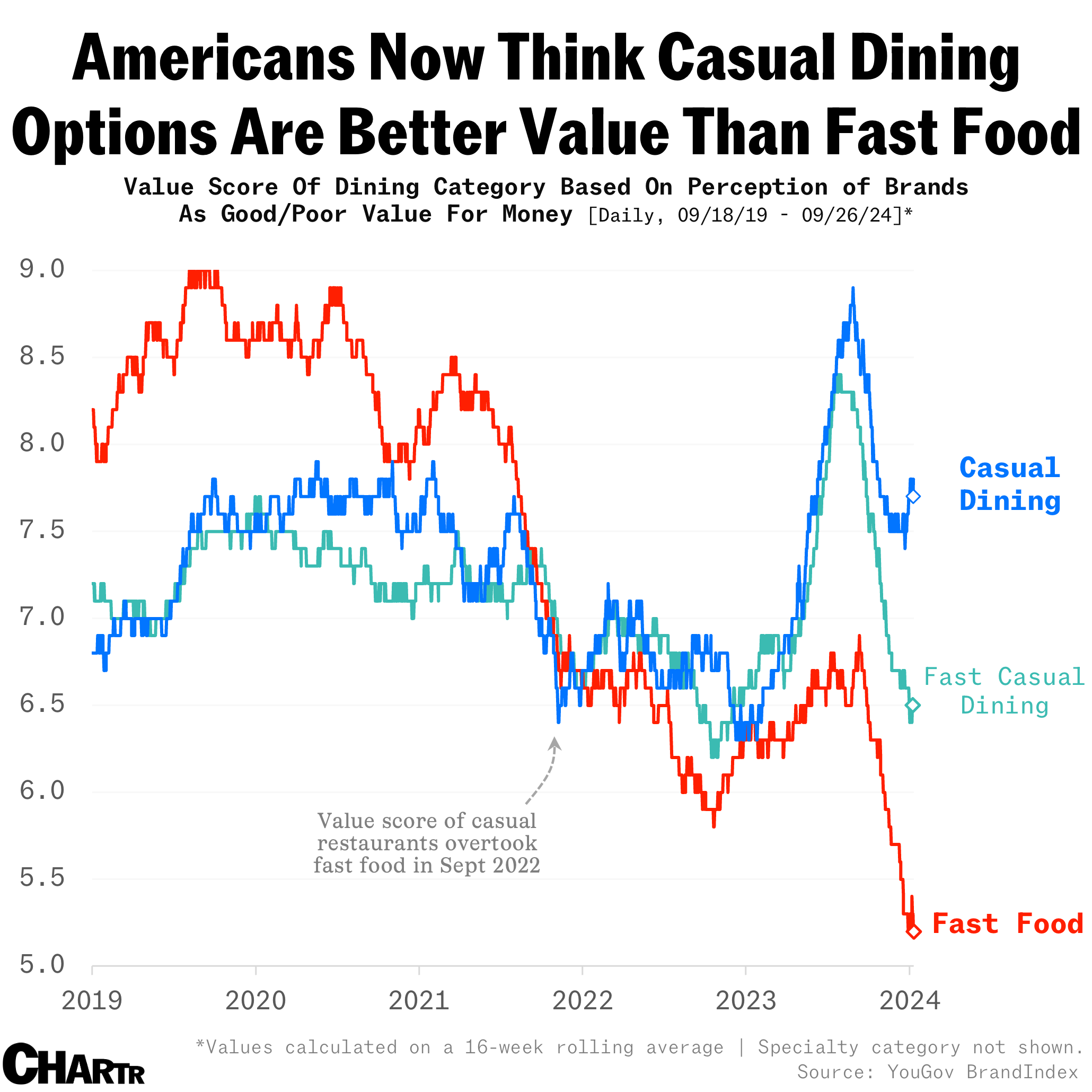
Indeed, as cost-conscious customers have been put off by inflation-spiked fast-food menus, they’ve been drawn toward household name casual restaurants by a combination of good service, good atmosphere, and good prices. A survey conducted by YouGov at the end of last year found that casual chains had soared in US consumers’ approximations as the best-value option for dining, while value scores for the fast-food and fast-casual categories sank throughout 2024.

Olive Garden topped the list of the brands considered the best for value, with Wendy’s the only fast-food category restaurant to break the top 10. Meanwhile, fast-food outlets dominated the list of poorest-value restaurants… but it was Starbucks, home of numerous ~$7 drinks, that was named the worst-value option overall.

More Business

See all Business
business

OpenAI’s ARR reached over $20 billion in 2025, CFO says

Sam Altman’s $500 billion artificial intelligence behemoth hit a major financial milestone last year, according to a new blog post over the weekend from OpenAI CFO Sarah Friar, as the company confirmed it had hit a more than $20 billion annual revenue run rate at the end of 2025.

Elsewhere in the blog post, Friar spent time addressing the company’s shifting goals, referencing plans to “close the distance between where intelligence is advancing and how individuals, companies, and countries actually adopt and use it.” As has become customary in the AI company press release genre, the CFO was also keen to tout the unending growth of the business, writing:

  • Both our Weekly Active User (WAU) and Daily Active User (DAU) figures continue to produce all-time highs. This growth is driven by a flywheel across compute, frontier research, products, and monetization.

  • Compute grew 3X year over year or 9.5X from 2023 to 2025: 0.2 GW in 2023, 0.6 GW in 2024, and ~1.9 GW in 2025.

And, perhaps most importantly for current backers and those keeping an eye on the private company before its rumored mega IPO:

  • Revenue followed the same curve growing 3X year over year, or 10X from 2023 to 2025: $2B ARR in 2023, $6B in 2024, and $20B+ in 2025. This is never-before-seen growth at such scale.

That latest figure has certainly set tongues in the tech world wagging, just as the company announced it would begin rolling out ads to free and ChatGPT Go users. It also puts the chatbot giant a fair way ahead of competitors like Anthropic, the company behind Claude.

OpenAI Anthropic ARR race
Sherwood News

Elsewhere in the blog post, Friar spent time addressing the company’s shifting goals, referencing plans to “close the distance between where intelligence is advancing and how individuals, companies, and countries actually adopt and use it.” As has become customary in the AI company press release genre, the CFO was also keen to tout the unending growth of the business, writing:

  • Both our Weekly Active User (WAU) and Daily Active User (DAU) figures continue to produce all-time highs. This growth is driven by a flywheel across compute, frontier research, products, and monetization.

  • Compute grew 3X year over year or 9.5X from 2023 to 2025: 0.2 GW in 2023, 0.6 GW in 2024, and ~1.9 GW in 2025.

And, perhaps most importantly for current backers and those keeping an eye on the private company before its rumored mega IPO:

  • Revenue followed the same curve growing 3X year over year, or 10X from 2023 to 2025: $2B ARR in 2023, $6B in 2024, and $20B+ in 2025. This is never-before-seen growth at such scale.

That latest figure has certainly set tongues in the tech world wagging, just as the company announced it would begin rolling out ads to free and ChatGPT Go users. It also puts the chatbot giant a fair way ahead of competitors like Anthropic, the company behind Claude.

OpenAI Anthropic ARR race
Sherwood News
The Sphere In Las Vegas

Washington, DC, looks set to get America’s second Sphere

Revenue for the Las Vegas version of the big orb has soared, but the Sphere is still a money pit.

business

Ford reportedly in talks to buy hybrid vehicle batteries from Chinese auto giant BYD

Detroit’s Ford and China’s BYD are said to be in ongoing talks to partner on an agreement that would see Ford buy hybrid vehicle batteries from BYD, according to reporting from The Wall Street Journal.

The report comes just days after President Trump toured a Ford factory in Michigan and implied openness to Chinese automakers coming to the US.

“If they want to come in and build a plant... that’s great, I love that,” Trump said on January 13. “Let China come in, let Japan come in.”

Last week, China’s Geely Automobile Holdings said it expects to make an announcement about expanding into the US within the next three years. Chinese carmakers currently face huge tariffs and software restrictions, effectively barring their vehicles from the US.

Ford has doubled down on hybrid vehicles amid high EV costs and the end of federal EV tax credits. The automaker is currently building a battery plant in Michigan where it plans to use tech from Chinese battery maker CATL.

“If they want to come in and build a plant... that’s great, I love that,” Trump said on January 13. “Let China come in, let Japan come in.”

Last week, China’s Geely Automobile Holdings said it expects to make an announcement about expanding into the US within the next three years. Chinese carmakers currently face huge tariffs and software restrictions, effectively barring their vehicles from the US.

Ford has doubled down on hybrid vehicles amid high EV costs and the end of federal EV tax credits. The automaker is currently building a battery plant in Michigan where it plans to use tech from Chinese battery maker CATL.

Still life of Ozempic and Wegovy with weight scale.

Lawsuit alleges Lilly, Novo locked up telehealth to kill compounded GLP-1s

Novo Nordisk CEO Mike Doustdar estimated that around 1.5 million US patients are using compounded versions of the company’s drugs.

Latest Stories

Sherwood Media, LLC produces fresh and unique perspectives on topical financial news and is a fully owned subsidiary of Robinhood Markets, Inc., and any views expressed here do not necessarily reflect the views of any other Robinhood affiliate, including Robinhood Markets, Inc., Robinhood Financial LLC, Robinhood Securities, LLC, Robinhood Crypto, LLC, or Robinhood Money, LLC.