

BigBerkshireEnergy

So you invested in Berkshire Hathaway: What did you buy?
Berkshire Hathaway’s Assets: Railroads. Energy. Insurance. $277 billion in cash. $300 billion in stocks. Patience.
With roots that can be traced all the way back to 1839 — when it was a textile manufacturer in Rhode Island — the $900+ billion behemoth that is Berkshire Hathaway today bears little resemblance to its origins.
Now, in the heart of Omaha, Nebraska, America’s largest non-technology company is slowly changing once again.
Price is what you pay…
A student of famed investor Benjamin Graham, Warren Buffett honed his skills and folksy charm with a multitude of investments that have become the stuff of investing lore since he first bought a controlling stake in Berkshire in 1965. Most notable, perhaps, are Buffett’s acquisitions of various insurance companies, assets that created a formidable financial flywheel. By using some of the insurance premiums (or float) collected to make further investments, he gained more diversification, which allowed him to underwrite additional insurance, collect more premiums upfront, and so on and so forth.
… value is what you get
As his reputation grew, some investors scrambled to copy his moves. The wisest among them simply invested in Berkshire Hathaway itself, collecting staggering returns. A theoretical $1,000 investment in Berkshire shares at the beginning of 1980 would be worth more than $2 million today.
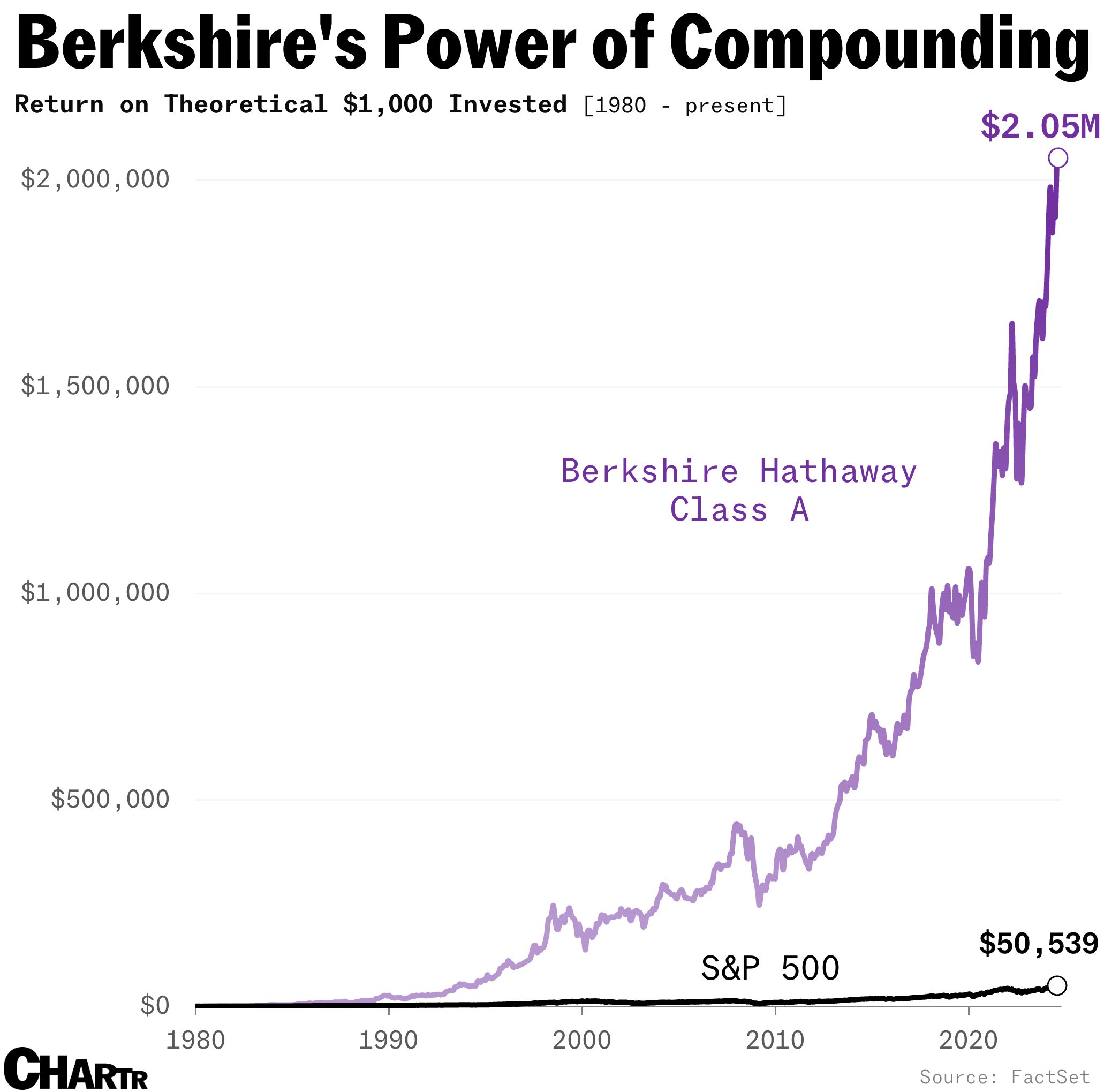
The same investment in the S&P 500 would have yielded a comparatively modest ~$50,000.
For some, Buffett took on an almost ethereal energy, earning the nickname “The Oracle of Omaha”. And although he made mistakes — like doubling down on the dying textile business by purchasing Waumbec Mills in 1975 — patience and discipline, particularly after partnering with Charlie Munger (who passed away in December 2023), became hallmarks of Berkshire’s investment process. But what is Berkshire today?
Know what you own, and why
Although we wish it would, splitting a pizza into 6, 8, or 10 slices doesn’t change how much food you’ve got: it just changes how unwieldy the food is to eat. Stocks are similar. Most companies try to split their equity ownership into slices that aren’t too big or too small, usually in the tens or hundreds of dollars, to appeal to as wide a range of investors as possible.
Indeed, numerous companies do stock splits to arbitrarily lower their stock price. Tesla did a 3-for-1 split in August 2022, Walmart announced one in January of this year, and high-flying Nvidia did a 10-for-1 split in June. Berkshire has never split its Class A shares… which is why buying one will set you back some $660,000 and change.
That strategy has attracted shareholders who align more with Buffett and co.’s longer term strategy and thinking. But, as Berkshire’s share price climbed into the many tens of thousands and beyond, people floated the idea of creating entities that “would hold nothing but Berkshire stock, and then parcel out its own shares in smaller denomination pieces to the public” — a potential arrangement that Buffett saw as ripe for abuse. So, in 1996, Berkshire created the Class B share, which is currently worth 1/1,500th of the Class A.
But, if you decide to invest in BRK.B, what are you really buying?
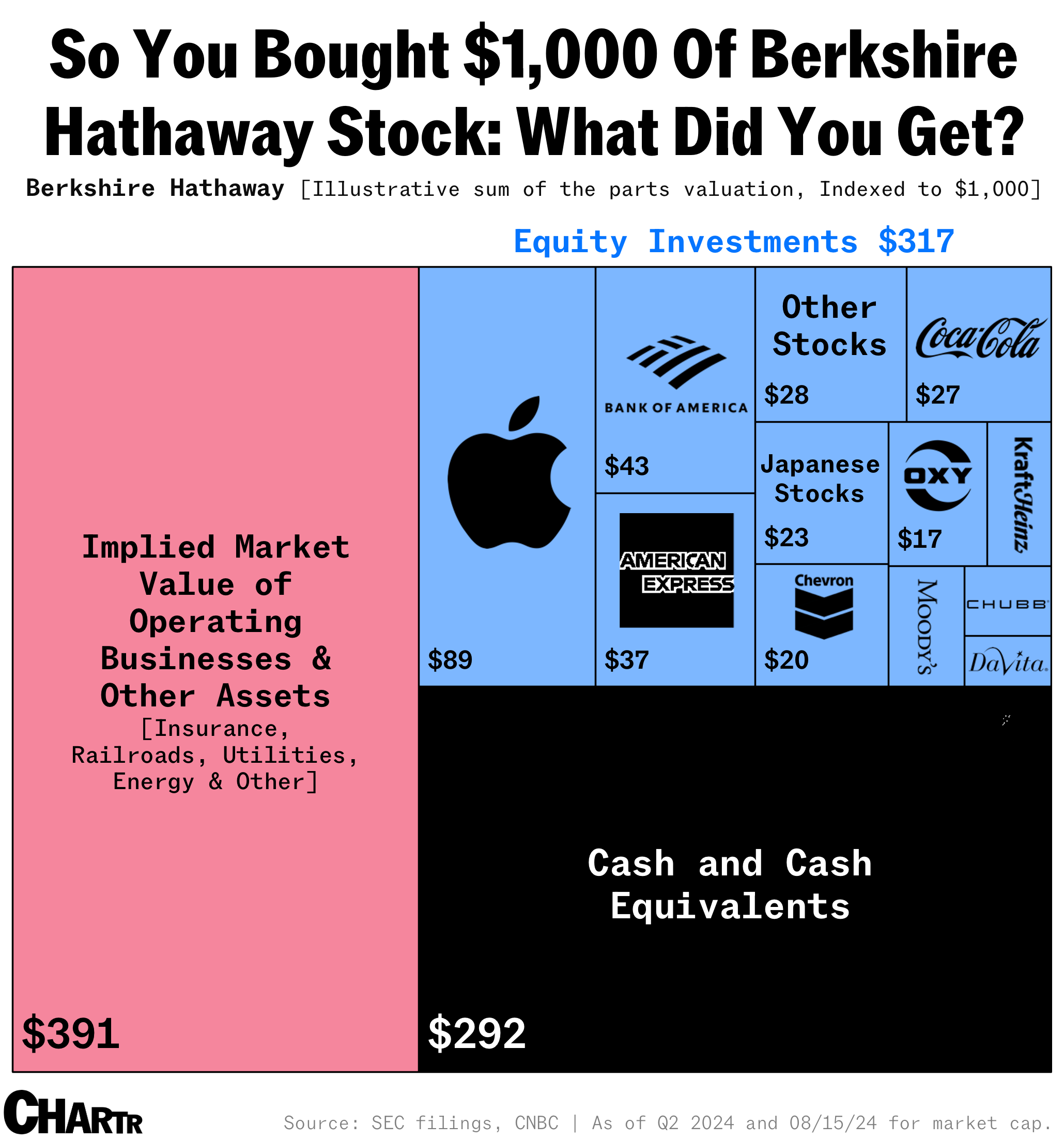
Well, for starters, Berkshire now has more cash than ever, some $277 billion worth at the end of Q2. Taking that at face value (assuming no holding company discounts), that’s roughly 30% of the company’s market value. So $292 of our $1,000 hypothetical investment in our example is just cash.
Next up is the company’s stock portfolio. An updated 13F filing from Wednesday reveals that — again assuming no conglomerate discount — it’s worth about $317 out of our $1,000. That implies that the rest of the business, primarily Berkshire’s actual operating divisions, is worth the remainder, or some $391 in our example. So if you’re buying Berkshire you’re getting exposure to: a bunch of iconic American stocks, some Japanese equities, cash, some railroads, insurance companies, and energy assets. Oh, and Dairy Queen and Duracell, which Berkshire also owns.
There’s even some technology investments… but that portion is shrinking.
Old dog, new tricks
For years, Warren Buffett claimed he "didn't understand tech companies" and avoided investing in them, preferring companies with a durable competitive advantage, often channeling one of his other mantras: “Invest in businesses any idiot could run because someday one will”.
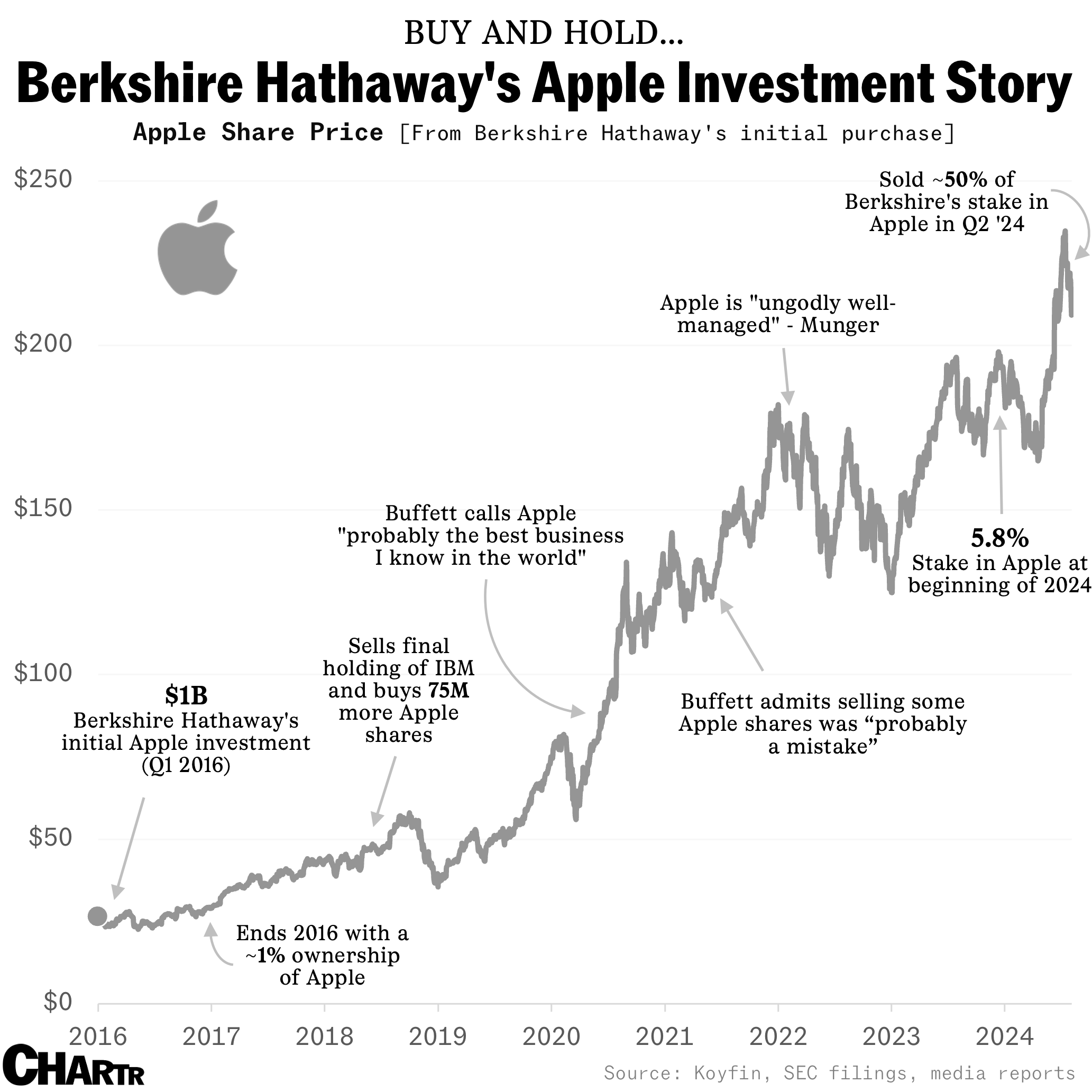
But, 2011 marked a turning point. As the tech giants boomed, Buffett made his first foray into tech, investing $11 billion in IBM. That investment didn’t really work out, but it set the stage for what — in pure dollar terms — became one of the most successful investments of all time: Berkshire’s investment in Apple, which started with a ~$1 billion purchase revealed in a filing from 2016. This decision, likely influenced by one of Buffett's investment managers, Ted Weschler or Todd Combs, proved to be a game-changer.
Bite out of the Apple
Since that initial purchase, Apple’s shares have made a total return of nearly 800%, with Berkshire seemingly happy to sit on its huge stake — until recently.
Indeed, Buffett and his team’s love of the iPhone-maker appears to be waning. In the last quarter, Berkshire roughly halved its position in the company, leaving it owning exactly 400 million shares, a sell-down that took Berkshire Hathaway's cash pile to more than $270 billion.
That cash buffer is, obviously, an asset. But, it’s also potentially a bit of a headache. There’s no point in investing in a company if all they do is park your cash at a bank. You can do that yourself.
So the problem for Berkshire, and we’re using “problem” in truly the loosest definition imaginable, is that its cash balance is just so enormous that the ways to deploy it meaningfully are becoming vanishingly small. Take Ulta Beauty for example. This week, Berkshire revealed a $266 million stake in the company. That was a big deal for Ulta Beauty, but a relative triviality for Berkshire: it represents about 0.03% of Berkshire’s value.
If Warren Buffett were to spend an hour talking about Berkshire’s portfolio, and he spoke about each asset in proportion to its value to the group, the new $266 million investment in Ulta Beauty would get 1.01 seconds of discussion, just enough time to say “Ulta-”. That’s how big Berkshire is.
How will Berkshire deploy its mounting cash pile? Will it jump back into tech investments, or wait for a more serious market wobble than the one we had a couple of weeks ago? Whatever it is, the decision won’t be rushed.


