
Business
How Amazon makes its money

Amazon is cutting hundreds of jobs from its AWS division

Amazon announced on Wednesday that it's cutting several hundred roles in its cloud computing division, Amazon Web Services (AWS).

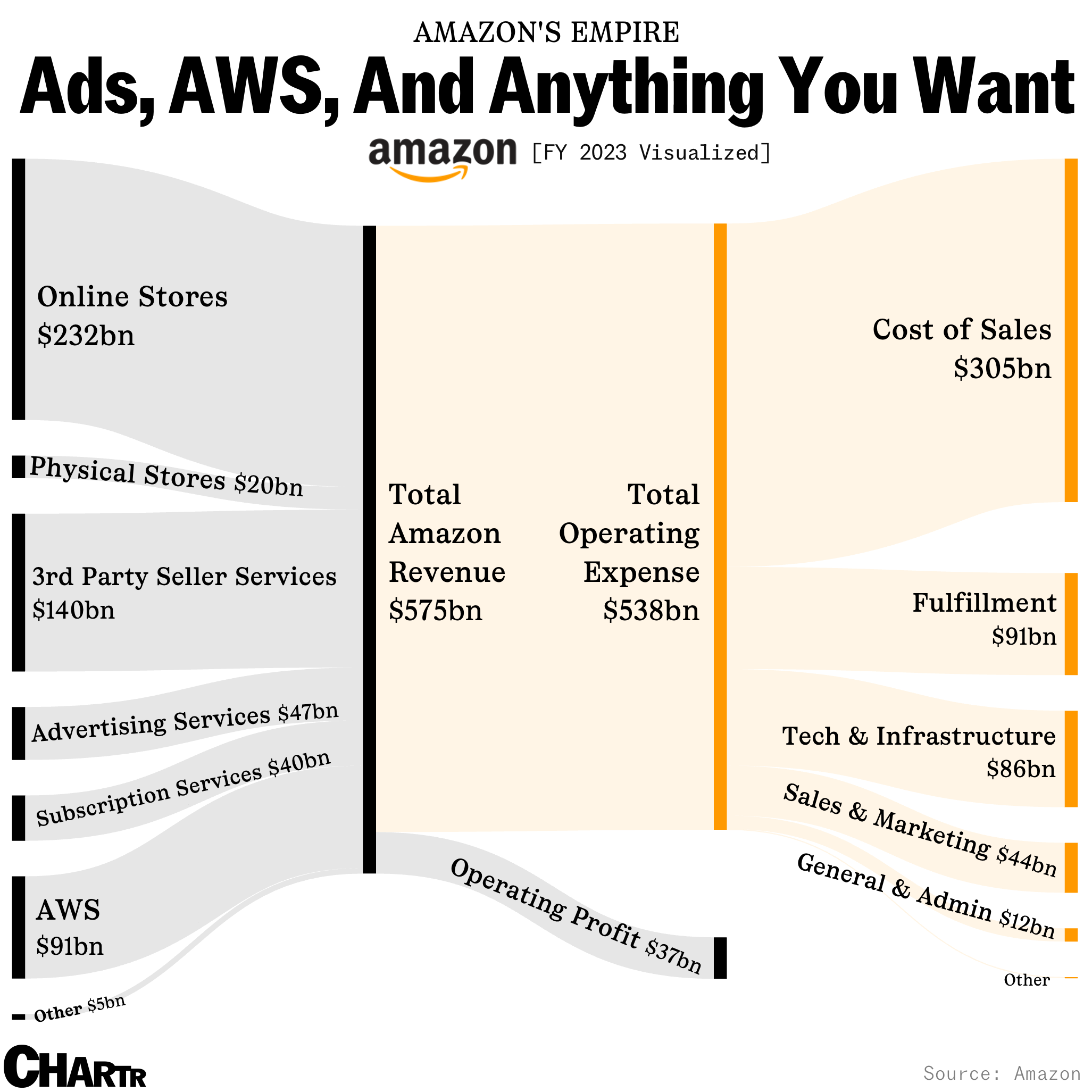
If you’ve ever streamed a movie on Netflix, attended a meeting on Zoom, or scrolled through your Facebook feed, you've indirectly used AWS, which provides computing power, storage, databases, servers, and more to millions of businesses — helping it to become the profit center of Amazon’s increasingly sprawling empire. Indeed, although it accounted for just 16% of revenue last year, AWS alone contributed 67% of the company’s ~$37 billion in operating profit.‍

Efficiency: From A to Z‍

The layoffs came just a day after Amazon ditched the “Just Walk Out” cashier-less technology used at its grocery stores — which turned out to be heavily reliant on a review team team in India — and at an interesting time for Amazon generally.

Although it overlaps with its peers Alphabet, Meta, Apple, and Nvidia in many ways, Amazon is a much more complicated entity: for example, no other tech company owns grocery stores. It’s the nation’s second-largest private employer, with 22x more people on its payroll than Meta, and the company’s core expertise is in less buzzy niches: deliveries, servers, supply chain logistics, e-commerce seller services, and, increasingly, ads.

Those businesses are wildly different, but Amazon’s ruthless drive for efficiency is universally applied to them all. The layoffs in the AWS division follow cuts in the subscription services business — home to Prime, Audible, and Twitch — earlier this year, and all told Amazon has shed more than 27,000 roles since the end of 2022 across almost every area of the company.‍

FOMO: Amazon isn’t completely ignoring the shiny new sectors, recently completing a $4 billion investment into AI startup Anthropic.

More Business

See all Business
business

Netflix is down amid reports it’s leading the Warner Bros. bidding war as Paramount cries foul

Netflix’s charm offensive appears to be working.

Netflix is reportedly emerging as the leader in the bidding war for Warner Bros. Discovery after second-round bids this week, edging out entertainment juggernaut rivals Comcast and Paramount Skydance.

Investors don’t appear psyched by the streaming leader’s turn of fortune: the stock is down on Thursday morning, a day after closing down nearly 5% following reports that scooping up HBO Max wouldn’t necessarily result in a big market share boost.

Paramount, which has reportedly made five bids for Warner Bros. Discovery, doesn’t love the current state of play, either. The company sent WBD a letter questioning the “fairness and adequacy” of the process, highlighting reports that WBD’s board favors Netflix and is resisting Paramount.

Any offer would be subject to regulatory approval — a fact that may have weighed against Netflix’s offer given that cofounder Reed Hastings’ politics are vocally to the left, very much at odds with the current regulatory regime. Paramount seems confident in its ability to get approval, reportedly boosting its breakup fee to $5 billion should its potential acquisition fall apart in the regulatory process.

Investors don’t appear psyched by the streaming leader’s turn of fortune: the stock is down on Thursday morning, a day after closing down nearly 5% following reports that scooping up HBO Max wouldn’t necessarily result in a big market share boost.

Paramount, which has reportedly made five bids for Warner Bros. Discovery, doesn’t love the current state of play, either. The company sent WBD a letter questioning the “fairness and adequacy” of the process, highlighting reports that WBD’s board favors Netflix and is resisting Paramount.

Any offer would be subject to regulatory approval — a fact that may have weighed against Netflix’s offer given that cofounder Reed Hastings’ politics are vocally to the left, very much at odds with the current regulatory regime. Paramount seems confident in its ability to get approval, reportedly boosting its breakup fee to $5 billion should its potential acquisition fall apart in the regulatory process.

business

Delta says the government shutdown will cost it $200 million in Q4

The 43-day government shutdown that ended last month will result in a $200 million ding for Delta Air Lines, the airline said in a filing on Wednesday.

That’s about $100,000 per shutdown-related canceled flight. (Delta previously said it canceled more than 2,000 flights due to FAA flight reductions.) When the company reports its fourth-quarter earnings, the shutdown will lop off about $0.25 per share.

Delta initially stayed calm about the shutdown, with CEO Ed Bastian stating in early October that the company was running smoothly and hadn’t seen any impacts at all. One historically long shutdown later, Delta wasn’t able to remain untouched.

The skies have since cleared, though, and Delta’s filing states that booking growth has “returned to initial expectations following a temporary softening in November.”

Delta’s shares were up over 2% as of Wednesday’s market open.

Delta initially stayed calm about the shutdown, with CEO Ed Bastian stating in early October that the company was running smoothly and hadn’t seen any impacts at all. One historically long shutdown later, Delta wasn’t able to remain untouched.

The skies have since cleared, though, and Delta’s filing states that booking growth has “returned to initial expectations following a temporary softening in November.”

Delta’s shares were up over 2% as of Wednesday’s market open.

Latest Stories

Sherwood Media, LLC produces fresh and unique perspectives on topical financial news and is a fully owned subsidiary of Robinhood Markets, Inc., and any views expressed here do not necessarily reflect the views of any other Robinhood affiliate, including Robinhood Markets, Inc., Robinhood Financial LLC, Robinhood Securities, LLC, Robinhood Crypto, LLC, or Robinhood Money, LLC.