
Business
BlackBerry sales

BlackBerry: Back in the black?

The once-iconic phonemaker expects to be profitable again

We’ll be fine

Shares of BlackBerry rose 11% yesterday after the company posted a smaller than expected loss, edging the once world-beating company back towards profitability, with the CEO expecting BlackBerry to be “generating positive cash flow in the fourth quarter”.

The results had nothing to do with shipping phones, however. Since its dramatic fall from grace, the company has pivoted towards selling the software and security features that helped make its phones so popular with security-conscious white-collar workers in the first place.

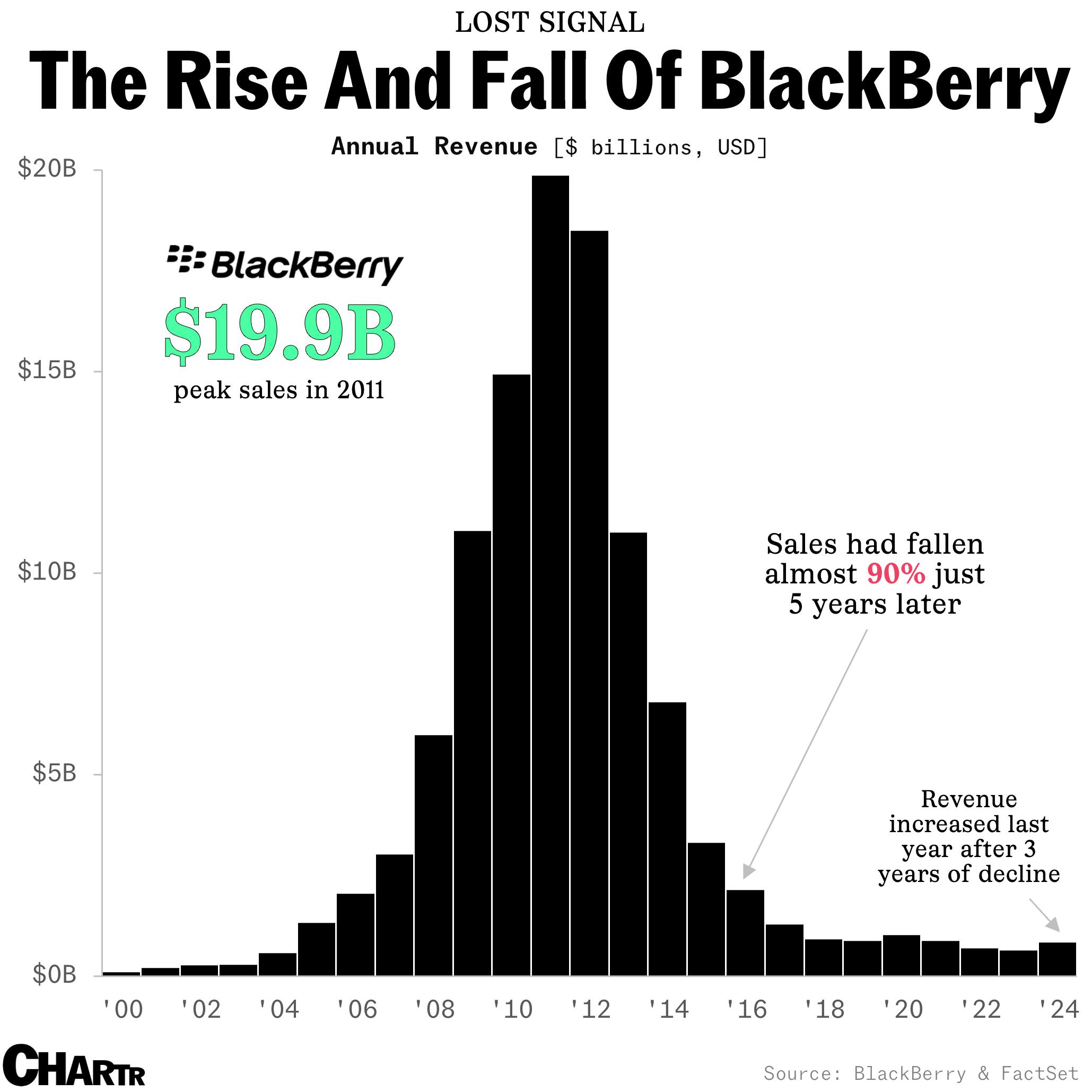
BlackBerry, along with other 2000s classics like Nokia, TomTom, and pretty much the entire MP3 market, was decimated by the release of the iPhone in 2007. The company’s revenue peaked just shy of $20 billion in 2011, but as the iPhone and other smartphones went mainstream, its sales plummeted. Just five years later, BlackBerry's revenue had dropped to around $2 billion, a period that included a staggering $4.4 billion loss in a single quarter due to a massive inventory writedown.

Realizing that its co-CEO’s famous words — "we'll be fine" — after the iPhone launch were, shall we say, a bit optimistic, the company eventually abandoned selling hardware in 2016. That shift has hardly restored BlackBerry into the global leader that it once was, its most recent annual sales amounted to just 4% of its record, but some version of the company remains alive and kicking. In fact, there’s a good chance you’ve recently used a BlackBerry product indirectly: the company reports that its software is in more than 235 million vehicles around the world.

More Business

See all Business
9.3%

As the war with Iran produces the biggest spike in US gas prices since Hurricane Katrina, car retailer CarMax is continuing to see heightened interest in EVs, hybrids, and plug-in hybrids.

“From Feb 1st - March 1st (inclusive), compared to March 2nd to March 15th (inclusive), we saw a 9.3% lift in page views for these vehicles,” a spokesperson for the company told Sherwood News.

As industry insiders recently told us, EV interest climbs when gas prices rise. That appears to be holding true even without EV tax credits, which the Trump administration ended under its new budget package.

CarMax also saw EV searches spike in 2022, amid Russia’s invasion of Ukraine and the resulting oil price spike.

Walt Disney Chairman And CEO Bob Iger Rings Opening Bell At NY Stock Exchange

It’s the end of Disney’s Iger era (again)

Incoming CEO Josh D’Amaro is replacing Bob Iger on Wednesday, though Iger will remain a senior adviser through the end of the year.

$35.4B

The tariffs imposed by the Trump administration have cost automakers at least $35.4 billion since the start of 2025, according to a new analysis by Automotive News.

That total will continue to climb this year, since the Supreme Court’s February tariff ruling largely leaves the 25% levy on vehicles and auto parts untouched.

Toyota has taken the biggest hit, projecting more than $9 billion in tariff costs in its fiscal year ending this month, while Detroit’s big three automakers — Ford, GM, and Stellantis — were hit with a combined $6.5 billion tariff charge in 2025.

In the fourth quarter, automakers sold about 8% fewer imported vehicles in the US compared to the same period a year ago, per the Automotive News Research & Data Center.

Tariff charges come at a rough time for legacy carmakers, which are also scaling back EV plans following the Trump administration’s elimination of tax credits and fuel standard goals. According to Automotive News, the cost of EV write-downs and restructuring is, so far, nearly $70 billion.

Universal Studios Orlando Theme Park

Universal Studios is giving theaters a longer minimum exclusive run

Universal will now guarantee a minimum of five weekends before a movie hits home screens — which might help theater companies like AMC finally get back to profitability.

Latest Stories

Sherwood Media, LLC produces fresh and unique perspectives on topical financial news and is a fully owned subsidiary of Robinhood Markets, Inc., and any views expressed here do not necessarily reflect the views of any other Robinhood affiliate, including Robinhood Markets, Inc., Robinhood Financial LLC, Robinhood Securities, LLC, Robinhood Crypto, LLC, Robinhood Derivatives, LLC, or Robinhood Money, LLC. Futures and event contracts are offered through Robinhood Derivatives, LLC.