
Tech
A screenshot from arcprize.org.
(Screenshot: https://arcprize.org/arc)

OpenAI’s ARC de Triumph

How a puzzle designed to resist memorization is reshaping AI intelligence tests. See if you can score better than an AI model.

OpenAI’s Sam Altman thinks that the upcoming GPT-5 AI model will be smarter than him. Emphasis ours:

“I don’t think I’m going to be smarter than GPT-5. And I don’t feel sad about it because I think it just means that we’ll be able to use it to do incredible things.” 

But what does it actually mean for an AI to be “smart”? It turns out this is pretty difficult to nail down, as the AI world can’t even decide what the definition of “artificial general intelligence” (AGI) is. While imperfect, the industry has embraced the use of “benchmarks” — tests designed to measure an AI model’s knowledge and reasoning ability.

Want to test how well an AI model can write code? There’s a benchmark for that: SWE-bench. High school math? AIME 2024. General knowledge across multiple subjects? MMLU

AI companies are quick to boast about how well their new model tested on different benchmarks, using them as proof of progress. But recently, a new high score for one of the most challenging benchmarks caught the industry’s attention. 

Unlike traditional benchmarks filled with multiple-choice questions, ARC-AGI is unique and challenges AI with purely visual puzzles designed to test complex reasoning skills. For five years, no AI model could score higher than 5% on the test. 

That changed when OpenAI announced on December 20, 2024, that its just-released “o3” model had solved the ARC-AGI test. This marked the first time any AI had passed the test — a huge leap over the other state-of-the-art models. 

François Chollet, an AI researcher and cofounder of new AI startup Ndea, created the ARC-AGI challenge in 2019. When asked about the significance of OpenAI’s breakthrough score on his test, Chollet called it “a major achievement.”

In an email to Sherwood News, Chollet noted that OpenAI’s previous GPT models all scored near zero on the test. “It demonstrates the fact that o3 is not limited to memorized skills and memorized knowledge, unlike the GPT series, or really unlike any prior major AI system. It is actually capable of adapting to novelty, at least in the very simple context of ARC-AGI tasks,” Chollet said.

Many of the previous testing tools failed to demonstrate what Chollet considers actual intelligence: “the ability to adapt on the fly to new situations and new problems. Rather they demonstrated memorized skill,” Chollet said. 

Input > Output

So what does this test look like? It’s a series of tasks comprised of visual puzzles. The puzzle is made up of a series of colored tiles on a grid, with the computer reading each color as a different number. 

Each task shows the test-taker a series of problem and solution pairs — the input and the output. The user has to look at the sample pairs and deduce the steps needed to solve these puzzles. Then the user is asked to solve a puzzle that only shows the input, applying the same solution from the examples. 
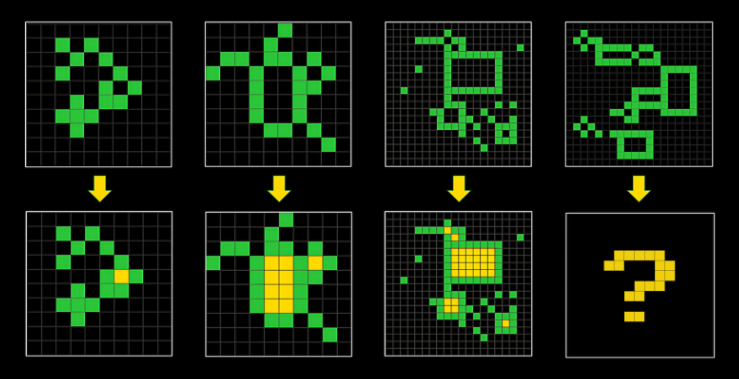
A screenshot from arcprize.org.
A screenshot from arcprize.org. Source: https://arcprize.org/arc

Chollet says the test was designed to not require any special training, but only innate “core knowledge” like object persistence, basic geometry, numbers and counting, and that objects can be animate or inanimate.  

“Most of the puzzles are elementary, something a young child could figure out,” Chollet explained. “There’s just one thing: it’s designed to resist memorization. Each task is unique. You must figure out each task on the fly.”

Note: this quiz is optimized for desktop and is best viewed on a computer.

OpenAI shared the results of its testing with Chollet, which he has verified. The company has not yet released the full results of the testing for the community to assess. The results we can see require some unpacking, though. 

According to Chollet, the test was done in several parts. One test used a “high efficiency, low cost” computing process. This cheaper, low-compute mode test scored an impressive 76%, which beat all previous records, but did not achieve the 85% passing score. The time it took for each puzzle to be solved was 1.3 minutes on average and it cost about $20 per puzzle in computing power to solve each one. 

But when OpenAI cranked it up and used the “low efficiency, high cost” process, it scored a winning 88% on the test. According to Greg Kamradt, president of the nonprofit ARC Prize Foundation — which develops and funds benchmarks like ARC-AGI — human performance on the test is about 85%. To achieve such a high score, OpenAI’s model had to work really hard and it cost exponentially more.

On average, the most computing-intensive test took 13.8 minutes of “thinking” for each puzzle. That’s a lot of time for some expensive GPUs, like Nvidia’s popular H100 chip, and all that thinking isn’t cheap.

The cost to solve each puzzle was about $3,400, according to estimates from Chollet. 

In January 2025, shortly after the release of DeepSeek’s R1 “reasoning” model, the foundation announced that the new model scored about as well as OpenAI’s “o1-preview” model, scoring a 20% on the test, but only costing $0.05 per puzzle on average.

Yesterday, OpenAI released GPT-4.5, the last “non-reasoning” model the company will release, and you might see why. The new model achieved a score of only 10% (for $0.29 per task). 

As the industry grapples with a possible plateau of the AI “scaling law” that fueled the first wave of the generative-AI boom, a consensus is emerging that multistep reasoning like that found in o3 and DeepSeek R1 is going to be an important part of future performance gains. But as these test results show, longer, more intensive AI computing also drastically increases the costs — both fiscal and environmental. 

Big Tech is planning on huge demand for this type of energy-thirsty computing, and intends to spend $315 billion this year alone on AI data centers and computing infrastructure. 

But… is this AGI?

In the 2019 research paper in which Chollet proposed the ARC dataset, he speculated about the capabilities of an advanced AI system that could one day solve the test. 

We posit that the existence of a human-level ARC solver would represent the ability to program an AI from demonstrations alone (only requiring a handful of demonstrations to specify a complex task) to do a wide range of human-relatable tasks of a kind that would normally require human-level, human-like fluid intelligence, Chollet wrote, emphasis ours. 

While its not clear that any AI has reached this level of intelligence yet, it is clear that new benchmarks will be needed to test new models emerging from the fast-moving AI development pipeline. The ARC foundation is currently funding development of ARC-AGI-2, which will be released in March, as well as ARC-AGI-3, which will look more like simple animated 8-bit video games. 

The ARC-AGI-2 benchmark was designed specifically to be difficult for these new reasoning models, but still easy for humans to solve. Today, humans appear to have the advantage, but the rapid pace of progress suggests that won’t last forever.

OpenAI did not return a request for comment. 

More Tech

See all Tech
South by Southwest Conference and Festivals

Gold Tesla Cybercabs are piling up, but they’re not picking up passengers yet

Low-volume production started in April. Now people are noticing them more and more in the wild.

Rani Molla6/15/26
tech
Jon Keegan

Anthropic pulls Fable and Mythos access worldwide after Trump administration bars their use by foreign nationals

Only days after releasing two versions of its next-gen AI model, Anthropic has disabled them for users worldwide.

Anthropic says it received a Friday night order from the Trump administration to suspend access to the models for any foreign national (anywhere in the world) — a group that included some Anthropic employees. In response, the company turned off access to everyone.

Last week, the company released to the public its much-anticipated Claude Fable 5 model (and its restricted version Claude Mythos 5, which is still being tested with trusted partners). Anthropic said in a blog post announcing the action that officials cited national security concerns with the new models, while offering few specific details.

The post said that the government gave the company “verbal evidence of a potential narrow, non-universal jailbreak” of the public Fable 5 model. A jailbreak is a means by which users can evade restrictions built into the code to unlock prohibited functionality. Anthropic downplayed the significance of the attack, and said other major models, such as OpenAI’s GPT-5.5, could also be affected by the technique described.

Fears of these first Mythos-class models being misused are running high, after Anthropic warned the cybersecurity world in May that the advanced cyber capabilities of Mythos have rapidly discovered thousands of vulnerabilities in ubiquitous software, leading to the decision to restrict the full version of the model to a close group of trusted partners for testing.

This morning, Axios reported that Anthropic technical staff have flown to Washington to meet with White House officials to resolve the issue.

The Wall Street Journal is reporting that the Trump administration’s decision to take action against Anthropic was prompted by discussions that Amazon CEO Andy Jassy had with officials, including Treasury Secretary Scott Bessent. According to the report, Amazon researchers said they had been able to evade some of Fable 5’s security restrictions using specific prompts. Amazon is a major investor in Anthropic.

Anthropic is currently suing the US government to fight the Pentagon’s blacklisting of the company on national security grounds.

Last week, the company released to the public its much-anticipated Claude Fable 5 model (and its restricted version Claude Mythos 5, which is still being tested with trusted partners). Anthropic said in a blog post announcing the action that officials cited national security concerns with the new models, while offering few specific details.

The post said that the government gave the company “verbal evidence of a potential narrow, non-universal jailbreak” of the public Fable 5 model. A jailbreak is a means by which users can evade restrictions built into the code to unlock prohibited functionality. Anthropic downplayed the significance of the attack, and said other major models, such as OpenAI’s GPT-5.5, could also be affected by the technique described.

Fears of these first Mythos-class models being misused are running high, after Anthropic warned the cybersecurity world in May that the advanced cyber capabilities of Mythos have rapidly discovered thousands of vulnerabilities in ubiquitous software, leading to the decision to restrict the full version of the model to a close group of trusted partners for testing.

This morning, Axios reported that Anthropic technical staff have flown to Washington to meet with White House officials to resolve the issue.

The Wall Street Journal is reporting that the Trump administration’s decision to take action against Anthropic was prompted by discussions that Amazon CEO Andy Jassy had with officials, including Treasury Secretary Scott Bessent. According to the report, Amazon researchers said they had been able to evade some of Fable 5’s security restrictions using specific prompts. Amazon is a major investor in Anthropic.

Anthropic is currently suing the US government to fight the Pentagon’s blacklisting of the company on national security grounds.

tech
Rani Molla

Tesla used skewed data in push for European FSD approval, Reuters finds

Tesla has used highly questionable safety stats in an effort to win over European regulators and rekindle sales in the region, according to a Reuters investigation.

Tesla reportedly pitched regulators in Sweden and the Netherlands with claims that its Full Self-Driving (FSD) tech is over 7x safer than human drivers. However, independent researchers told Reuters that the stats are misleading because Tesla compares airbag-deployment crashes involving FSD-equipped vehicles with much broader US crash statistics, while also benchmarking newer Teslas against the entire US vehicle fleet, which is significantly older on average.

Despite the flawed metrics, the Dutch regulator approved FSD in April, saying its decision was based on its own “tests, analyses and verifications,” and Tesla is now pushing for EU-wide clearance. A version of FSD is currently available in five European markets.

Despite the flawed metrics, the Dutch regulator approved FSD in April, saying its decision was based on its own “tests, analyses and verifications,” and Tesla is now pushing for EU-wide clearance. A version of FSD is currently available in five European markets.

tech
Rani Molla

Report: Microsoft weighs Xbox spin-off amid major overhaul

Microsoft is reportedly considering spinning out or restructuring its struggling Xbox unit, per The Information. While new Xbox CEO Asha Sharma, who took over in February, is preparing for layoffs, shes simultaneously planning to boost investment in its biggest franchises like “Halo,” “Fallout,” and “Minecraft.”

The latest potential shake-up comes as the gaming division battles major headwinds, following a massive 33% plunge in Q3 console sales and a recent move to slash Game Pass prices while removing new Call of Duty titles.

The latest potential shake-up comes as the gaming division battles major headwinds, following a massive 33% plunge in Q3 console sales and a recent move to slash Game Pass prices while removing new Call of Duty titles.

Latest Stories

Sherwood Media, LLC and Chartr Limited produce fresh and unique perspectives on topical financial news and are fully owned subsidiaries of Robinhood Markets, Inc., and any views expressed here do not necessarily reflect the views of any other Robinhood affiliate, including Robinhood Markets, Inc., Robinhood Financial LLC, Robinhood Securities, LLC, Robinhood Crypto, LLC, Robinhood Money, LLC, Robinhood U.K. Ltd, Robinhood Derivatives, LLC, Robinhood Gold, LLC, Robinhood Asset Management, LLC, Robinhood Credit, Inc., Robinhood Ventures DE, LLC and, where applicable, its managed investment vehicles.

