
Tech
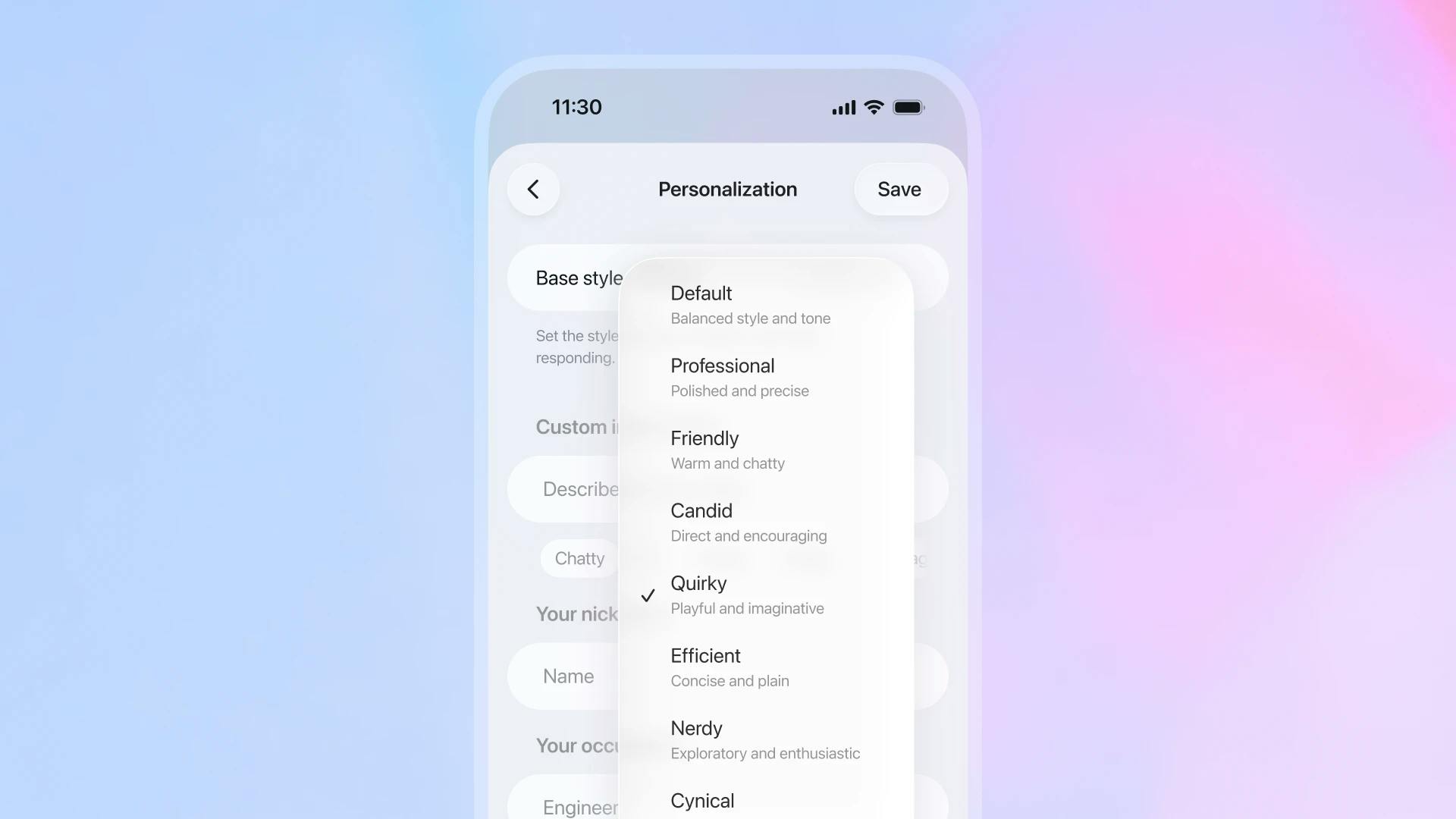
GPT-5.1 screenshot
(OpenAI)

OpenAI releases GPT 5.1, which can be “Professional,” “Candid,” or “Quirky”

The new “more conversational” model follows instructions better, but backslides on some safety tests.

Jon Keegan

Today OpenAI released GPT 5.1, an update that aims to make ChatGPT “more conversational.” The model comes in two versions: GPT-5.1 Instant (“now warmer, more intelligent, and better at following your instructions”) and GPT-5.1 Thinking (“now easier to understand and faster on simple tasks, more persistent on complex ones”).

Despite an earlier update this year that was rolled back due to being overly sycophantic, the new model responds in more chummy conversation that the company says “surprises people with its playfulness” in testing.

Users now have finer control over ChatGPT’s “personality,” with new settings for “Professional,” “Candid,” and “Quirky.”

In the model’s system card, OpenAI details how well the new 5.1 models compare to the earlier 5.0 models on internal benchmarks for disallowed content.

The company has said it is prioritizing the addition of new checks to help users who may be suffering a mental health crisis, after a series of alarming incidents where ChatGPT encouraged self-harm and reinforced delusional behavior.

Two new tests were included with this release for the first time: “mental health” and “emotional reliance.” GPT 5.1 Thinking actually scored slightly lower on 9 of 13 testing categories than its predecessor, GPT-5 Thinking, and GPT-5.1 Instant scored lower than GPT-5 Instant on 5 of 13 tests.

More thinking, more tokens

OpenAI says that GPT-5.1 Thinking now spends less time on simple tasks and more time on difficult problems. This is measured by the number of model-generated tokens (tiny bits of text). Based on a chart in the announcement, the very toughest queries handled by GPT-5.1 Thinking will use 71% more tokens to complete the query. That’s a lot more tokens, and a lot more computing!

All those tokens can add up. Every time OpenAI’s customer-facing models gobble up more computing cycles, it spends more on “inference,” or running the models (as opposed to the more resource-intensive training process that happens while building the models). When enterprise customers use OpenAI’s API to use the models, the customer pays by the token count, but free users using the chat interface do not.

As a private company, OpenAI’s finances aren’t public, but a new report from the Financial Times raises the question of how much all these “thinking” models are costing the company. While The Information recently reported that OpenAI spent $2.5 billion in the first half of 2025, AI skeptic, podcaster, and writer Ed Zitron told the FT he has seen internal OpenAI figures showing that OpenAI’s cash burn for the first half of the year was much higher — close to $5 billion.

To satisfy the $1 trillion in recent deals it has signed on to, OpenAI will need to find a way to generate more revenue.


More Tech

See all Tech
South by Southwest Conference and Festivals

Gold Tesla Cybercabs are piling up, but they’re not picking up passengers yet

Low-volume production started in April. Now people are noticing them more and more in the wild.

tech

Anthropic pulls Fable and Mythos access worldwide after Trump administration bars their use by foreign nationals

Only days after releasing two versions of its next-gen AI model, Anthropic has disabled them for users worldwide.

Anthropic says it received a Friday night order from the Trump administration to suspend access to the models for any foreign national (anywhere in the world) — a group that included some Anthropic employees. In response, the company turned off access to everyone.

Last week, the company released to the public its much-anticipated Claude Fable 5 model (and its restricted version Claude Mythos 5, which is still being tested with trusted partners). Anthropic said in a blog post announcing the action that officials cited national security concerns with the new models, while offering few specific details.

The post said that the government gave the company “verbal evidence of a potential narrow, non-universal jailbreak” of the public Fable 5 model. A jailbreak is a means by which users can evade restrictions built into the code to unlock prohibited functionality. Anthropic downplayed the significance of the attack, and said other major models, such as OpenAI’s GPT-5.5, could also be affected by the technique described.

Fears of these first Mythos-class models being misused are running high, after Anthropic warned the cybersecurity world in May that the advanced cyber capabilities of Mythos have rapidly discovered thousands of vulnerabilities in ubiquitous software, leading to the decision to restrict the full version of the model to a close group of trusted partners for testing.

This morning, Axios reported that Anthropic technical staff have flown to Washington to meet with White House officials to resolve the issue.

The Wall Street Journal is reporting that the Trump administration’s decision to take action against Anthropic was prompted by discussions that Amazon CEO Andy Jassy had with officials, including Treasury Secretary Scott Bessent. According to the report, Amazon researchers said they had been able to evade some of Fable 5’s security restrictions using specific prompts. Amazon is a major investor in Anthropic.

Anthropic is currently suing the US government to fight the Pentagon’s blacklisting of the company on national security grounds.

Last week, the company released to the public its much-anticipated Claude Fable 5 model (and its restricted version Claude Mythos 5, which is still being tested with trusted partners). Anthropic said in a blog post announcing the action that officials cited national security concerns with the new models, while offering few specific details.

The post said that the government gave the company “verbal evidence of a potential narrow, non-universal jailbreak” of the public Fable 5 model. A jailbreak is a means by which users can evade restrictions built into the code to unlock prohibited functionality. Anthropic downplayed the significance of the attack, and said other major models, such as OpenAI’s GPT-5.5, could also be affected by the technique described.

Fears of these first Mythos-class models being misused are running high, after Anthropic warned the cybersecurity world in May that the advanced cyber capabilities of Mythos have rapidly discovered thousands of vulnerabilities in ubiquitous software, leading to the decision to restrict the full version of the model to a close group of trusted partners for testing.

This morning, Axios reported that Anthropic technical staff have flown to Washington to meet with White House officials to resolve the issue.

The Wall Street Journal is reporting that the Trump administration’s decision to take action against Anthropic was prompted by discussions that Amazon CEO Andy Jassy had with officials, including Treasury Secretary Scott Bessent. According to the report, Amazon researchers said they had been able to evade some of Fable 5’s security restrictions using specific prompts. Amazon is a major investor in Anthropic.

Anthropic is currently suing the US government to fight the Pentagon’s blacklisting of the company on national security grounds.

tech

Tesla used skewed data in push for European FSD approval, Reuters finds

Tesla has used highly questionable safety stats in an effort to win over European regulators and rekindle sales in the region, according to a Reuters investigation.

Tesla reportedly pitched regulators in Sweden and the Netherlands with claims that its Full Self-Driving (FSD) tech is over 7x safer than human drivers. However, independent researchers told Reuters that the stats are misleading because Tesla compares airbag-deployment crashes involving FSD-equipped vehicles with much broader US crash statistics, while also benchmarking newer Teslas against the entire US vehicle fleet, which is significantly older on average.

Despite the flawed metrics, the Dutch regulator approved FSD in April, saying its decision was based on its own “tests, analyses and verifications,” and Tesla is now pushing for EU-wide clearance. A version of FSD is currently available in five European markets.

Despite the flawed metrics, the Dutch regulator approved FSD in April, saying its decision was based on its own “tests, analyses and verifications,” and Tesla is now pushing for EU-wide clearance. A version of FSD is currently available in five European markets.

tech
Rani Molla

Report: Microsoft weighs Xbox spin-off amid major overhaul

Microsoft is reportedly considering spinning out or restructuring its struggling Xbox unit, per The Information. While new Xbox CEO Asha Sharma, who took over in February, is preparing for layoffs, shes simultaneously planning to boost investment in its biggest franchises like “Halo,” “Fallout,” and “Minecraft.”

The latest potential shake-up comes as the gaming division battles major headwinds, following a massive 33% plunge in Q3 console sales and a recent move to slash Game Pass prices while removing new Call of Duty titles.

The latest potential shake-up comes as the gaming division battles major headwinds, following a massive 33% plunge in Q3 console sales and a recent move to slash Game Pass prices while removing new Call of Duty titles.

Latest Stories

Sherwood Media, LLC and Chartr Limited produce fresh and unique perspectives on topical financial news and are fully owned subsidiaries of Robinhood Markets, Inc., and any views expressed here do not necessarily reflect the views of any other Robinhood affiliate, including Robinhood Markets, Inc., Robinhood Financial LLC, Robinhood Securities, LLC, Robinhood Crypto, LLC, Robinhood Money, LLC, Robinhood U.K. Ltd, Robinhood Derivatives, LLC, Robinhood Gold, LLC, Robinhood Asset Management, LLC, Robinhood Credit, Inc., Robinhood Ventures DE, LLC and, where applicable, its managed investment vehicles.
