Tech
Meta Connect developer conference
Mark Zuckerberg (Andrej Sokolow/Getty Images)
ZUCK BUCKS

How much money do Facebook, Instagram, Reddit, Pinterest, and Snapchat make from you?

Most social media platforms squeeze a few bucks a month out of users — Meta’s ability to monetize your scrolling is on a completely different level.

David Crowther

We’ve all been on the internet long enough to know that when the product is free, you are the product. Some people are understandably very angry about Big Tech hoarding our data to prey on our conscious (or more commonly our subconscious) insecurities and desires. Most of us don’t care enough to stop.

But how much is your doomscrolling actually worth to the Mark Zuckerbergs and Evan Spiegels of the world? That answer, of course, depends on a few key factors.

Users from lower-income countries tend to be a lot less valuable to advertisers. But which platform you’re on matters a lot, too. Just this week, Reddit said its revenue was booming thanks to AI-powered ads. Pinterest shares, meanwhile, are sinking this morning on the exact opposite — AI’s influence underwhelmed investors. At Snap, it was the same story, with shares diving 17% on Wednesday as the company is somehow barely growing while its peers leap forward.

For all three of those companies, the average revenue per active user (ARPU) was about $2.40 to $2.80 a month for a user in the US or North America. (They define their geographies slightly differently.) So, not a whole lot to split them.

But what about Meta?

Mark Zuckerberg’s social media giant is a little harder to pin down, after it inconveniently decided to stop splitting out its daily active users by geography. But, based on our best estimate that it has 250 million daily active users in the US and Canada (more on this below), combined with the fact that Meta reported $20 billion in ad revenue in the US and Canada, implies that the typical Meta user is worth somewhere around 10x as much: about $26 and change.
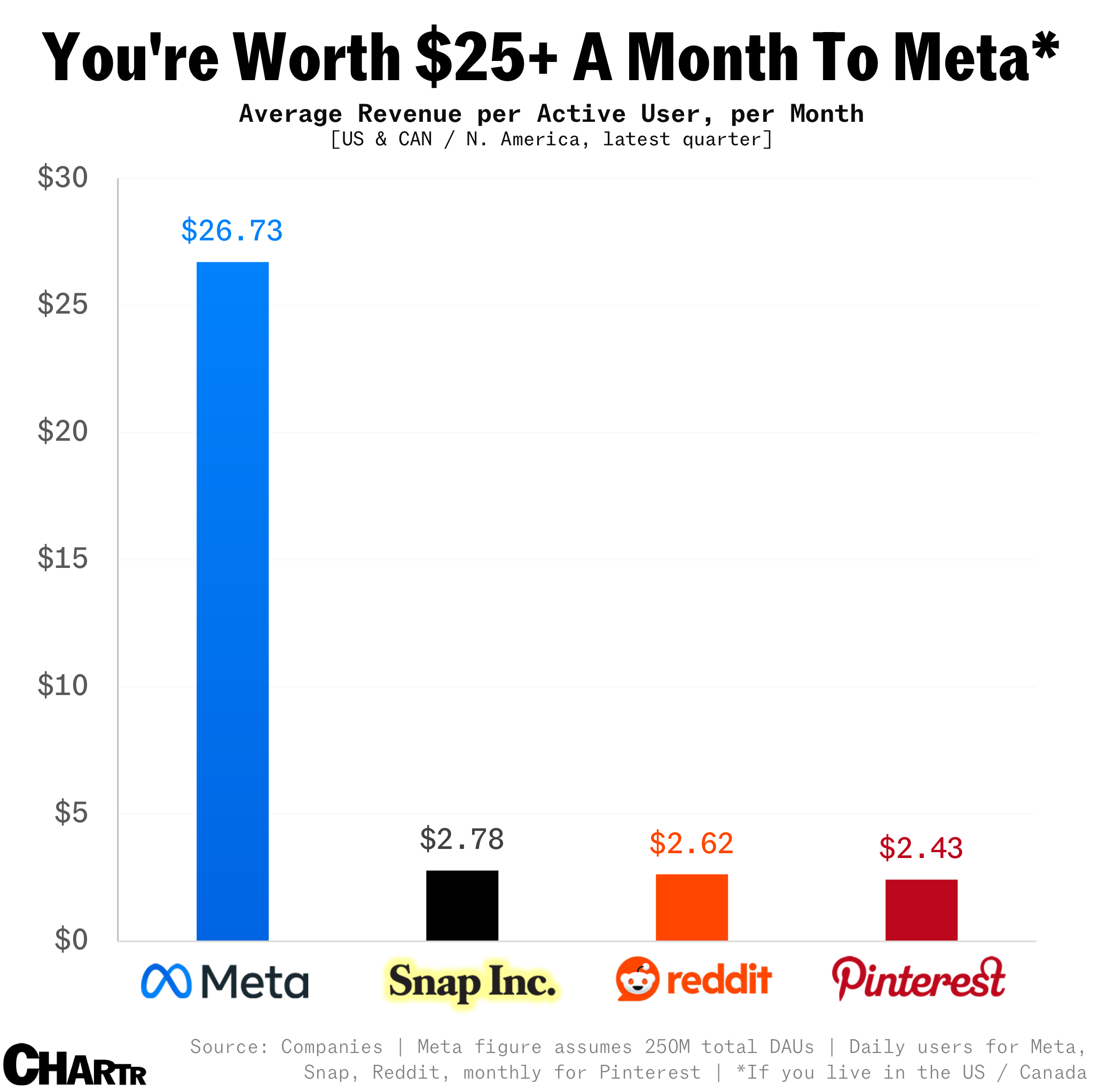
Meta average revenue per user
Sherwood News

Put another way, Meta is making more money from you than Netflix charges for its most expensive tier ($24.99).

Of course, Meta does have both Facebook and Instagram to monetize your eyeballs, but even if we split the figure in half, it’s miles ahead of its peers.


Napkin math-ing Meta’s DAUs

So, Meta doesn’t tell us exactly how many unique daily active users it has in the US and Canada — but we can make a decent guess based on a few facts we do have.

Per a filing for the last quarter of 2023, the company said it had 205 million daily active Facebook users in the US and Canada. That number had been growing in the quarters previous to it.
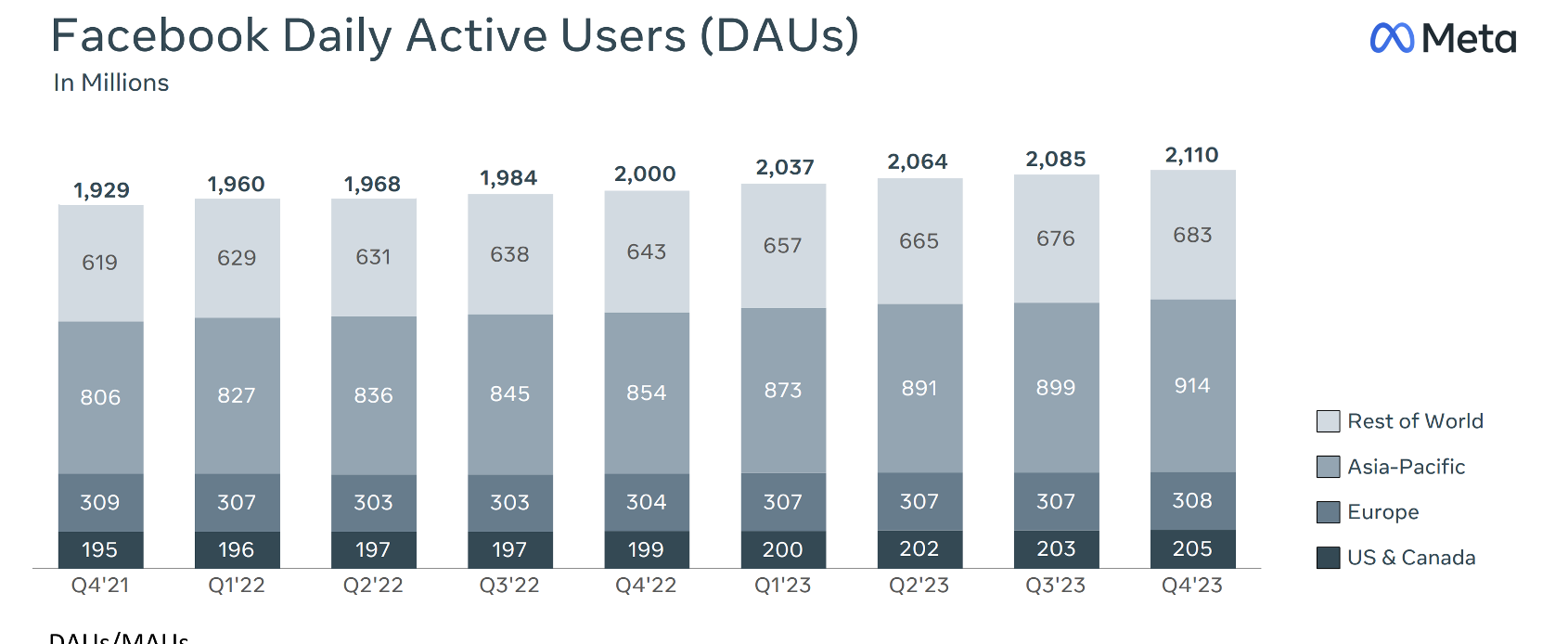
Facebook DAUs
Facebook

Now, we could charitably say that those figures were likely to continue growing. However, companies tend to like showing things when numbers are going up, so the fact Meta no longer discloses them gives some weight to the idea that it might have gone backwards since. Also, with 205 million active users, there just can’t be that many adults left in the US and Canada who have internet access and aren’t yet on Facebook. So, let’s say that the Facebook figure has stayed broadly flat at 205 million.

Now we need to account for Instagram. Or, more specifically, the daily active Instagram users that aren’t already included in the Facebook figure.

Per a Pew Research survey from last year, the number of people who say they use Instagram has been rising, but is still below Facebook overall, with ~50% of US adults saying they use Instagram.

Given that we knew Facebook had 205 million DAUs at a similar time to when 68% of people told Pew they used Facebook, we can make an educated guess that there might be ~150 million Instagram DAUs in the US and Canada. (Here we’re assuming a fair amount about the relative uptakes of both and placing a lot of weight on the Pew survey, but intuitively it feels broadly correct, and is in the ballpark of other estimates.)

Now, assuming there’s a decent amount of overlap — say, 70% — between the two services (some estimates suggest it might be as high as 80%, but gut feeling tells us that younger users don’t want to be seen dead on Facebook, so that feels a little high) and we arrive at our final figure: an incremental ~45 million DAUs.

Put it all together and we’re estimating that Meta has 250 million unique daily active users in the US and Canada.

Let’s sense check that: there are about 265 million adults in the US, and another ~35 million in Canada, so ~300 million in total. Our math suggests that about 80% to 85% of those use a Meta platform every day.


More Tech

See all Tech
tech

FT: Meta considering “tens of billions” in new capital to fund AI

Just days after Google announced a monster $85 billion upsized equity raise, the extremely profitable Meta is seeking to sell “tens of billions of dollars” in stock, according to a new report from the FT.

Meta is planning on spending between $125 billion to $145 billion on AI capex this year alone.

Shares dropped more than 5% on the news.

tech

FT: Anthropic staff helping the NSA use Mythos for offensive cyberattacks

Anthropic’s Mythos AI model was deemed too dangerous to release to the public, with the company citing its ability to orchestrate novel cyberattacks.

And that’s just what the National Security Agency is doing, with the help of Anthropic staff embedded at the agency, according to a report from the Financial Times.

Only a small number of companies and US allies have been given access to the advanced model, which means America’s adversaries have not had the chance to shore up their defenses against the AI model’s new offensive capabilities.

The arrangement is especially unusual as the Pentagon has deemed Anthropic’s AI a national security supply chain risk — effectively blacklisting it for defense work — in response to the company’s refusal to allow its technology to be used for any legal application, which could include autonomous killing or mass surveillance. Anthropic is currently suing the US government to fight the determination.

Only a small number of companies and US allies have been given access to the advanced model, which means America’s adversaries have not had the chance to shore up their defenses against the AI model’s new offensive capabilities.

The arrangement is especially unusual as the Pentagon has deemed Anthropic’s AI a national security supply chain risk — effectively blacklisting it for defense work — in response to the company’s refusal to allow its technology to be used for any legal application, which could include autonomous killing or mass surveillance. Anthropic is currently suing the US government to fight the determination.

tech

Longtime Tesla bear JPMorgan upgraded Tesla and raised its price target to $475 from $145

For more than a decade, JPMorgan was Wall Streets most stubborn Tesla skeptic, anchored by auto analyst Ryan Brinkman’s strict focus on traditional car fundamentals and near-term delivery numbers.

But JPM recently handed coverage of the stock to a new analyst, Rajat Gupta, who is throwing that playbook out the window. In a note Friday, the firm upgraded Tesla to neutral from underweight and raised its price target 228% to $475 from $145. (The analyst consensus on FactSet is $403.) Instead of focusing on the company’s struggling vehicle business, the new analyst is orienting himself more toward Tesla’s idea of the future, now modeling Tesla’s physical AI and robotaxi fleets all the way out to the year 2040.

Here are the main reasons for the capitulation:

  • Looking past the car lot: Gupta argues that Tesla is at the forefront of physical AI, entering uncharted TAMs” and therefore deserves the benefit of the doubt to be valued on LT earnings potential rather than near-term speed bumps.

  • Unmatched vertical integration: Teslas control over everything from battery cells to custom silicon gives it a massive moat. JPM notes this starting point advantage is unmatched at an industrial level scale” and “still somewhat under-appreciated and misunderstood.

  • The AWS flywheel effect: Deploying Optimus robots inside its own factories should not only lower COGS for the base automotive business, but more importantly, help validate the product at an industrial scale.” Gupta called it “a classic flywheel effect, somewhat analogous to AWS and Kiva at AMZN.

For Tesla bulls who have argued for years that this is an AI company and not a carmaker, JPM’s sudden $3.9 trillion valuation model is the ultimate validation.

skynet terminator

Anthropic ponders self-improving AI

Anthropic says Claude already writes 80% of its code. A new post asks what happens when the models can improve themselves — and whether anyone could stop them.

Latest Stories

Sherwood Media, LLC and Chartr Limited produce fresh and unique perspectives on topical financial news and are fully owned subsidiaries of Robinhood Markets, Inc., and any views expressed here do not necessarily reflect the views of any other Robinhood affiliate, including Robinhood Markets, Inc., Robinhood Financial LLC, Robinhood Securities, LLC, Robinhood Crypto, LLC, Robinhood Money, LLC, Robinhood U.K. Ltd, Robinhood Derivatives, LLC, Robinhood Gold, LLC, Robinhood Asset Management, LLC, Robinhood Credit, Inc., Robinhood Ventures DE, LLC and, where applicable, its managed investment vehicles.