
Personal Finance
Home price to income graph

The American Dream is getting really expensive

Homeownership increasingly requires a $100k+ annual income

Curbed appeal

As wage growth struggles to keep pace with home price inflation, buying a house has felt increasingly out of reach for millions of Americans recently — a trend that’s been ongoing for the last 3+ decades.

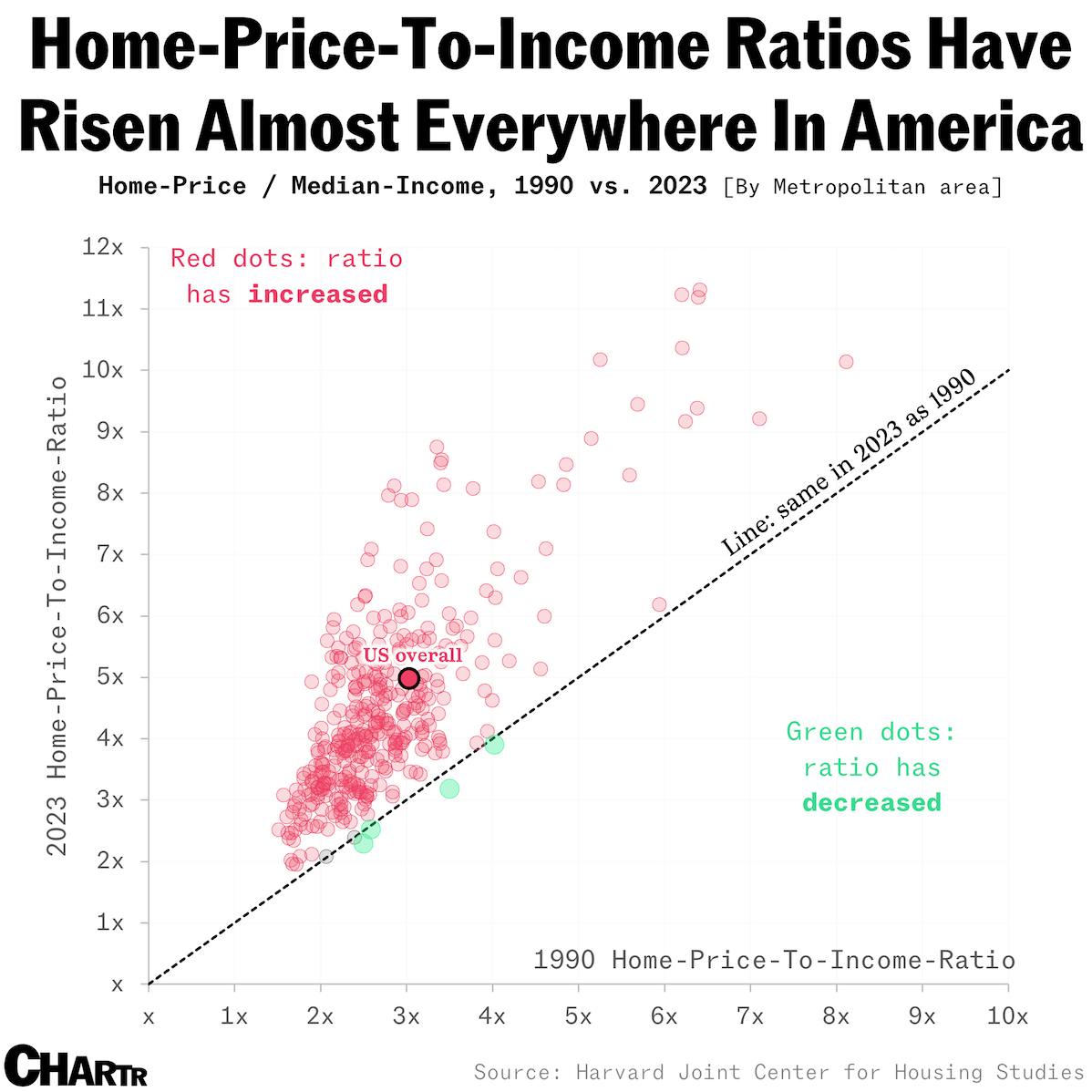
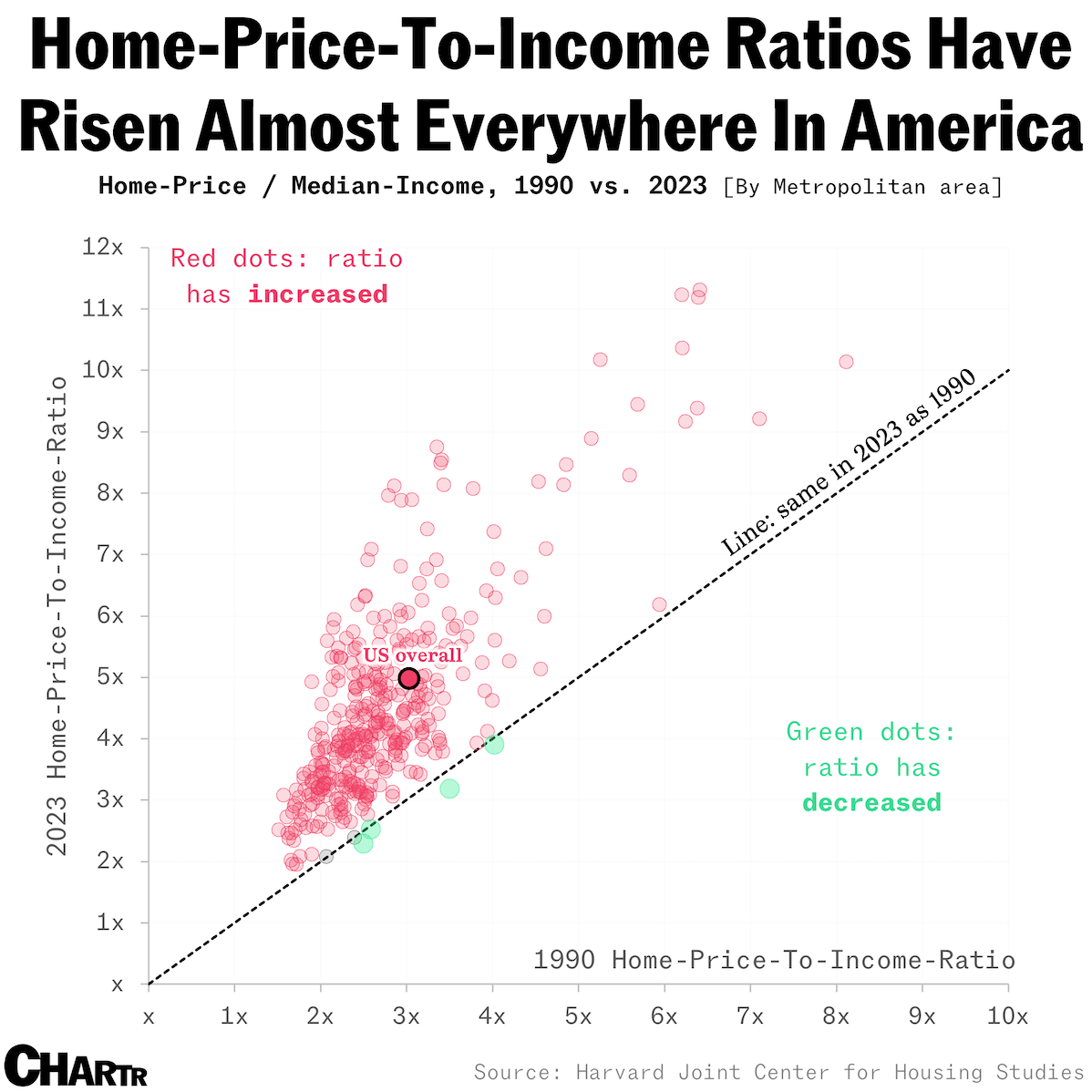
Indeed, in 2023, a typical home in America will cost buyers 4.9x the median income. That’s a 50%+ increase on the 3.1x price-to-income ratio averaged in 1990 and only slightly below the record figure set in 2022, according to new analysis from the Harvard Joint Center for Housing Studies.

Furthermore, this is a phenomenon that’s happening almost everywhere: a whopping 378 out of the 384 American Metropolitan areas (98.4%) that Chartr analyzed from the Harvard report saw rises between 1990 and 2023. Just 2 areas reported a home-price-to-median-income ratio that was the same as in 1990 and only 4 reported a drop.
home-price-income-ratios-newsletter-min

Inflation continues to be the factor in how Americans perceive the economy — and the cost of houses is a major factor in that sentiment. Across the US, home prices have surged by 47% since the start of 2020 and have more than doubled since 2010, based on data from the NAR cited in the report.

While new-home construction has fallen to a 4-year low, there’s also fewer existing homes entering the market. Rising interest rates have created a "golden handcuff" effect, discouraging homeowners from selling and taking on new, more expensive mortgages. Additionally, more homes are owned by older generations who are less likely to move. This has all culminated in a stark reality: you now need an annual income of $100,000 to afford a median-priced home in nearly half of all metro areas.

As for renters? The majority of them are already declaring the American Dream of homeownership dead.

More Personal Finance

See all Personal Finance
personal-finance

Ahead of Mother’s Day, Google searches for “same day flower delivery” have ticked up a little earlier this year

If you’ve already made plans for a Mother’s Day gift in advance of this Sunday, congratulations. But if alarm bells are suddenly ringing, consider this a gentle reminder that, like a sizable share of the US population this time of year often does, you can still scrape together some last-minute flowers for the woman who carried you for nine months.

Data from Google Trends reveals that searches for “same day flower delivery” spike in the US in May every year, when Mother’s Day takes place. As we noted last February, the same query also gains traction around Valentine’s Day.

Flower
Sherwood News

This year, however, it appears that searches for last-minute flowers have remained elevated in the last two months after the usual peak in February — with the search interest this April actually exceeding that seen around Cupid’s Day.

Honestly, we’re not sure why searches are spiking a little early. One explanation might be that Passover and Easter have overlapped at the start of April, and Americans wanted to celebrate with some flowers. Maybe it’s a host of Claude bots that are now running errands for AI-obsessed execs — or perhaps Americans are just impulse-buying some seasonal spring blooms after an unusually warm March, without a particular occasion.

Graduate holding scroll and wearing robe, standing with parents

Which US cities give new grads the best shot in 2026?

The ideal place to start a career might be less about prestige and more about where the paycheck stretches furthest.

Latest Stories

Sherwood Media, LLC and Chartr Limited produce fresh and unique perspectives on topical financial news and are fully owned subsidiaries of Robinhood Markets, Inc., and any views expressed here do not necessarily reflect the views of any other Robinhood affiliate, including Robinhood Markets, Inc., Robinhood Financial LLC, Robinhood Securities, LLC, Robinhood Crypto, LLC, Robinhood Money, LLC, Robinhood U.K. Ltd, Robinhood Derivatives, LLC, Robinhood Gold, LLC, Robinhood Asset Management, LLC, Robinhood Credit, Inc., Robinhood Ventures DE, LLC and, where applicable, its managed investment vehicles.