
Personal Finance
Three Men Locked Behind Bars
(Getty Images)
subjugation

Forget fatigue — we’re now in the age of “subscription captivity,” per the WSJ

Could the Netflix-WBD deal tighten streaming’s stranglehold further?

Tom Jones

For many of us, monthly charges for services that let us enjoy free delivery from our favorite retailers, watch thousands of movies and shows, listen to millions of songs (and then get told how old our taste makes us), stay up to date with the latest news, and literally keep us fed have become second nature.

Whether we’re happy about it is, of course, a different point entirely. However, according to a Wall Street Journal article over the weekend, we don’t exactly have much choice in the matter, graduating from a collective sense of subscription fatigue to “subscription captivity,” wherein “we aren’t just overwhelmed. We’re locked in.” 

Nowhere is this more true than in the world of TV and film, even before Netflix’s blockbuster $83 billion deal for Warner Bros. Discovery’s studio and streaming businesses threatened to upend the industry as we know it.
Top subscription services chart
Sherwood News

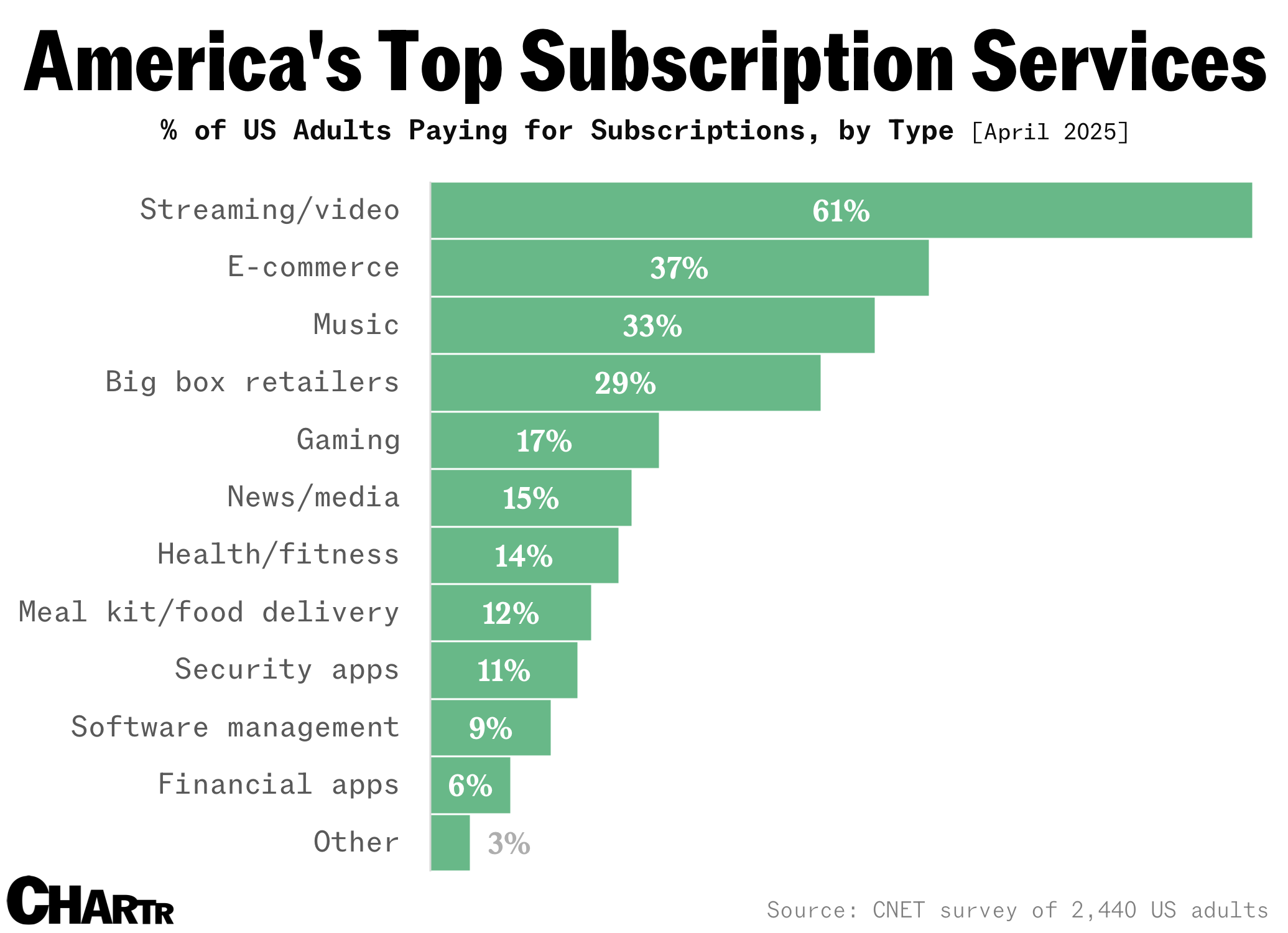
If the buyout does break through the wall of opposition it now faces — with even the president having weighed in to say the deal “could be a problem” — the lure of having the platforms’ combined content mega-libraries under one roof could help boost the share of Americans who pay for streaming/video subscriptions, which currently sits at 61% per an April CNET survey conducted by YouGov.

While that figure might seem low (looking at you, people who still sign in to their parents’/friends’/ex’s account), it still makes streaming services the biggest subscription category in 2025, ahead of e-commerce and music platforms. CNET found that four in five Americans had paid for a subscription service in the last 12 months, spending an average of $90 each month, though Gen Z and millennials had both pared back their outlays.

More Personal Finance

See all Personal Finance
personal-finance

Ahead of Mother’s Day, Google searches for “same day flower delivery” have ticked up a little earlier this year

If you’ve already made plans for a Mother’s Day gift in advance of this Sunday, congratulations. But if alarm bells are suddenly ringing, consider this a gentle reminder that, like a sizable share of the US population this time of year often does, you can still scrape together some last-minute flowers for the woman who carried you for nine months.

Data from Google Trends reveals that searches for “same day flower delivery” spike in the US in May every year, when Mother’s Day takes place. As we noted last February, the same query also gains traction around Valentine’s Day.

Flower
Sherwood News

This year, however, it appears that searches for last-minute flowers have remained elevated in the last two months after the usual peak in February — with the search interest this April actually exceeding that seen around Cupid’s Day.

Honestly, we’re not sure why searches are spiking a little early. One explanation might be that Passover and Easter have overlapped at the start of April, and Americans wanted to celebrate with some flowers. Maybe it’s a host of Claude bots that are now running errands for AI-obsessed execs — or perhaps Americans are just impulse-buying some seasonal spring blooms after an unusually warm March, without a particular occasion.

Graduate holding scroll and wearing robe, standing with parents

Which US cities give new grads the best shot in 2026?

The ideal place to start a career might be less about prestige and more about where the paycheck stretches furthest.

Latest Stories

Sherwood Media, LLC and Chartr Limited produce fresh and unique perspectives on topical financial news and are fully owned subsidiaries of Robinhood Markets, Inc., and any views expressed here do not necessarily reflect the views of any other Robinhood affiliate, including Robinhood Markets, Inc., Robinhood Financial LLC, Robinhood Securities, LLC, Robinhood Crypto, LLC, Robinhood Money, LLC, Robinhood U.K. Ltd, Robinhood Derivatives, LLC, Robinhood Gold, LLC, Robinhood Asset Management, LLC, Robinhood Credit, Inc., Robinhood Ventures DE, LLC and, where applicable, its managed investment vehicles.