
Markets
Businessman Wondering How Low It Can Go
Getty Images
Weird Money

We're in a godawful vintage for venture funds

Data from Carta shows that venture funds launched in 2021 and 2022 are struggling.

Jack Raines

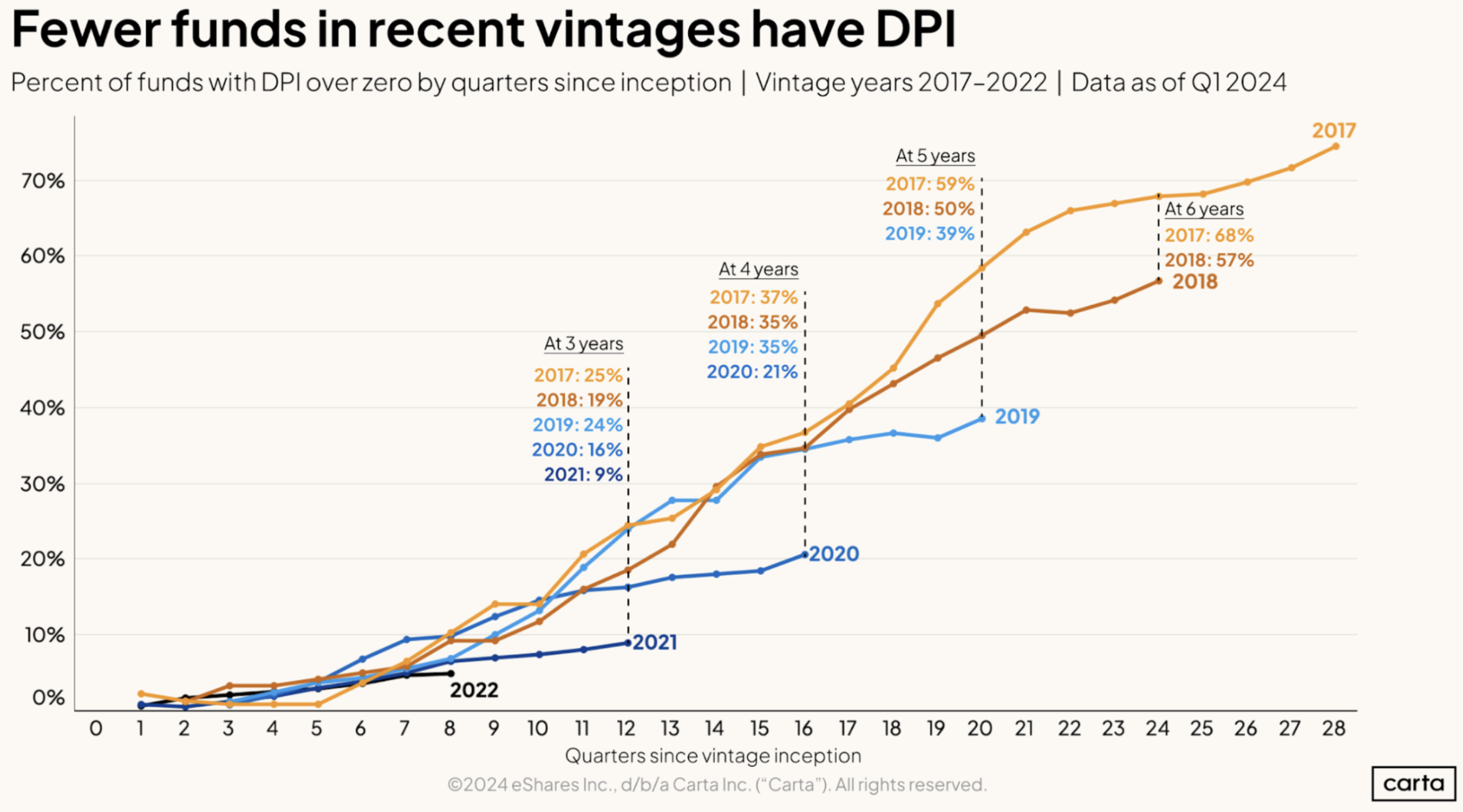
Equity management platform Carta published a detailed report on the state of venture capital through Q1 2024, and the results show that funds launched in 2021 and 2022 are not having a great time. Check these two slides from their report showing median internal rate of return (IRR) and distribution to paid-in capital (DPI) for different vintages over time:
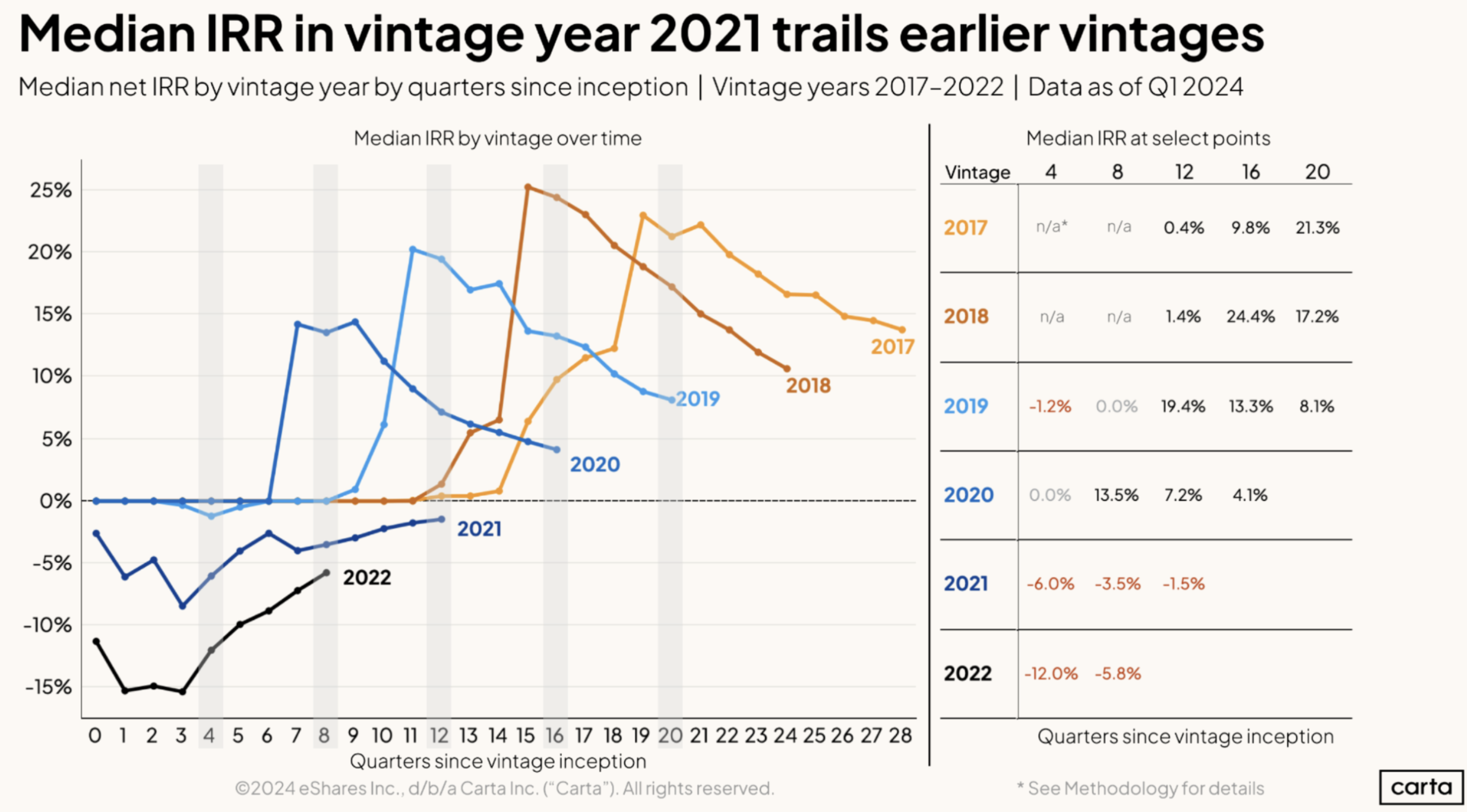
Median IRR Carta
Median DPI Carta

IRR, which is one of the most commonly used performance metrics in venture, measures the returns of a fund while accounting for the time value of cash flows. Through 12 quarters, the median IRR of 2021 funds is negative, while the median IRR for the previous four vintages over the same time period was positive.

The median DPI for 2021 funds is even worse. DPI is the ratio of capital paid out to investors vs. what they invested, and through three years, 2021’s median DPI of 9% is less than half of the median DPI for 2017-2019 funds, and seven percentage points off from 2020.

The TL;DR is that younger funds are underperforming their predecessors by a wide margin.

Why the underperformance, and what does it all mean?

First, the 2021 market was hot, with the exit value in the US VC market hitting a record $797 billion. Thanks to a hot market, it was easier than ever to raise new VC funding, a record $128.3 billion in new venture funding was raised in the US, and 270 first-time funds were launched, the highest number in the last decade.

However, valuations and deal volume collapsed beginning in 2022 as the fed began raising interest rates, with exit value in the US venture market falling from its $797 billion peak in 2021 to just $61.5 billion in 2023. As valuations collapsed, many startups needing new funding were forced to raise down rounds, or funding rounds at lower valuations, and Carta noted that in Q1 2023, almost 20% of all venture investments were down rounds, vs. 5% of deals in 2022.

While funds raised prior to 2021 benefited from high-priced exits in a hot market, funds that launched in 2021 and 2022 have seen their returns struggle as they began deploying capital at market peaks. The biggest losers of this trend are the first-time funds who raised in 2021. While mature firms, who likely exited positions at the market high of 2021, can point to their multi-year track records when raising new funds, first-time venture funds are being judged on their current funds’ performances. Limited partners who invest in first-time venture funds want to see returns before committing to a new fund, and, unless returns improve for 2021 and 2022 funds, many of these first-time funds will struggle to raise new funding in the future.

More Markets

See all Markets
markets

SpaceX gets a wave of bullish ratings from Wall Street analysts

SpaceX received more than a dozen positive analyst calls on Tuesday — including from major Wall Street banks — as they initiate coverage on Elon Musk’s space and AI company.

SpaceX went public on June 12 at a $2.2 trillion valuation, the largest debut in history. While the company hasn’t yet posted a profit, it seems to have convinced Wall Street that it will get there and grow its valuation on the way.

Of the at least 17 analysts that gave a rating on Tuesday, all but one gave it a “buy” or “outperform” rating. MoffettNathanson was "neutral."

The ratings come as SpaceX joined the Nasdaq 100 index, a benchmark tech-heavy basket of companies that underpins millions of portfolios. The inclusion adds built-in demand for the stock from index funds and ETFs.

Still, SpaceX fell more than 5% on Tuesday amid a broader sell-off, and is currently effectively flat from its opening price of $150 a share.

markets

Nike sinks to lowest level since 2014 after warning of “challenged” sales environment in Q4 report

Did Nike do it?

Investors had a mixed reaction after the global sports apparel company reported its fourth quarter earnings on Tuesday after the bell. Shares initially rose 5% as Nike beat out Wall Street expectations amid a hefty tariff refund bonus. However, the stock then sank to its lowest level since August 2014 in postmarket trading.

Here are the Q4 numbers:

  • Revenue of $11.0 billion (estimate: $10.8 billion).

  • Adjusted earnings per share of $0.20 (estimate: $0.12).

Ahead of this report, Nike warned that results would be flattered by a one-time tariff refund (now estimated at roughly $0.52 per share for the bottom line). That gave the company an extra cushion in snapping its streak of seven quarters of year-over-year profit declines.

Over the past year, the company had been punished by tariffs on imported goods, stagnant consumer spending, and increasing competition from other footwear brands like New Balance, Adidas, and Hoka.

Outgoing CFO Matthew Friend deemed it an “increasingly challenging operating environment, where sell-through remains challenged.”

Latest Stories

Sherwood Media, LLC and Chartr Limited produce fresh and unique perspectives on topical financial news and are fully owned subsidiaries of Robinhood Markets, Inc., and any views expressed here do not necessarily reflect the views of any other Robinhood affiliate, including Robinhood Markets, Inc., Robinhood Financial LLC, Robinhood Securities, LLC, Robinhood Crypto, LLC, Robinhood Money, LLC, Robinhood U.K. Ltd, Robinhood Derivatives, LLC, Robinhood Gold, LLC, Robinhood Asset Management, LLC, Robinhood Credit, Inc., Robinhood Ventures DE, LLC and, where applicable, its managed investment vehicles.

