
Markets
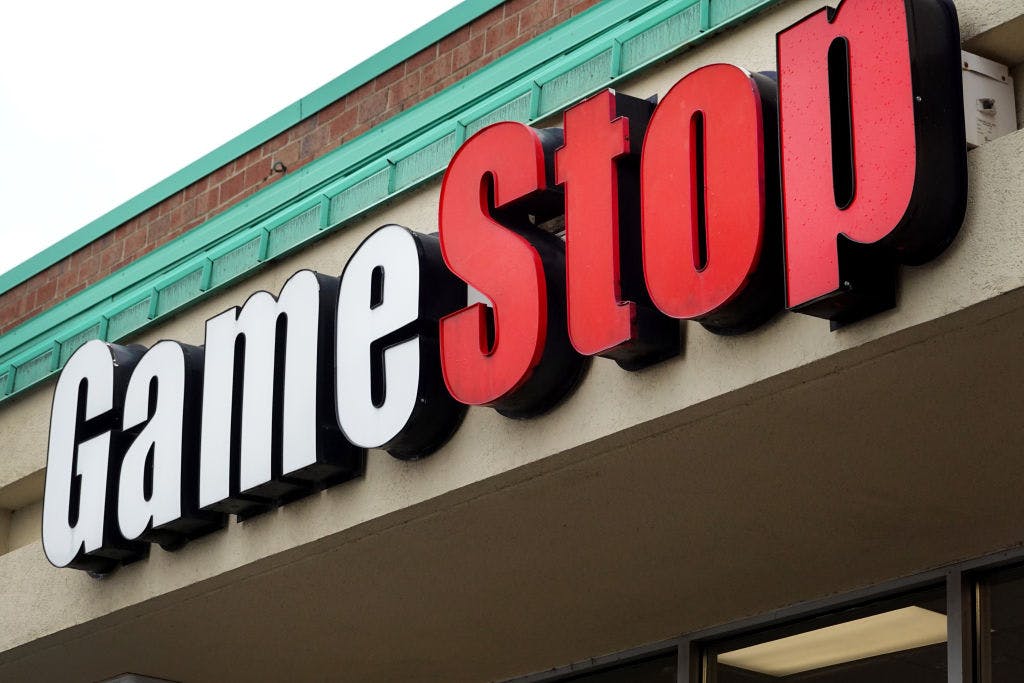
GameStop signage
(Getty Images)
Same Strategy, different outcome

Why copying Strategy’s playbook isn’t working for GameStop

Buying bitcoin is an arbitrage play for Strategy that lets management take advantage of the elevated valuation of its shares. For GameStop, it’s something that puts the source of its premium valuation at risk.

Luke Kawa

GameStop is doing the exact same thing as Strategy: issuing convertible notes to (presumably) buy bitcoin.

Yet the tactic that’s seemingly worked so well for Strategy CEO Michael Saylor isn’t working for GameStop CEO Ryan Cohen, based on the stock’s tumble after Wednesday’s announcement.

What’s the difference here?

Well, as my former colleague Jack Raines explained, (then Micro)Strategy has had a huge incentive to raise capital to buy bitcoin. The market ascribes a much higher value to the stock than the value of its underlying bitcoin holdings. And it’s not like the underlying business is doing much to justify that — revenues have been flat to down over the past decade. To oversimplify, as long as this massive premium exists, Strategy can reasonably say that it’s selling high (on its stock) and buying low (in bitcoin), regardless of the price of the cryptocurrency.

On the other hand, GameStop already has an asset on its balance sheet that investors are ascribing huge value to: its cash. We can tell this because the company’s book value per share soared after capital raises in 2024 amid the meme stock mania, and has remained very elevated thereafter. Cash, equivalents, and short-term investments currently make up about 80% of GameStop’s assets, which is the numerator in book value per share.

“GameStop is following the MicroStrategy playbook, but MicroStrategy currently trades at less than 2x the value of its Bitcoin holdings,” wrote Wedbush analyst Michael Pachter, who has an “underperform” rating and $11.50 price target on the stock. “With GameStop already trading at more than 2x its cash holdings it is unlikely that its conversion of cash into Bitcoin will drive an even greater premium.”

While on the surface, this capital raise will increase GameStop’s cash, it’s not a sure bet that this ultimately nets out that way. For starters, let’s assume some cash is turned into bitcoin. Then, remember that holders of these notes will either end up getting their cash back or diluting existing shareholders.

Buying bitcoin is an arbitrage play for Strategy that lets management take advantage of the elevated valuation of its shares. For GameStop, it’s something that puts the source of its premium valuation at risk.

At the same time GameStop was able to raise a lot of cash, the market ascribed a much higher value to that cash. The thinking here was that Cohen would pull off some kind of transformative acquisition that would reinvigorate the company’s future prospects. To quote well-known GameStop bull Keith Gill, “It becomes a bet on the management, in particular, of course, Ryan fucking Cohen.”

Since then, I’d argue Cohen has displayed some operational prowess — just look at the company’s fourth-quarter operating income. But that’s come by making the retailer leaner and less inefficient, rather anything resembling a successful growth strategy.

“We find it hard to understand why any investor would be pay more than 2x cash value for the potential for GameStop to convert that cash into Bitcoin, particularly since the same investors can invest in Bitcoin or a Bitcoin ETF themselves,” Pachter added.

The conclusion here is that traders were simply hoping that whatever Cohen used that cash for, it would be a better investment opportunity than bitcoin.

More Markets

See all Markets
markets

Energy stocks follow oil lower as Strait of Hormuz set to reopen

Oil names including Occidental Petroleum, Marathon Petroleum, CF Industries, Devon Energy, Phillips 66, ConocoPhillips, Exxon, and Chevron are all ticking lower on Monday, following oil itself, after the US and Iran agreed to strike a deal to end a conflict that has pushed energy stocks up in recent months.

Alongside the countries both declaring the end of their military operations, US President Donald Trump said on Sunday that the Strait of Hormuz would be opened when the agreement is signed in Switzerland on Friday, writing on Truth Social, “Ships of the World, start your engines. Let the oil flow!

Let the oil flow?

Vessel traffic through the Strait of Hormuz, however, remains largely unchanged since the announcement of the peace deal on Sunday, per crossing data tracked by AIS. With the exception of some smaller vessels and prearranged crossings, shipowners are likely waiting for the planned signing on Friday and further confirmation from the Iranian side before attempting transits.

Analysts at the Baltic and International Maritime Council said that they “still consider it very risking for ships to commence transits” through Hormuz, adding that they “expect it will take several weeks for all [trapped] ships to leave” in a conversation with CNN.

US-POLITICS-DIPLOMACY

Stocks soar as US and Iran reach deal to open Strait of Hormuz, end the war

The details of the framework for peace are not yet available.

markets

AMD shares climb on double Citi upgrade to “buy” with $575 price target

AMD’s shares are rising in premarket trading following a double upgrade from Citi. Citi analyst Atif Malik raised AMD’s investment rating to “buy” from “neutral” and boosted the bank’s 12-month price target to $575 from $460 per share, per Barron’s.

Malik argued that the broader market currently misprices AMD by looking at it primarily as a CPU producer, underestimating its massive GPU potential. Citi says that AMD is uniquely “poised to win the lion’s share” of Meta’s customized graphics chip business. Meta is leaning into AMD’s custom MI450 chips, which deliver a lower total cost of ownership compared to buying traditional off-the-shelf merchant hardware, according to Investing.com.

Citi highlighted a massive multiyear deal between the two tech giants involving a 160 million-share common stock warrant. As the first phase ramps up through 2027, Citi expects each gigawatt of data center infrastructure to translate into roughly $15 billion in revenue. Consequently, Citi hiked its 2027 AMD AI sales forecast to $33 billion (up 137% year over year) and projects GPU sales to reach $50.8 billion by 2028.

CEO Lisa Su recently delivered an optimistic demand forecast, predicting that the global market for CPUs will grow by more than 35% annually over the next five years. The chipmaker delivered a robust Q1 earnings report back in May that beat Wall Street expectations across key data center segments.

markets

Astera Labs, CoreWeave, Nebius, Rocket Lab, Teradyne rise on Nasdaq 100 Index inclusion announcement

Tech stocks Astera Labs, CoreWeave, Nebius, Rocket Lab, and Teradyne have risen as much as 8.9% in premarket trading on Friday, thanks in part to Nasdaq’s announcement that the five companies will join its flagship Nasdaq 100 Index starting June 22.

As part of the index operator’s quarterly rebalance, which affects some $1.4 trillion in assets within the Nasdaq 100 ecosystem, the companies will replace Charter, Zscaler, Cognizant, Insmed, and Verisk — relatively slow-growth legacy businesses that have lingered around the bottom of the index in market cap terms of late. Most of those stocks slipped slightly on the news.

With CoreWeave and Nebius as two of the major players in the neocloud space, and Astera Labs and Teradyne specializing in making AI hardware and semiconductors, the latest additions reflect how the index is upping its exposure to the AI infrastructure stack. Back in December, Nasdaq also added AI data storage names Seagate Technology Holdings and Western Digital, as well as AI server manager Monolithic Power Systems, as part of its quarterly rebalance.

markets
Jon Keegan

Adobe beats on Q2 earnings, revenue; CFO to step down

Adobe reported fiscal Q2 results Thursday, beating analysts’ estimates for revenue and earnings, as its stock plumbed its lowest levels since 2019.

For Q2 2026, the creative software company posted:

  • Revenues of $6.62 billion (estimate: $6.45 billion).

  • Adjusted earnings per share of $5.96 (estimate: $5.82).

  • Annual recurring revenue of $27.1 billion (estimate: $26.6 billion).

  • Subscription revenue of $6.42 billion (estimate: $6.27 billion).

  • Remaining performance obligations of $22.27 billion (estimate: $21.86 billion).

The company also said its CFO, Dan Durn, would step down next week “to pursue a new professional opportunity.” And it boosted its full-year guidance for earnings and revenue.

Shares fell 5.5% in after-hours trading.

Adobe is feeling the pressure from AI, as the April release of Anthropic’s Claude Design threatens the company’s core design software business. Shares have tanked lately, with the stock down by nearly half over the past 12 months, putting it at levels not seen in years.

Last quarter, Adobe announced that CEO Shantanu Narayen, who had been at the company for 18 years, would be leaving after his successor was appointed. Today, Adobe announced that CFO Dan Durn would also be leaving the company — this month.

Adobe announced a $25 billion stock buyback in April, which gave the stock a boost. The company said it repurchased about 8.5 million shares during the quarter.

In a press release, Narayen said:

“Adobe delivered record revenue of $6.62 billion in Q2 reflecting strong AI-driven demand across our customer groups and we are raising our full-year fiscal 2026 revenue and non-GAAP EPS targets on the strength of that performance.”

Latest Stories

Sherwood Media, LLC and Chartr Limited produce fresh and unique perspectives on topical financial news and are fully owned subsidiaries of Robinhood Markets, Inc., and any views expressed here do not necessarily reflect the views of any other Robinhood affiliate, including Robinhood Markets, Inc., Robinhood Financial LLC, Robinhood Securities, LLC, Robinhood Crypto, LLC, Robinhood Money, LLC, Robinhood U.K. Ltd, Robinhood Derivatives, LLC, Robinhood Gold, LLC, Robinhood Asset Management, LLC, Robinhood Credit, Inc., Robinhood Ventures DE, LLC and, where applicable, its managed investment vehicles.

