
Markets
Federal Reserve Chair Jerome Powell Testifies Before The House Financial Services Committee
Fed Chair Jay Powell smiles (Chip Somodevilla/Getty Images)

What does the Fed have to do with the bounce in momentum stocks? Absolutely nothing.

The performance of momentum-linked names has been rate agnostic.

Luke Kawa

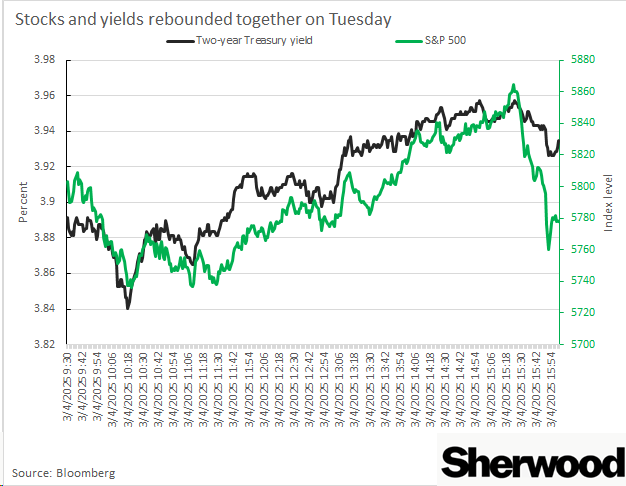
Here’s the first problem with trying to draw any link between the bounce in stocks off the lows on Tuesday and the market’s pricing of Federal Reserve policy: stocks and short-term bond yields traveled in the same direction, nearly all day!

The point in time when the market was pricing in the most easing was also the point in time when the stock market was the lowest. The point in time when the stock market was the highest was when yields were also the highest. Its simply not cogent to suggest that cut odds going up were a factor behind stocks recovering when the amount of Fed easing priced in was going down the entire time stocks were rebounding.
StocksYieldsTogether

This dynamic — stocks and bonds being negatively correlated (or stocks and yields being positively correlated, if you prefer) — has been a prominent feature of the investment backdrop over the past month. It’s another way of saying the “good news (about the economy) is good news (for the stock market),” and vice versa. This relationship is also an indication that investors are more worried at present about downside risks to growth than upside risks to inflation.

Let’s zoom in on Broadcom and Palantir, a couple stocks highlighted as “great performers over the last year when the market was pricing in and absorbing rate cuts from the Federal Reserve.”

A not-even-that-close examination of the performance of these stocks during the AI boom shows that their relative returns have been rate agnostic, to be charitable.

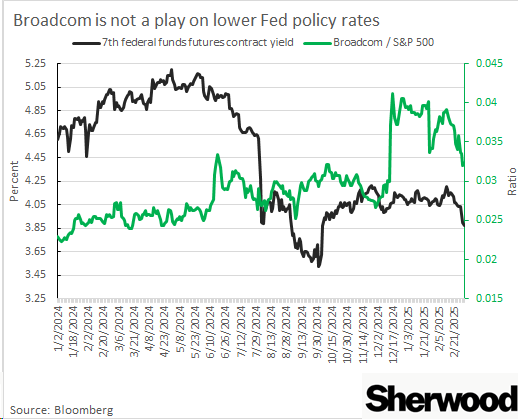
Broadcom substantially outperformed the S&P 500 in the first half of 2024, a period of time when traders were pricing in less, not more, easing from the Federal Reserve over the following six months. Then, from mid-June through the end of September, expectations for where the policy rate would be in about six months’ time fell a whopping 150 basis points. The chip designer underperformed the S&P 500 during this stretch. Broadcom has also been substantially lagging the market since mid-February of this year, a period during which expectations for where the Fed’s policy rate would be in about six months’ time have gone down by about 40 basis points.
AVGO rates

It’s also not too hard to make the case for why Broadcom’s revenue growth isn’t too sensitive to the rate outlook. We know that the so-called hyperscalers loading up on advanced chips are cash-rich. By and large, this capex binge is not being funded by debt; it’s being funded by the incredible cash-generating machines attached to megacap tech companies.

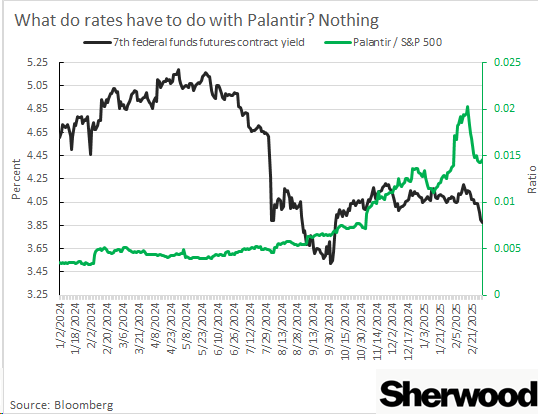
For Palantir, it’s a similar but different story. Palantir has outperformed with rates going down a lot. It’s also outperformed with rates going up a lot. It’s even outperformed with rates going sideways! But again, the most recent stretch during which rates have been dropping sharply has been a period of massive underperformance for the AI defense software company.
PLTRNothing

Long story short, the notion that the outperformance of these companies is a Fed- and rate-driven phenomenon is devoid of any supporting evidence. Otherwise, these stocks should have been crushing it since mid-February, and theyve been doing the precise opposite.

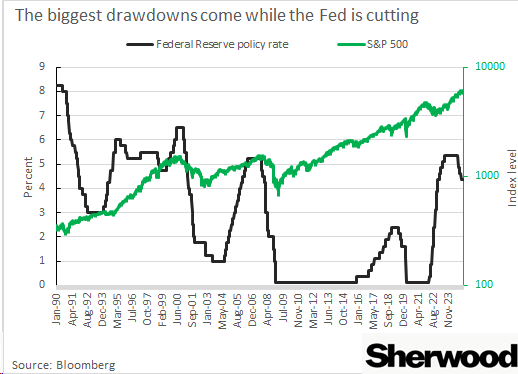
As for the idea that “don’t fight the Fed” is some kind of first commandment of the stock market, thats certainly not something we would say. Every big market drawdown in my lifetime except for one (2022’s generationally high inflation) has come during a period when the Federal Reserve is aggressively cutting interest rates.

When the Fed is frantically fighting to revive a downturn in economic activity — and losing that battle! — is precisely when investors suffer the most pain.
FedCutsDraw

More Markets

See all Markets
markets

Lionsgate closes higher on Netflix acquisition rumor

Shares for the film production company Lionsgate soared on Tuesday following rumors of a potential buyout.

According to a person familiar with the possible merger and acquisitions deal, streaming giant Netflix is one of the companies that may be interested in buying Lionsgate Studios, per reporting by Semafor.

Neither Lionsgate nor Netflix confirmed the news, but nevertheless the stock climbed, closing up 14%.

Netflix closed lower on news that Fox will acquire Roku in an approximately $22 billion deal after it was also rumored that the streaming company was interested in that acquisition. “Netflix did not make a bid for Roku,” a spokesperson told Semafor. This comes after Netflix withdrew its buyout bid for Warner Bros. Discovery earlier this year.

Lionsgates shares are up 77% since January. Lionsgate owns massive franchises like John Wick and The Hunger Games. The film company has a market cap of approximately $4.7 billion, making it roughly 5x smaller than Roku and 13x smaller than Warner Bros.

markets

Oil tumbles below $80 to 3-month low on US-Iran deal

Oil prices slid to their lowest levels in more than three months today after a preliminary ceasefire agreement between the US and Iran raised expectations that more crude could return to global markets and key shipping routes through the Strait of Hormuz could reopen.

Brent crude fell below $78 a barrel while West Texas Intermediate dropped to $73.31, extending losses as traders priced in lower geopolitical risk premiums tied to Middle East supply disruptions.

The preliminary pact announced by President Donald Trump and Iranian leaders establishes a 60-day ceasefire to end the active hostilities that have choked the Middle East since late February. A formal memorandum of understanding is scheduled to be officially signed in Switzerland this Friday, according to Bloomberg report.

Trump said on Sunday that the Strait of Hormuz would be opened when the agreement is signed in Switzerland on Friday, writing on Truth Social, “Ships of the World, start your engines. Let the oil flow!

US Energy Department data, meanwhile, showed that Americas strategic oil stockpiles sank last week to their lowest level since 1983, indicating sustained demand to rebuild them even if the Mideast conflict ends.

Stocks that moved lower:

markets

Eos Energy surges on commercial launch of second battery production line

Eos Energy Enterprises is surging in early trading after announcing the official start of commercial production at its second automated battery manufacturing line.

In a statement, the company said this milestone positions it to scale production of its proprietary zinc-based long-duration energy storage systems to meet rising commercial demand.

Management touted the enhanced efficiency of this facility, with design upgrades slashing raw material travel by 86% and shortening the physical production line length by 40% compared to Line 1.

“Battery Line 2 demonstrates our ability to continuously improve as we scale,” said John Mahaz, Chief Operating Officer of Eos. “It validates that our manufacturing system can be replicated and scaled with discipline.”

The battery energy storage company confirmed that while subassemblies will continue coming online through the early third quarter, full production capacity is targeted for the fourth quarter of 2026. The ultimate goal is to hit an aggregate 4 gigawatt-hours of annual manufacturing capacity by the end of 2026. Management also highlighted that Battery Line 1 already surpassed its full-year 2025 output within the first 164 days of 2026.

Today’s announcement builds on recent operational momentum for Eos, which posted better-than-expected Q1 sales and announced a joint venture with Cerberus Capital Management in May. However, shares are still down 37% year to date.

For the full year, Eos still expects to achieve revenues between $300 million and $400 million, in line with its previously provided guidance.

markets
Luke Kawa

Qualcomm reportedly in talks to acquire AI chip design company Tenstorrent

Qualcomm is in talks to acquire AI chip design firm Tenstorrent for $8 billion to $10 billion, according to The Information.

This transaction, if completed, would be another concrete signal of the San Diego-based chip company’s attempt to carve out a niche in the upstream AI space (data centers), rather than focusing on end-user devices.

Qualcomm’s key business of handset chips has fallen on hard times, particularly in China, due to the memory chip shortage.

Less than eight weeks ago, the chip company was the lowlight in the Philadelphia Semiconductor Index, down about 20% year to date.

Shares proceeded to surge over 60%, buoyed by optimism that the rising AI tide will lift all boats. With the release of Q2 earnings, CEO Cristiano Amon said that initial shipments of AI chips to a “leading hyperscaler” were on track for later this year, and to expect more on the company’s AI growth plans at its investor day on June 24 (next week). Last month, Bloomberg reported that Qualcomm is poised to sell “millions” of AI chips to TikTok parent ByteDance.

Established AI chip giants and hyperscalers alike have reached agreements with or gobbled up burgeoning AI chip companies as the boom rolls on. In December, Nvidia announced a major licensing deal with AI inference specialist Groq, while Meta bought AI chip startup Rivos in September.

Latest Stories

Sherwood Media, LLC and Chartr Limited produce fresh and unique perspectives on topical financial news and are fully owned subsidiaries of Robinhood Markets, Inc., and any views expressed here do not necessarily reflect the views of any other Robinhood affiliate, including Robinhood Markets, Inc., Robinhood Financial LLC, Robinhood Securities, LLC, Robinhood Crypto, LLC, Robinhood Money, LLC, Robinhood U.K. Ltd, Robinhood Derivatives, LLC, Robinhood Gold, LLC, Robinhood Asset Management, LLC, Robinhood Credit, Inc., Robinhood Ventures DE, LLC and, where applicable, its managed investment vehicles.

