

Markets
Wall Street
Getty Images
Slice of pie

The US stock market has become the global market over the last 60 years. Will that continue?

Goldman Sachs sees another $300 billion from foreign investors flowing into US stocks this year, even as tariff risks loom and growth forecasts are slashed.

Hyunsoo Rim

Foreign investors hold a record slice of America’s $93 trillion stock market — and they might not let go anytime soon.

As of Q4 2024, overseas investors owned $16.5 trillion, or 18%, of US equities, the highest share on record, according to Federal Reserve data. Thats up from 8% in 2000 and just 2% in the 1950s.
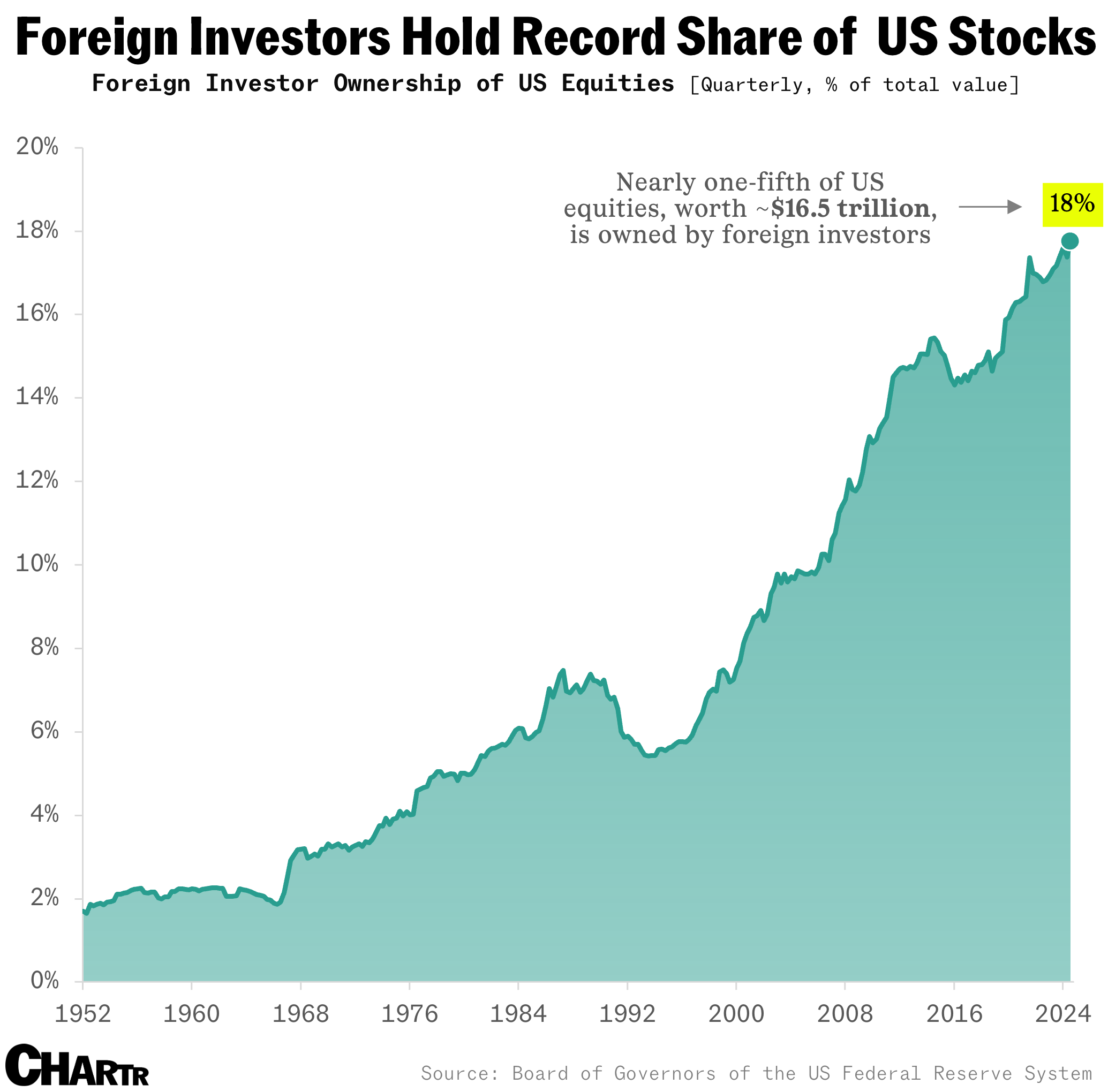
Foreign ownership US stocks
Sherwood News

TINA

As globalization gripped the world, the American stock market became the go-to investment for trillions of dollars of capital. With the world’s largest and most innovative companies like Apple and Nvidia in the United States, if you were an institutional investor in India or an individual in Italy, there was no alternative to buying US stocks.

But with protectionist policies like tariffs looming and US stocks seeing a sluggish start to 2025 — the SPDR S&P 500 Trust is down 3% year-to-date, lagging Europes STOXX 600 (up 9%) and Chinas CSI 300 (up 1%) — is growing foreign ownership a trend that’s likely to continue?

Researchers from Goldman Sachs, led by David Kostin, outlined in a note published Friday why they believe foreign investors will keep buying. They argued that the US market’s size and liquidity — the S&P 500 is 4x the size of Europe’s STOXX 600 and 8x bigger than China’s CSI 300 — makes it impossible to ignore for global investors looking to invest large sums.

Furthermore, though slowing growth has become a concern on Wall Street, Goldman still expects S&P 500 earnings to grow 7% annually in 2025 and 2026, outpacing Europes 4% and 6% growth in the same period. They also observed that a weakening US dollar — which makes US stocks cheaper for overseas buyers — could support buying: the bank expects global investors to pour another $300 billion into US equities this year, roughly matching last year’s inflows.

Of course, any significant deterioration of the fundamental US economic picture could push investors to look elsewhere.

More Markets

See all Markets
markets

SpaceX gets a wave of bullish ratings from Wall Street analysts

SpaceX received more than a dozen positive analyst calls on Tuesday — including from major Wall Street banks — as they initiate coverage on Elon Musk’s space and AI company.

SpaceX went public on June 12 at a $2.2 trillion valuation, the largest debut in history. While the company hasn’t yet posted a profit, it seems to have convinced Wall Street that it will get there and grow its valuation on the way.

Of the at least 17 analysts that gave a rating on Tuesday, all but one gave it a “buy” or “outperform” rating. MoffettNathanson was "neutral."

The ratings come as SpaceX joined the Nasdaq 100 index, a benchmark tech-heavy basket of companies that underpins millions of portfolios. The inclusion adds built-in demand for the stock from index funds and ETFs.

Still, SpaceX fell more than 5% on Tuesday amid a broader sell-off, and is currently effectively flat from its opening price of $150 a share.

markets

Nike sinks to lowest level since 2014 after warning of “challenged” sales environment in Q4 report

Did Nike do it?

Investors had a mixed reaction after the global sports apparel company reported its fourth quarter earnings on Tuesday after the bell. Shares initially rose 5% as Nike beat out Wall Street expectations amid a hefty tariff refund bonus. However, the stock then sank to its lowest level since August 2014 in postmarket trading.

Here are the Q4 numbers:

  • Revenue of $11.0 billion (estimate: $10.8 billion).

  • Adjusted earnings per share of $0.20 (estimate: $0.12).

Ahead of this report, Nike warned that results would be flattered by a one-time tariff refund (now estimated at roughly $0.52 per share for the bottom line). That gave the company an extra cushion in snapping its streak of seven quarters of year-over-year profit declines.

Over the past year, the company had been punished by tariffs on imported goods, stagnant consumer spending, and increasing competition from other footwear brands like New Balance, Adidas, and Hoka.

Outgoing CFO Matthew Friend deemed it an “increasingly challenging operating environment, where sell-through remains challenged.”

Latest Stories

Sherwood Media, LLC and Chartr Limited produce fresh and unique perspectives on topical financial news and are fully owned subsidiaries of Robinhood Markets, Inc., and any views expressed here do not necessarily reflect the views of any other Robinhood affiliate, including Robinhood Markets, Inc., Robinhood Financial LLC, Robinhood Securities, LLC, Robinhood Crypto, LLC, Robinhood Money, LLC, Robinhood U.K. Ltd, Robinhood Derivatives, LLC, Robinhood Gold, LLC, Robinhood Asset Management, LLC, Robinhood Credit, Inc., Robinhood Ventures DE, LLC and, where applicable, its managed investment vehicles.

