
Markets
2022 NHL All-Star Skills
Photo by Ethan Miller/Getty Images
Mind the gap

Happy CEOs versus sad Average Joes

Americans are still fairly pessimistic on the economy. Business leaders are getting more confident.

Luke Kawa

In June 2022, Kyla Scanlon coined the term “vibecession” to describe the gap between the economy — which was (and still is!) in a solid position — compared to consumer and business sentiment, which was in the toilet. According to Paul Krugman, we’re still in that vibecession.

But while that may still be true for the American public, it’s no longer true of corporate America.

Call it the K-shaped vibecovery, or Happy CEOs versus sad Average Joes:
Americans have a fairly downbeat view on the economy, but corporate executives are getting bulled up.

Last week, purchasing managers’ indexes for the US economy — which ask business leaders if conditions are getting better or worse — hit the highest level since mid-2022, when confidence was collapsing as Scanlon’s “vibecession” thesis made its debut.

“If consumer sentiment continues to struggle, corporate sentiment is actually in pretty good shape, and perhaps accelerating,” wrote Michael Purves, CEO of Tallbacken Capital, in a note to clients. “Surveys from CEOs of both large and smaller companies are showing the C-Suite is embracing the economy.”

One simple way to demonstrate this divide:

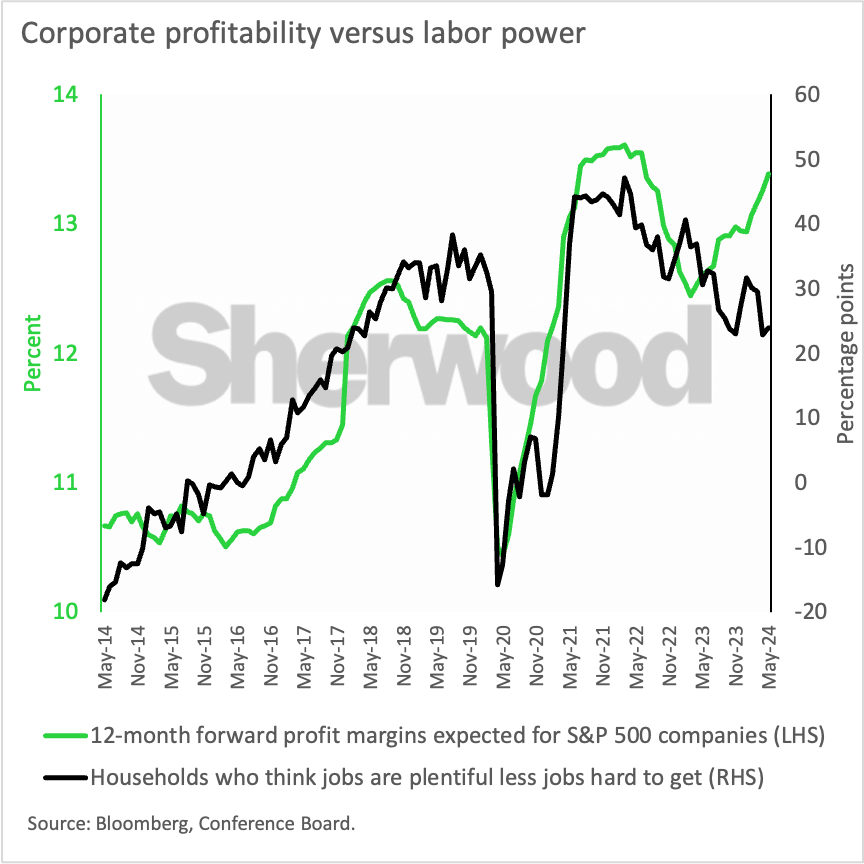
Since the middle of 2023, expectations for S&P 500 profit margins in the year ahead have been persistently revised to the upside. During that same period, the share of Americans who say jobs are “plentiful” less those who say jobs are “hard to get” has been shrinking.
MarginsvsLaborPower

Let’s set aside the question of whether it’s “right” for Americans to feel so gloomy and instead explore why businesses might be more optimistic than households.

Corporate America:

CFOs think recession risk is below average. Publicly traded companies are exceeding analysts’ earnings expectations by more than usual. Supply chains have largely un-snarled. Inventory-to-sales ratios have improved.  And firms are getting rewarded for capital spending

“Earnings growth is a three-quarter leading indicator for capex spending, and the continued strength in earnings suggests that we will see a strong rebound in business fixed investment over the coming quarters” writes Torsten Slok, chief economist at Apollo Global Management, in a note to clients.

Non-corporate America aka Average Joes:

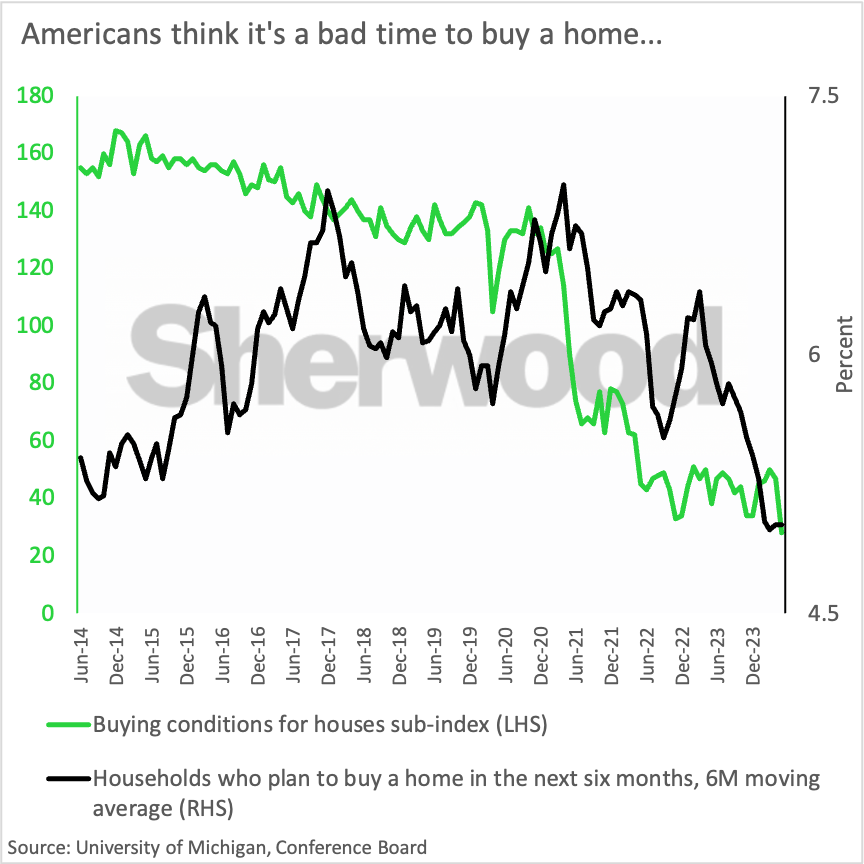
Wage growth is off the boil (in both nominal and inflation-adjusted terms). The private sector quits rate (a good leading indicator for wage growth, since a big reason to voluntarily leave your job is for higher pay) is now well below its pre-pandemic peak. Price levels throughout the economy are still high (even though inflation has decelerated meaningfully). Consumers think it’s a bad time to buy a house, and few plan to do so in the next six months.
HousingBad

In some respects, it seems zero sum: a couple of the reasons why consumers are a little sour are the same ones why businesses are happy. On a micro level, lower wage pressures help flatter profit margins. And a high price level — so long as it does not have an outsized negative impact on volumes sold — is also good for the bottom line.

The good news is that this better perception among businesses has the ability to improve households’ reality.

Changes in business spending are, empirically, much more volatile compared to household spending. Not to sound callous, but on a macroeconomic level, how people feel doesn’t matter — as long as it doesn’t impact their spending habits. Businesses are afforded a lot more discretion on how much they spend, what they spend on, and when to do so. So if this K-shaped vibecovery for corporate sentiment catalyzes capital spending, that typically leads to an increase in employment opportunities.

But for now, it’s no surprise that while consumers might not be too optimistic about their own income growth prospects, they are pretty confident that the stock market will keep going up!

More Markets

See all Markets
Chicago Bulls player Michael Jordan is surrounded by NBA Championship trophies after his team defeated the Utah Jazz 90-86 to win the 1997 NBA Finals at the United Center in Chicago, IL.

Stock climb on US-Iran peace deal; semiconductors rally

This morning, President Trump and Iranian President Masoud Pezeshkian signed a memorandum of understanding aimed at ending the war.

markets

Intel surges after Trump announces US chip deal with Apple

Intel is soaring in early trading after President Donald Trump posted on Truth Social that Apple has agreed to work with the semiconductor giant to design and manufacture its chips domestically.

President Trump positioned the agreement as the latest victory for his administration’s industrial policy after the federal government acquired a 9.9% equity stake in Intel last year.

"Stupid Presidents took our Economy for granted, and let Taiwan and others steal our Semiconductor Factories," Trump wrote in the post. "We design everything, but we need to BUILD it here, NOW! So I decided to help Intel because we need to design and build our Chips right here in America... and, finally, Apple has agreed to work with Intel to design and build its Chips in America."

Intel reportedly reached a preliminary agreement back in May to manufacture chips for the Apple, which has been facing supply constraints for its iPhone as well other products. The deal could help Apple reduce its reliance on longtime partner TSMC by bringing more of its chip manufacturing stateside.

"This partnership helps Apple with chip development and manufacturing on US soil with greater focus on reducing dependence on Asian manufacturing facilities." Wedbush's Dan Ives commented in a company report. He has a $400 price target for Apple this year.

The timing aligns with Intel's technical roadmap. Earlier this week, Intel confirmed that its advanced, performance-boosted 18A-P process node officially entered its risk production phase. This move serves as a blueprint for both Intel chips and processors the company plans to build for foundry customers.

“The current capacity crunch is probably emboldening customers to give Intel a harder look at this stage than perhaps they might ordinarily be inclined to do as the prospect of more advanced capacity will take on higher value in a constrained environment,” wrote Bernstein analyst Stacy Rasgon. “We are sure that Trump’s encouragement is at least not going to hurt though.”

Momentum was built around Intel Foundry services as surging global AI demand continuously outpaced capacity. Earlier this month, Google reportedly placed an order with Intel to manufacture more than 3 million of its increasingly popular tensor processing unit chips in 2028. According to the report, Nvidia is also testing to see if Intel could manufacture its next-gen Feynman chips.

markets

Stocks rise after US, Iran sign peace plan

Stocks rose Thursday morning after President Trump and Iranian President Masoud Pezeshkian signed a memorandum of understanding aimed at ending the war, in another sign that a months-long war that caused energy prices to spike could be coming to an end.

Trump signed the MOU before a dinner in Versailles, France on Wednesday evening. The president previously announced that a deal had been reached on Sunday evening, saying that traffic through the Strait of Hormuz would resume and that the US naval blockade would be lifted.

The deal comes after both sides exchanged attacks last week, escalating tensions to some of the highest levels since the US and Israel struck Iran in late February.

The price of Brent Crude ticked even lower after dropping on Sunday, sitting at about $76 a barrel. Oil giants like Shell, Chevron and Exxon fell on the news, as average gas prices in the US dropped below $4 for the first time in months.

Futures for the S&P 500 and Nasdaq Composite rose 0.9% and 1.5%, respectively. Last week, inflation readings for May showed both wholesale inflation and consumer prices rose in large part because of higher energy costs.

Signs of the peace deal have also lead to buying of momentum stocks this week. iShares MSCI USA Momentum Factor ETFrose another 1.46% in premarket trading.

Latest Stories

Sherwood Media, LLC and Chartr Limited produce fresh and unique perspectives on topical financial news and are fully owned subsidiaries of Robinhood Markets, Inc., and any views expressed here do not necessarily reflect the views of any other Robinhood affiliate, including Robinhood Markets, Inc., Robinhood Financial LLC, Robinhood Securities, LLC, Robinhood Crypto, LLC, Robinhood Money, LLC, Robinhood U.K. Ltd, Robinhood Derivatives, LLC, Robinhood Gold, LLC, Robinhood Asset Management, LLC, Robinhood Credit, Inc., Robinhood Ventures DE, LLC and, where applicable, its managed investment vehicles.