

Markets
markets

Trump’s tariffs brought billions of dollars in customs revenue, but now the US may have to give it back

The US has collected ~$40 billion worth of customs duties since April, but with the US Court of International Trade blocking the majority of President Trumps tariffs, the government may end up returning the money.

After raking in a record $15.6 billion in customs revenue in April, the Treasury hit a new all-time high again this month, likely from Trumps 10% baseline tariffs on nearly all imports, with some $22 billion accumulated so far in May. Thats a massive jump from $9 billion back in January, and is likely lower than reality, as the customs-only figure excludes excise taxes on specific imported goods like fuel, alcohol, and tobacco.
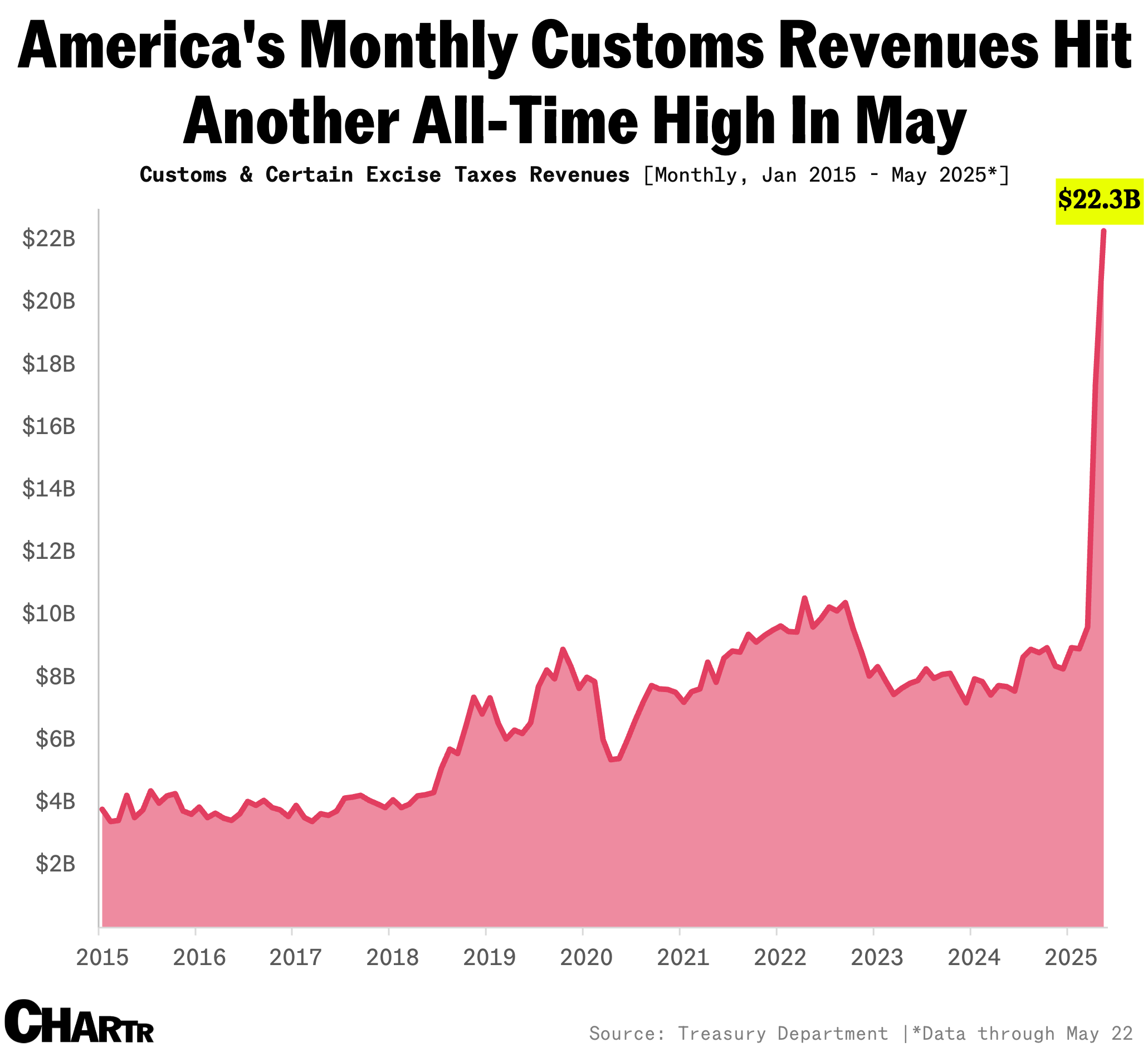
America's customs revenue is growing
Sherwood News

But the new ruling invalidates all orders rooted in the International Emergency Economic Powers Act, including last months Liberation Day tariffs on almost all US trading partners and levies against China, Mexico, and Canada enacted before then. Trump now has up to 10 days to sort out the necessary administrative actions, unless the administrations notice of appeal filed against the decision goes through.

The revenue was a boon but still small compared to the fiscal pressure America is under. Mounting federal debt is raising concerns in bond markets, and Trumps big, beautiful bill,” which includes tax cuts, might cost an additional $3.8 trillion over the next decade.

Of course, theres also a catch: even if the ruling holds, the White House could deploy other trade laws and continue imposing sector-specific tariffs, which might not change the final outcome for most major U.S. trading partners, per Goldman Sachs analyst Alec Phillips.

But the new ruling invalidates all orders rooted in the International Emergency Economic Powers Act, including last months Liberation Day tariffs on almost all US trading partners and levies against China, Mexico, and Canada enacted before then. Trump now has up to 10 days to sort out the necessary administrative actions, unless the administrations notice of appeal filed against the decision goes through.

The revenue was a boon but still small compared to the fiscal pressure America is under. Mounting federal debt is raising concerns in bond markets, and Trumps big, beautiful bill,” which includes tax cuts, might cost an additional $3.8 trillion over the next decade.

Of course, theres also a catch: even if the ruling holds, the White House could deploy other trade laws and continue imposing sector-specific tariffs, which might not change the final outcome for most major U.S. trading partners, per Goldman Sachs analyst Alec Phillips.

More Markets

See all Markets
markets

AMD shares climb on double Citi upgrade to “buy” with $575 price target

AMD’s shares are rising in premarket trading following a double upgrade from Citi. Citi analyst Atif Malik raised AMD’s investment rating to “buy” from “neutral” and boosted the bank’s 12-month price target to $575 from $460 per share, per Barron’s.

Malik argued that the broader market currently misprices AMD by looking at it primarily as a CPU producer, underestimating its massive GPU potential. Citi says that AMD is uniquely “poised to win the lion’s share” of Meta’s customized graphics chip business. Meta is leaning into AMD’s custom MI450 chips, which deliver a lower total cost of ownership compared to buying traditional off-the-shelf merchant hardware, according to Investing.com.

Citi highlighted a massive multiyear deal between the two tech giants involving a 160 million-share common stock warrant. As the first phase ramps up through 2027, Citi expects each gigawatt of data center infrastructure to translate into roughly $15 billion in revenue. Consequently, Citi hiked its 2027 AMD AI sales forecast to $33 billion (up 137% year over year) and projects GPU sales to reach $50.8 billion by 2028.

CEO Lisa Su recently delivered an optimistic demand forecast, predicting that the global market for CPUs will grow by more than 35% annually over the next five years. The chipmaker delivered a robust Q1 earnings report back in May that beat Wall Street expectations across key data center segments.

markets

Astera Labs, CoreWeave, Nebius, Rocket Lab, Teradyne rise on Nasdaq 100 Index inclusion announcement

Tech stocks Astera Labs, CoreWeave, Nebius, Rocket Lab, and Teradyne have risen as much as 8.9% in premarket trading on Friday, thanks in part to Nasdaq’s announcement that the five companies will join its flagship Nasdaq 100 Index starting June 22.

As part of the index operator’s quarterly rebalance, which affects some $1.4 trillion in assets within the Nasdaq 100 ecosystem, the companies will replace Charter, Zscaler, Cognizant, Insmed, and Verisk — relatively slow-growth legacy businesses that have lingered around the bottom of the index in market cap terms of late. Most of those stocks slipped slightly on the news.

With CoreWeave and Nebius as two of the major players in the neocloud space, and Astera Labs and Teradyne specializing in making AI hardware and semiconductors, the latest additions reflect how the index is upping its exposure to the AI infrastructure stack. Back in December, Nasdaq also added AI data storage names Seagate Technology Holdings and Western Digital, as well as AI server manager Monolithic Power Systems, as part of its quarterly rebalance.

markets
Jon Keegan

Adobe beats on Q2 earnings, revenue; CFO to step down

Adobe reported fiscal Q2 results Thursday, beating analysts’ estimates for revenue and earnings, as its stock plumbed its lowest levels since 2019.

For Q2 2026, the creative software company posted:

  • Revenues of $6.62 billion (estimate: $6.45 billion).

  • Adjusted earnings per share of $5.96 (estimate: $5.82).

  • Annual recurring revenue of $27.1 billion (estimate: $26.6 billion).

  • Subscription revenue of $6.42 billion (estimate: $6.27 billion).

  • Remaining performance obligations of $22.27 billion (estimate: $21.86 billion).

The company also said its CFO, Dan Durn, would step down next week “to pursue a new professional opportunity.” And it boosted its full-year guidance for earnings and revenue.

Shares fell 5.5% in after-hours trading.

Adobe is feeling the pressure from AI, as the April release of Anthropic’s Claude Design threatens the company’s core design software business. Shares have tanked lately, with the stock down by nearly half over the past 12 months, putting it at levels not seen in years.

Last quarter, Adobe announced that CEO Shantanu Narayen, who had been at the company for 18 years, would be leaving after his successor was appointed. Today, Adobe announced that CFO Dan Durn would also be leaving the company — this month.

Adobe announced a $25 billion stock buyback in April, which gave the stock a boost. The company said it repurchased about 8.5 million shares during the quarter.

In a press release, Narayen said:

“Adobe delivered record revenue of $6.62 billion in Q2 reflecting strong AI-driven demand across our customer groups and we are raising our full-year fiscal 2026 revenue and non-GAAP EPS targets on the strength of that performance.”

markets

Trump says he’s called off impending strikes on Iran, sending stocks higher and oil plunging

President Trump on Thursday afternoon said he is calling off upcoming planned strikes on Iran. In a Truth Social post, Trump said “discussions with the Islamic Republic of Iran have been brought to the highest level of Iranian leadership and approved.”

Stocks broadly popped, with the S&P 500 moving from roughly flat to up 1.4% on the day, and oil plunged on the news.

“Discussions and final points have been, in both concept and great detail, approved by all parties involved, including the United States, Israel, Saudi Arabia, UAE, Qatar, Turkey, Pakistan, Bahrain, Kuwait, Jordan, Egypt, and others. The Naval Blockade will remain in full force and effect until this Transaction is finalized — Time and place of the signing to be announced shortly,” the president added.

West Texas Intermediate crude futures are down 3% on Thursday afternoon, dropping sharply following the post.

Oil-sensitive stocks reacted accordingly, with airlines including Delta Air Lines, American Airlines, United Airlines, Southwest Airlines, JetBlue, Alaska Air, and Frontier all climbing significantly. Carnival, Norwegian, and Royal Caribbean similarly jumped.

Freight companies including UPS, FedEx, XPO, and Old Dominion Freight were also up on oil’s movement.

Oil-adjacent companies including Exxon, ConocoPhillips, and Occidental Petroleum dipped.

Latest Stories

Sherwood Media, LLC and Chartr Limited produce fresh and unique perspectives on topical financial news and are fully owned subsidiaries of Robinhood Markets, Inc., and any views expressed here do not necessarily reflect the views of any other Robinhood affiliate, including Robinhood Markets, Inc., Robinhood Financial LLC, Robinhood Securities, LLC, Robinhood Crypto, LLC, Robinhood Money, LLC, Robinhood U.K. Ltd, Robinhood Derivatives, LLC, Robinhood Gold, LLC, Robinhood Asset Management, LLC, Robinhood Credit, Inc., Robinhood Ventures DE, LLC and, where applicable, its managed investment vehicles.