Markets
TOPSHOT-US-POLITICS-TRUMP-BIDEN
President Joe Biden shakes hands with President-elect Donald Trump during a meeting in the Oval Office (Saul Loeb/Getty Images)
second time’s the charm?

Fund managers with $500 billion are piling into the same “Trump trades” that mostly fizzled out last time

I guess there’s a reason that they call them “Trump trades,” not “Trump investments.”

Luke Kawa

The knee-jerk market reaction to Donald Trump’s victory in the presidential election — US equities and the dollar outperforming their peers — has been a case of déjà vu all over again.

And fund managers with $565 billion in assets are diving into so-called “Trump trades” in earnest: the same things that everyone bought the last time.

Bank of America’s closely watched global fund-manager survey had an interesting wrinkle this month: with responses received between November 1 and 7, they were able to isolate how much investors’ views changed immediately following the US vote.

The common theme from these respondents, who collectively manage $565 billion, was as pro-US as a bald eagle eating apple pie.

Those surveyed before the election thought US and global stocks would be about neck-and-neck in 2025; now, American equities are decisively the preferred option.
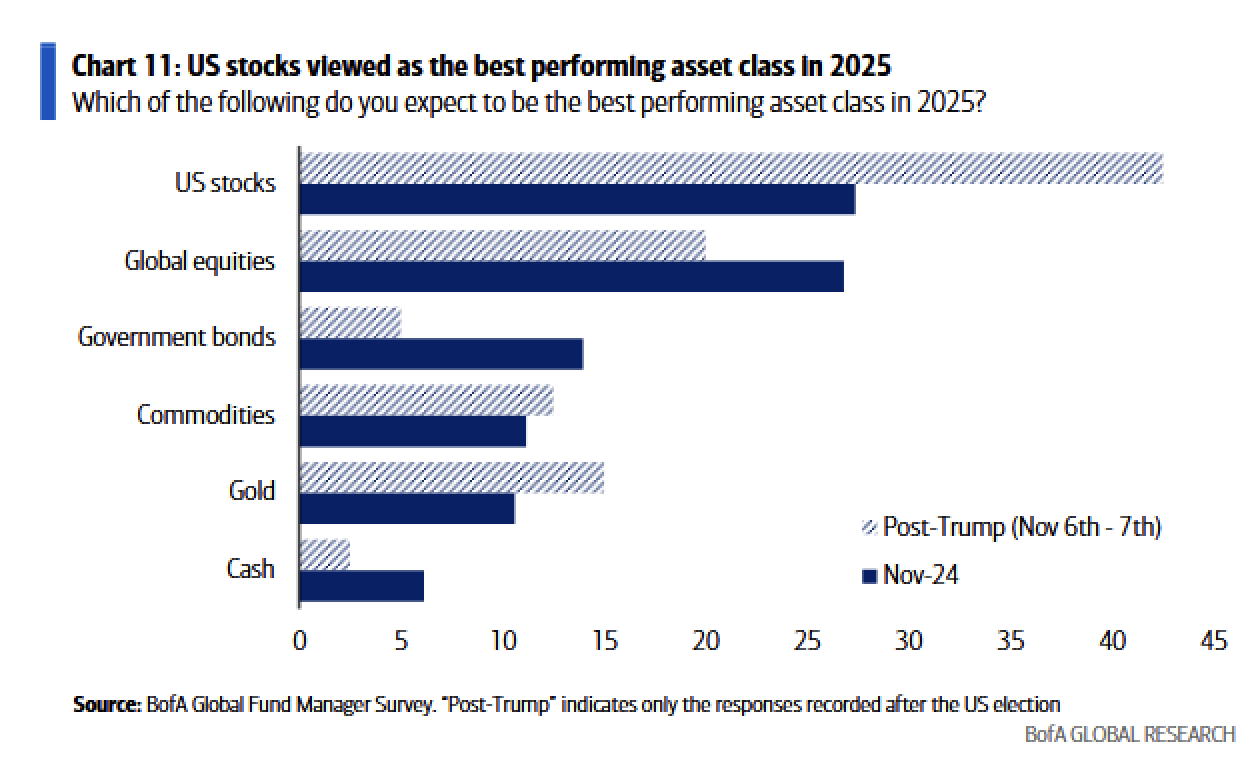
US stocks Nov 24 FMS
Source: BofA

The US dollar? The top pick to outperform in the world of foreign exchange.
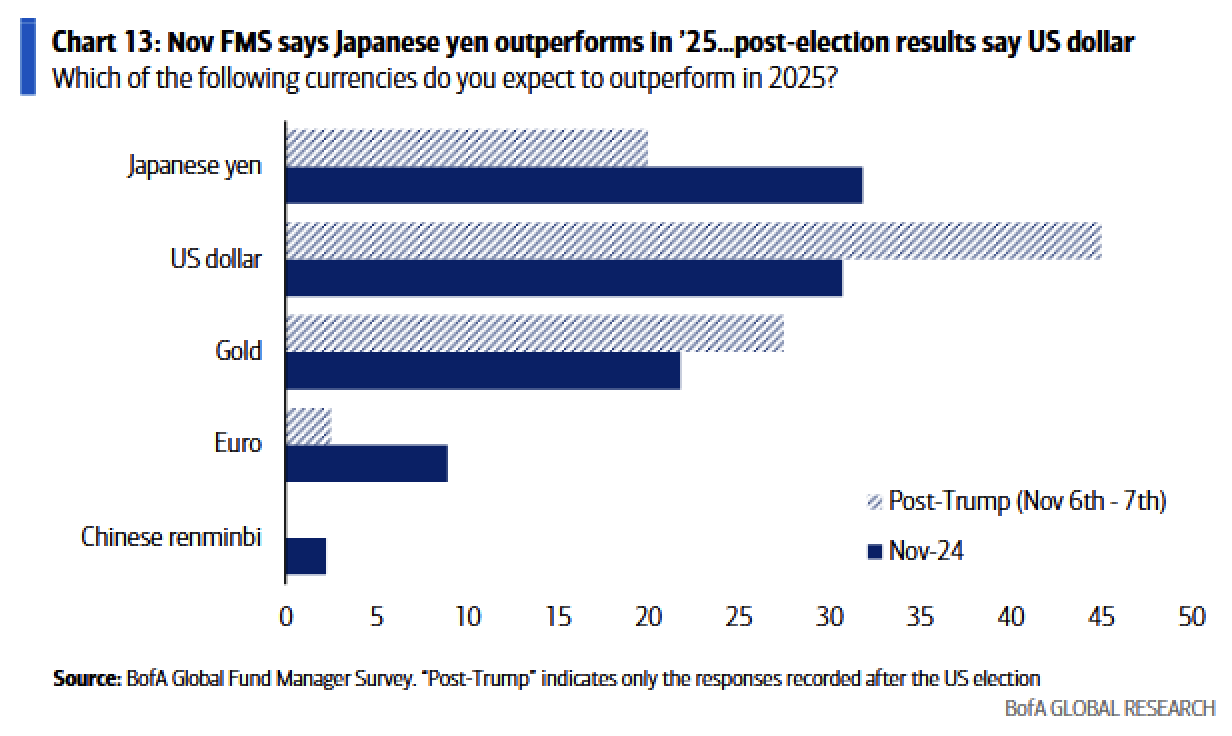
Foreign exchange FMS Nov 2024
Source: BofA

And it’s now conventional wisdom within this group that small caps, which are more sensitive to domestic growth and tax changes, will outperform the S&P 500.
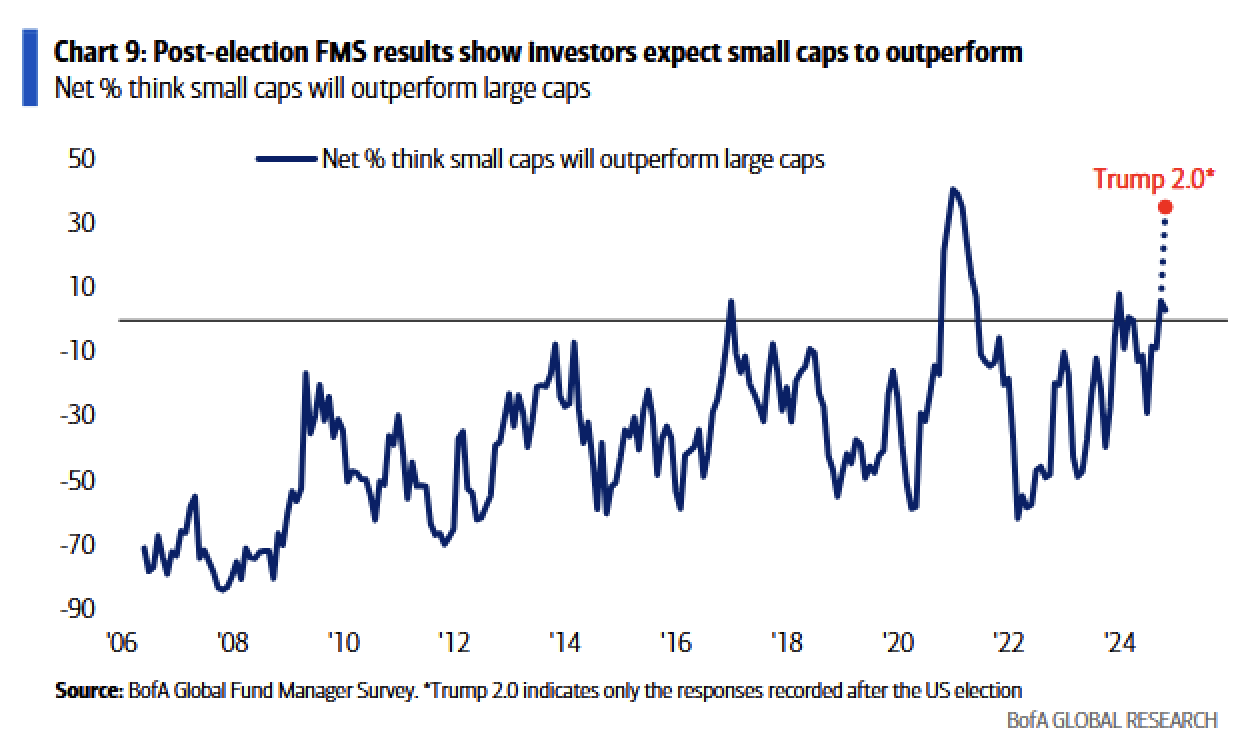
Small vs large BofA FMS Nov 24
Source: BofA

Let’s evaluate how all of these trades fared through Trump 1.0.

Small caps proceeded to underperform large caps by more than 20% from Election Day 2016 through Election Day 2020, even after getting off to a 10% lead within a month of Trump’s surprising 2016 victory. Heck, US small caps barely outperformed developed-market small caps as a whole over this period despite superior US economic growth and the Tax Cuts and Jobs Act, a specific catalyst that benefited this cohort relative to their international peers!

The Dollar Spot Index, which tracks the value of the greenback versus other major developed market currencies? Down between the 2016 and 2020 presidential elections. Oh, what about the Bloomberg Dollar Spot Index, which also includes emerging-market currencies like the Mexican peso and Chinese offshore yuan, which got smacked on the 2016 results? Also down from November 8, 2016, through November 3, 2020.

Then there are US stocks. Yes, these outperformed the MSCI World between Trump’s election win and Biden’s, as they did between Trump’s win and Biden’s after that, and during both of Obama’s terms. You have to go back to George Bush’s win over John Kerry to find a time when US stocks underperformed their global counterparts from one presidential race through the next.

US stocks over their global peers isn’t a really Trump trade; it’s a tech trade.

The S&P 500 has outperformed for a long time primarily due to the outsize earnings power of established and emergent tech giants.

While that profitability was boosted by tax cuts, Big Tech was not one of the key beneficiaries of the TCJA. The yawning gap between the growth in forward-earnings estimates for Nasdaq 100 (which is even more tech-heavy than the S&P 500) compared to the MSCI ACWI between the 2016 and 2020 elections is a story of operational excellence and global footprints.

Fiscal policy, trade policy, regulatory policy, all of that certainly matters for markets. But sometimes (dare I say, oftentimes), there are bigger forces at play, or markets are simply unable to trade the same thematic catalyst for years on end — unless it’s a major factor underpinning incremental increases in profitability.

So-called “Trump trades” are much more a “reaction-to-Trump-winning trades” than they have been durable, investable themes. I guess there’s a reason why they call them “Trump trades” and not “Trump investments.”

More Markets

See all Markets
Chicago Bulls player Michael Jordan is surrounded by NBA Championship trophies after his team defeated the Utah Jazz 90-86 to win the 1997 NBA Finals at the United Center in Chicago, IL.

Stock climb on US-Iran peace deal; semiconductors rally

This morning, President Trump and Iranian President Masoud Pezeshkian signed a memorandum of understanding aimed at ending the war.

markets

Intel surges after Trump announces US chip deal with Apple

Intel is soaring in early trading after President Donald Trump posted on Truth Social that Apple has agreed to work with the semiconductor giant to design and manufacture its chips domestically.

President Trump positioned the agreement as the latest victory for his administration’s industrial policy after the federal government acquired a 9.9% equity stake in Intel last year.

"Stupid Presidents took our Economy for granted, and let Taiwan and others steal our Semiconductor Factories," Trump wrote in the post. "We design everything, but we need to BUILD it here, NOW! So I decided to help Intel because we need to design and build our Chips right here in America... and, finally, Apple has agreed to work with Intel to design and build its Chips in America."

Intel reportedly reached a preliminary agreement back in May to manufacture chips for the Apple, which has been facing supply constraints for its iPhone as well other products. The deal could help Apple reduce its reliance on longtime partner TSMC by bringing more of its chip manufacturing stateside.

"This partnership helps Apple with chip development and manufacturing on US soil with greater focus on reducing dependence on Asian manufacturing facilities." Wedbush's Dan Ives commented in a company report. He has a $400 price target for Apple this year.

The timing aligns with Intel's technical roadmap. Earlier this week, Intel confirmed that its advanced, performance-boosted 18A-P process node officially entered its risk production phase. This move serves as a blueprint for both Intel chips and processors the company plans to build for foundry customers.

“The current capacity crunch is probably emboldening customers to give Intel a harder look at this stage than perhaps they might ordinarily be inclined to do as the prospect of more advanced capacity will take on higher value in a constrained environment,” wrote Bernstein analyst Stacy Rasgon. “We are sure that Trump’s encouragement is at least not going to hurt though.”

Momentum was built around Intel Foundry services as surging global AI demand continuously outpaced capacity. Earlier this month, Google reportedly placed an order with Intel to manufacture more than 3 million of its increasingly popular tensor processing unit chips in 2028. According to the report, Nvidia is also testing to see if Intel could manufacture its next-gen Feynman chips.

markets

Stocks rise after US, Iran sign peace plan

Stocks rose Thursday morning after President Trump and Iranian President Masoud Pezeshkian signed a memorandum of understanding aimed at ending the war, in another sign that a months-long war that caused energy prices to spike could be coming to an end.

Trump signed the MOU before a dinner in Versailles, France on Wednesday evening. The president previously announced that a deal had been reached on Sunday evening, saying that traffic through the Strait of Hormuz would resume and that the US naval blockade would be lifted.

The deal comes after both sides exchanged attacks last week, escalating tensions to some of the highest levels since the US and Israel struck Iran in late February.

The price of Brent Crude ticked even lower after dropping on Sunday, sitting at about $76 a barrel. Oil giants like Shell, Chevron and Exxon fell on the news, as average gas prices in the US dropped below $4 for the first time in months.

Futures for the S&P 500 and Nasdaq Composite rose 0.9% and 1.5%, respectively. Last week, inflation readings for May showed both wholesale inflation and consumer prices rose in large part because of higher energy costs.

Signs of the peace deal have also lead to buying of momentum stocks this week. iShares MSCI USA Momentum Factor ETFrose another 1.46% in premarket trading.

Latest Stories

Sherwood Media, LLC and Chartr Limited produce fresh and unique perspectives on topical financial news and are fully owned subsidiaries of Robinhood Markets, Inc., and any views expressed here do not necessarily reflect the views of any other Robinhood affiliate, including Robinhood Markets, Inc., Robinhood Financial LLC, Robinhood Securities, LLC, Robinhood Crypto, LLC, Robinhood Money, LLC, Robinhood U.K. Ltd, Robinhood Derivatives, LLC, Robinhood Gold, LLC, Robinhood Asset Management, LLC, Robinhood Credit, Inc., Robinhood Ventures DE, LLC and, where applicable, its managed investment vehicles.