

Markets
US Trade down Trade bargains discounters
(CSA Archive/Getty Images)

The trade-down trade is a market theme worth watching

Annoyingly high costs of living are driving bargain hunting and big gains for discounters.

Earnings season came to its usual, consumer-oriented conclusion over the last couple weeks, with a flurry of quarterly reports from retailers peppering the tape.

The market was clearly taken aback by some superstrong numbers from a few unsexy off-price retailers. Kohl’s mooned 24% Wednesday after posting its numbers. Burlington Stores rose a more muted 5% Thursday for the same reason, as did Five Below, which gained about 4%. Others like Dollar General and TJX Maxx parent TJX Cos. also did much better than expected, even if the stock reaction wasn’t so dramatic.

The upside wasn’t uniform — Ross Stores posted slightly disappointing sales last week, for instance — but in the aggregate, the news seemed to reinforce the message of an interesting chart published in a note by Bank of America analysts.
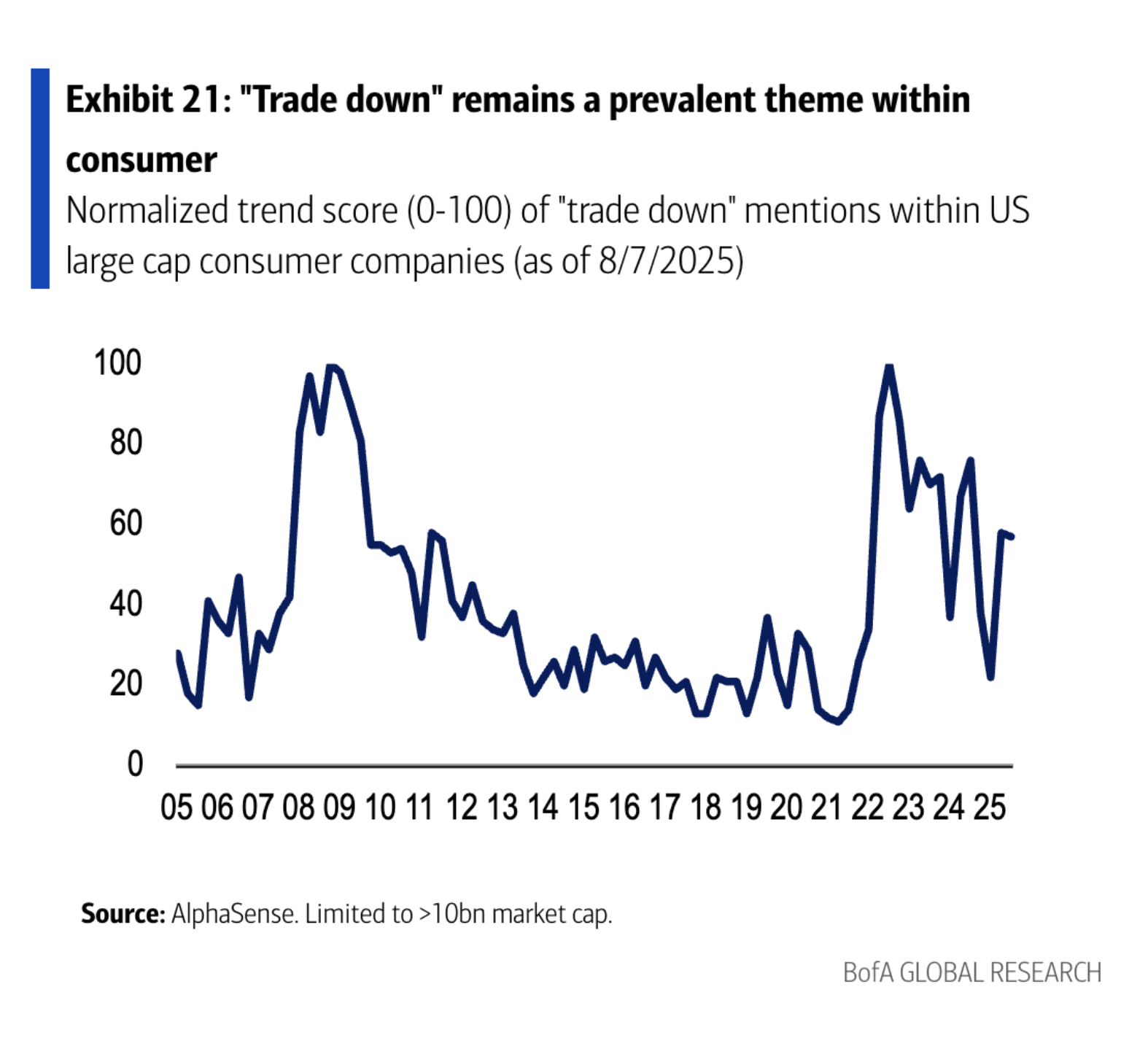
Trade Down Stock Market Theme
(Bank of America Global Research)

This trend line charts the change in mentions of “trading down” — that is, consumers shopping for lower-priced options rather than paying premium prices — on conference calls hosted by large US companies over the last 20 years.

Mentions of such behavior spiked during great financial crisis of 2008-09, and then again a decade or so later during the post-Covid inflation, as consumers saw their buying power weaken either because of job losses during the recession or because their pay didn’t keep up with price increases after the pandemic.

After a brief respite, this chart says (and the recent numbers from discounters confirm) that trading down is back.

This makes sense, as inflation remains stubbornly high. Actually it’s a bit worse than that, as inflation is actually accelerating.

The Fed’s preferred measure of underlying inflationary pressures, core PCE, hit an annual rate of nearly 3% last month, up from 2.6% back in April, according to data released Friday. It was the third straight monthly increase.

At the same time, the job market, while more or less stable, seems to be softening a bit on the margin, with the number of those receiving continued unemployment benefits rising and net employment growth decelerating, both of which make it harder to switch jobs or push for higher pay.

That might sound like an uncomfortable world for workers.

But it’s a solid backdrop for stocks of bargain retailers. Such stocks might be a decent place for risk-averse investors — if such a breed still exists — to hunt for relatively safe trades that could perform well in the high-inflation, soft-growth economy we might be looking at for a while.

More Markets

See all Markets
markets

SpaceX gets a wave of bullish ratings from Wall Street analysts

SpaceX received more than a dozen positive analyst calls on Tuesday — including from major Wall Street banks — as they initiate coverage on Elon Musk’s space and AI company.

SpaceX went public on June 12 at a $2.2 trillion valuation, the largest debut in history. While the company hasn’t yet posted a profit, it seems to have convinced Wall Street that it will get there and grow its valuation on the way.

Of the at least 17 analysts that gave a rating on Tuesday, all but one gave it a “buy” or “outperform” rating. MoffettNathanson was "neutral."

The ratings come as SpaceX joined the Nasdaq 100 index, a benchmark tech-heavy basket of companies that underpins millions of portfolios. The inclusion adds built-in demand for the stock from index funds and ETFs.

Still, SpaceX fell more than 5% on Tuesday amid a broader sell-off, and is currently effectively flat from its opening price of $150 a share.

markets

Nike sinks to lowest level since 2014 after warning of “challenged” sales environment in Q4 report

Did Nike do it?

Investors had a mixed reaction after the global sports apparel company reported its fourth quarter earnings on Tuesday after the bell. Shares initially rose 5% as Nike beat out Wall Street expectations amid a hefty tariff refund bonus. However, the stock then sank to its lowest level since August 2014 in postmarket trading.

Here are the Q4 numbers:

  • Revenue of $11.0 billion (estimate: $10.8 billion).

  • Adjusted earnings per share of $0.20 (estimate: $0.12).

Ahead of this report, Nike warned that results would be flattered by a one-time tariff refund (now estimated at roughly $0.52 per share for the bottom line). That gave the company an extra cushion in snapping its streak of seven quarters of year-over-year profit declines.

Over the past year, the company had been punished by tariffs on imported goods, stagnant consumer spending, and increasing competition from other footwear brands like New Balance, Adidas, and Hoka.

Outgoing CFO Matthew Friend deemed it an “increasingly challenging operating environment, where sell-through remains challenged.”

Latest Stories

Sherwood Media, LLC and Chartr Limited produce fresh and unique perspectives on topical financial news and are fully owned subsidiaries of Robinhood Markets, Inc., and any views expressed here do not necessarily reflect the views of any other Robinhood affiliate, including Robinhood Markets, Inc., Robinhood Financial LLC, Robinhood Securities, LLC, Robinhood Crypto, LLC, Robinhood Money, LLC, Robinhood U.K. Ltd, Robinhood Derivatives, LLC, Robinhood Gold, LLC, Robinhood Asset Management, LLC, Robinhood Credit, Inc., Robinhood Ventures DE, LLC and, where applicable, its managed investment vehicles.

