
Markets
Screaming Man
Screaming man

The three technical charts raising jitters over the AI trade

Semis head and shoulders, Nvidia below the 50-day average, and September seasonality.

Luke Kawa

A soft start to September after a poor end to August has left the most important part of the stock market — everything related to AI — in a shakier state.

A Morgan Stanley basket of AI tech beneficiaries fell 5.5% over the past two sessions, its worst two-day drubbing since the sessions immediately following “Liberation Day” on April 2, when the extent of President Donald Trump’s reciprocal tariff regime was unveiled.

With Google and Apple roaring on Wednesday, the picture is a little brighter for the AI trade. But in the background, there are still three technical spots of bother with the complex that’s been critical to the US stock market’s gains for the past two years and counting.

Semiconductors are in a precarious position, with the VanEck Semiconductor ETF not too far away from completing a bearish head-and-shoulders top pattern recently flagged by Bank of America head of technical research Paul Ciana.
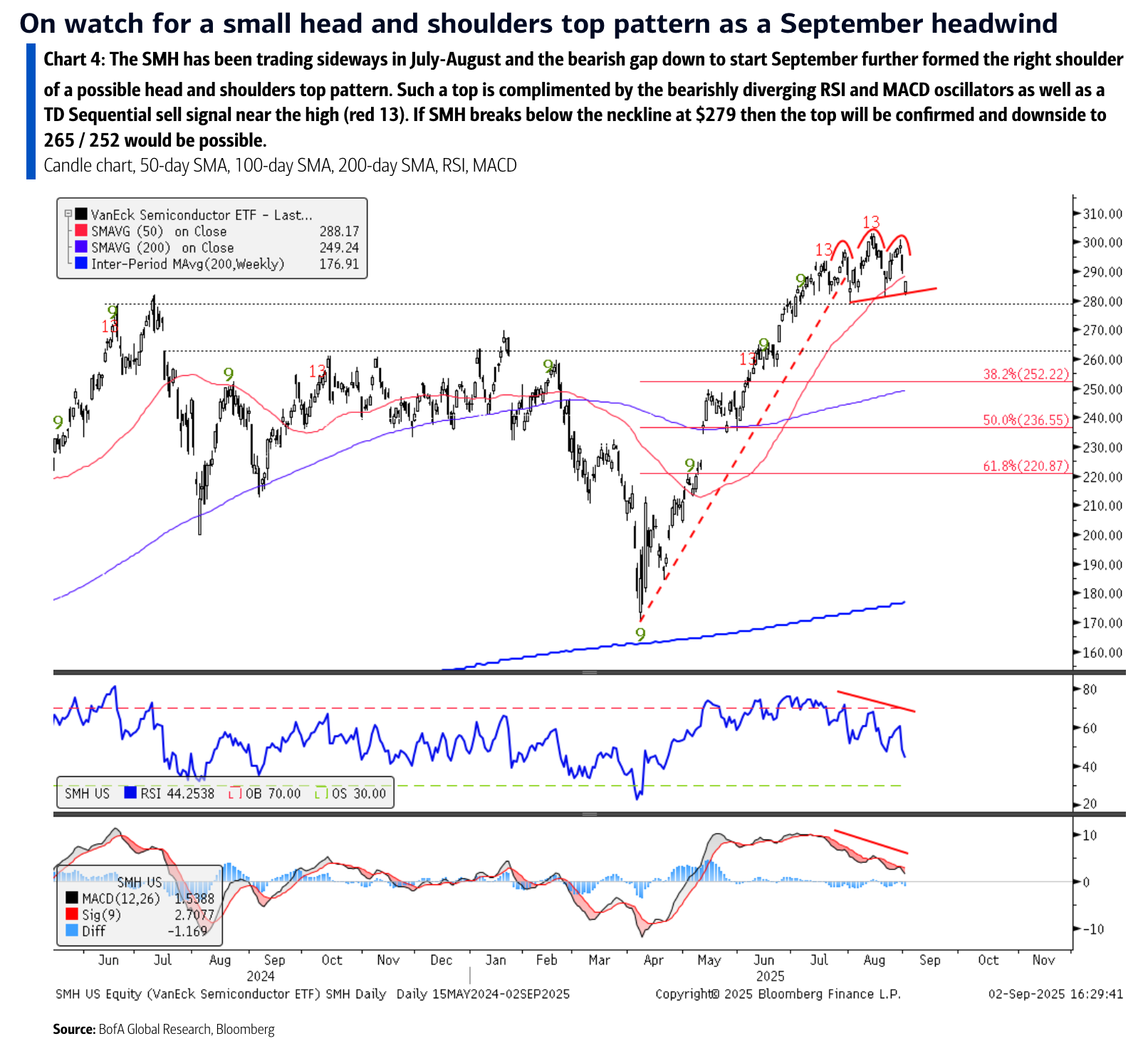
BofA SMH H&S

Zooming in on the most important semiconductor stock: Nvidia, the heart, soul, and many other body parts of the AI trade, closed below its 50-day moving average on Tuesday for the first time since May, when it was repairing damage done in the wake of the momentum meltdown and tariff angst that roiled markets.

Since the AI boom unofficially kicked off in May 2023, there have been only four previous instances where Nvidia had a fresh break below its 50-day moving average (that is, closing below that level for the first time in at least 21 sessions):

  • August 9, 2023

  • April 19, 2024

  • July 24, 2024

  • December 10, 2024

And now, yesterday. The good news is that breaching that technical threshold hasn’t been a big deal for Nvidia. One-month forward returns from the above dates have been strongly positive (up at least 7%) on three of four occasions, and the one loss was less than 2%.

But oh yeah, it’s September, a seasonally bad time for the stock market. Returns have varied widely for the Nasdaq 100 over the past 20 years, from up as much as 13% to down nearly 15%, but on average it’s been the only month with negative returns for the tech-heavy gauge.

“One needs to be pragmatic while at these levels, namely because the tape is not only following the Fed Cut script closely of buying the rumor to then sell the news, but also because divergences in momentum and breadth as well elevated levels of complacency, all of which leaves the market open to a violent, yet buyable dip opportunity,” wrote John Kolovos, chief technical market strategist at Macro Risk Advisors.

That being said, he’s still constructive on the medium-term technical picture for stocks through year-end and early into 2026.

More Markets

See all Markets
markets

Nvidia and SK Hynix strike multiyear partnership on memory chips, AI data center build-out

Nvidia shares are modestly higher after it announced a multiyear partnership with SK Hynix on memory chips and building out AI data centers.

The agreement secures a long-term pipeline of memory chips for Nvidia. At the center of the partnership is the integration of SK Hynix’s high-bandwidth memory chips into Nvidia’s newly unveiled Vera central processing units. The Vera processor is Nvidia’s first stand-alone data center microprocessor designed to compete directly against traditional enterprise server lines.

The collaboration is also structured to reshape how semiconductors are manufactured. Under the terms of the agreement, SK Hynix will implement Nvidia’s CUDA-X library and PhysicsNeMo framework directly into its memory design and manufacturing workflows.

The announcement happened during a high-profile visit to Seoul by Nvidia CEO Jensen Huang, who arrived on June 5 to align with core infrastructure partners. Over the weekend, Huang met with SK Group Chairman Chey Tae-won, SK Hynix CEO Kwak Noh-Jung, and other top South Korean technology executives during a dinner meeting, according to Nvidia’s blog posts and Reuters.

Last week, SK Hynix told investors that its proposed US listing has received strong backing, which would potentially give US investors an alternative way to play the memory chip crunch.

markets

FuelCell Energy rises as AI data center pipeline overshadows Q2 miss

FuelCell Energy shares rebounded into positive territory during premarket trading, reversing an initial dip sparked by Q2 results that showed widening net losses and a year-over-year revenue decline.

Key numbers:

  • Revenue of $35.6 million (compared to analyst estimates of $40.56 million).

  • An adjusted loss per share of $1.45 (estimate: a $0.50 loss).

That revenue number marks a 5% decrease from the $37.4 million generated during the same quarter last year.

The company’s net loss expanded to $78.7 million, or $1.45 per share, compared to a loss of $38.8 million in the prior-year period. Management attributed the deeper loss primarily to a $42.6 million one-time impairment expense linked to essential equipment upgrades at its Groton Project facility.

While a 9.9% drop in total backlog initially added to the shares’ downward momentum, investors appeared to quickly pivot their attention to the company’s forward-looking metrics. FuelCell highlighted a 267% sequential jump in its sales pipeline, which has reached 4 gigawatts. The surge is driven by demand for its packaged 12.5-megawatt utility-grade power block solution tailored specifically for the booming AI data center market.

To support this high-growth data center strategy, FuelCell announced a major capacity expansion at its Torrington, Connecticut, manufacturing facility. The company plans to raise its annualized production ceiling from 350 MW to 500 MW, an infrastructure upgrade estimated to cost between $200 million and $275 million over the next 24 months.

Driven by the AI data center narrative, FuelCell Energy’s stock has risen over 130% year to date.

markets

Lilly says its next-gen GLP-1 shot drove 28.3% weight loss, reduced comorbidities

Eli Lilly has risen around 4% in premarket trading after reporting impressive trial results for its next-generation weight-loss drug over the weekend.

According to the results unveiled on Saturday, Lilly’s experimental weight-loss shot, retatrutide, helped patients lose 28.3% of their body weight at 80 weeks. That’s more than tirzepatide, Lilly’s weight-loss shot currently considered the most effective in the market, which helped people lose 26% of their weight over 88 weeks.

Retatrutide is a triple agonist, meaning it mimics three different hormones that promote weight loss, compared to one by Novo Nordisk’s semaglutide and two by tirzepatide. Lilly says it helps preserve more muscle mass than other weight-loss shots and also helped improve knee osteoarthritis pain and obstructive sleep apnea.

Lilly has said it would submit the drug for approval this year with the goal of getting it out to market in 2027. The jab could be the next big moneymaker for Lilly, which currently sells the most lucrative drug in the world but has had an underwhelming rollout of its oral weight-loss pill, which came to market earlier this year.

Retatrutide is already quite popular among those who experiment with peptides, or unapproved injectable drugs often sold online “for research purposes only.” For gym bros trying to attain a certain physique, a drug that has shown it can melt fat while preserving muscle is enticing.

But in a market full of knockoff drugs, will retatrutide enthusiasts pay full price for the drug when it officially goes to market?

markets

Marvell and Flex rise on S&P 500 inclusion announcement

Chipmaker Marvell Technology and electronics manufacturer Flex are jumping 7% and 3%, respectively, in premarket trading on Monday after S&P Dow Jones Indices announced late on Friday that the two companies are set to join the S&P 500 benchmark index.

Replacing Pool Corp. and Campbell’s in the S&P 500, Marvell and Flex’s addition will be effective from June 22, per a press release from the provider, which assesses and updates the index on a quarterly basis.

Marvell has been one of the leading candidates for inclusion across the last few quarterly index rebalances. The company has ballooned into a $230 billion chip giant of late, thanks to the wider AI boom, investors chasing momentum, and, yes, Jensen Huang. Flex, which has been part of the S&P MidCap 400 Index since 2024, has also grown recently, having played a part in the data center boom with a portfolio that spans across infrastructure and cooling systems.

With today’s premarket movement taken into account, MRVL has now risen almost 40% in the last week alone.

Latest Stories

Sherwood Media, LLC and Chartr Limited produce fresh and unique perspectives on topical financial news and are fully owned subsidiaries of Robinhood Markets, Inc., and any views expressed here do not necessarily reflect the views of any other Robinhood affiliate, including Robinhood Markets, Inc., Robinhood Financial LLC, Robinhood Securities, LLC, Robinhood Crypto, LLC, Robinhood Money, LLC, Robinhood U.K. Ltd, Robinhood Derivatives, LLC, Robinhood Gold, LLC, Robinhood Asset Management, LLC, Robinhood Credit, Inc., Robinhood Ventures DE, LLC and, where applicable, its managed investment vehicles.

