
Markets
Leaping Lamb
Getty Images
SPY GAMES

The S&P 500 inclusion effect springboard is back in a big way

That temporary price bump had cooled throughout the 2010s — now it’s heating up again, per a new Goldman Sachs report.

Hyunsoo Rim

It’s not unusual to see shares pop when a company is set to join the S&P 500, an index now linked to a staggering $20 trillion in global assets. Just last Friday, Block soared 10% after its inclusion was announced, while Datadog spiked 15% on similar news earlier this month. 

Known as the “S&P 500 Index Effect,” this short-lived bump is fueled in part by fresh demand from $13 trillion worth of passive funds and ETFs tracking the benchmark, which are required to buy shares of newly added companies.

But over the past decade, this effect had been losing steam. According to a 2023 Harvard study, the average announcement day return for S&P 500 additions dropped from 9.4% in the 1990s to just 0.8% by the late 2010s — partially because markets got better at absorbing these shocks, and traders got better at predicting inclusions.

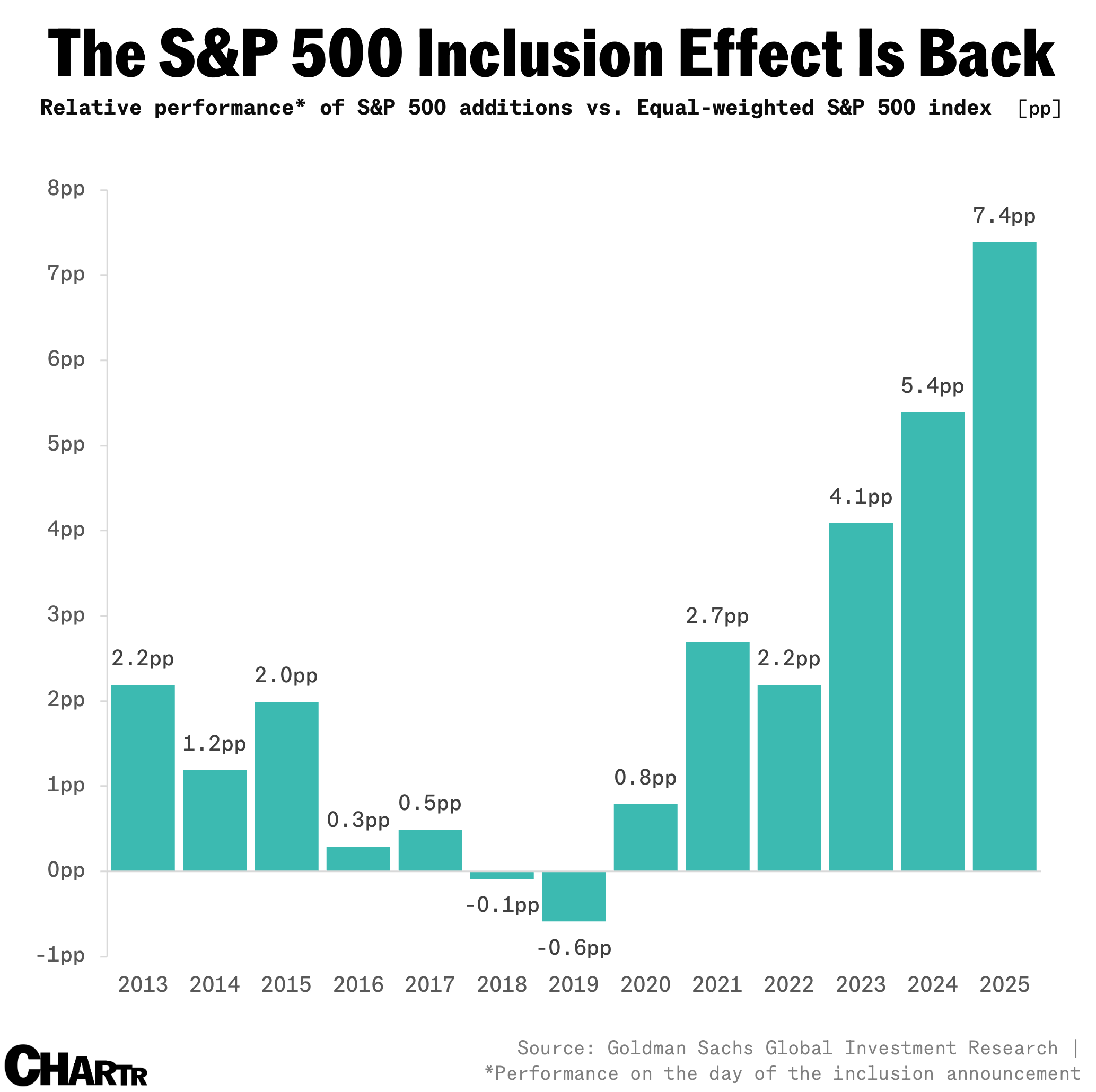
Now, though, a new Goldman Sachs analysis suggests the inclusion effect may be staging a comeback.
s&p500
Sherwood News

Since 2021, stocks newly added to the S&P 500 have outperformed the equal-weighted index by an average of 4 percentage points on the announcement day — with nearly three-quarters of those stocks beating the benchmark.

Source matters

One factor driving the revival is that fewer companies are migrating from the S&P MidCap 400 Index. Per Goldman’s estimate, stocks added from outside the S&P 400 have seen average relative gains of 5.3 pp since 2013, while those graduating from the midcap index actually dipped 0.4 pp.

Retail hype may also be adding fuel, with recent entrants like Coinbase, Super Micro Computer, Palantir, and Datadog already beloved by traders ahead of their debut — and tied to popular themes like AI or crypto

So, which big names could be next in line for America’s flagship index?

Go Deeper: Datadog is now in the S&P 500. These big stocks still aren’t.

More Markets

See all Markets
markets

SpaceX gets a wave of bullish ratings from Wall Street analysts

SpaceX received more than a dozen positive analyst calls on Tuesday — including from major Wall Street banks — as they initiate coverage on Elon Musk’s space and AI company.

SpaceX went public on June 12 at a $2.2 trillion valuation, the largest debut in history. While the company hasn’t yet posted a profit, it seems to have convinced Wall Street that it will get there and grow its valuation on the way.

Of the at least 17 analysts that gave a rating on Tuesday, all but one gave it a “buy” or “outperform” rating. MoffettNathanson was "neutral."

The ratings come as SpaceX joined the Nasdaq 100 index, a benchmark tech-heavy basket of companies that underpins millions of portfolios. The inclusion adds built-in demand for the stock from index funds and ETFs.

Still, SpaceX fell more than 5% on Tuesday amid a broader sell-off, and is currently effectively flat from its opening price of $150 a share.

markets

Nike sinks to lowest level since 2014 after warning of “challenged” sales environment in Q4 report

Did Nike do it?

Investors had a mixed reaction after the global sports apparel company reported its fourth quarter earnings on Tuesday after the bell. Shares initially rose 5% as Nike beat out Wall Street expectations amid a hefty tariff refund bonus. However, the stock then sank to its lowest level since August 2014 in postmarket trading.

Here are the Q4 numbers:

  • Revenue of $11.0 billion (estimate: $10.8 billion).

  • Adjusted earnings per share of $0.20 (estimate: $0.12).

Ahead of this report, Nike warned that results would be flattered by a one-time tariff refund (now estimated at roughly $0.52 per share for the bottom line). That gave the company an extra cushion in snapping its streak of seven quarters of year-over-year profit declines.

Over the past year, the company had been punished by tariffs on imported goods, stagnant consumer spending, and increasing competition from other footwear brands like New Balance, Adidas, and Hoka.

Outgoing CFO Matthew Friend deemed it an “increasingly challenging operating environment, where sell-through remains challenged.”

Latest Stories

Sherwood Media, LLC and Chartr Limited produce fresh and unique perspectives on topical financial news and are fully owned subsidiaries of Robinhood Markets, Inc., and any views expressed here do not necessarily reflect the views of any other Robinhood affiliate, including Robinhood Markets, Inc., Robinhood Financial LLC, Robinhood Securities, LLC, Robinhood Crypto, LLC, Robinhood Money, LLC, Robinhood U.K. Ltd, Robinhood Derivatives, LLC, Robinhood Gold, LLC, Robinhood Asset Management, LLC, Robinhood Credit, Inc., Robinhood Ventures DE, LLC and, where applicable, its managed investment vehicles.

