

Markets
markets

The job-openings-to-job-seekers ratio is getting smaller

On Friday, the Bureau of Labor Statistics released some pretty underwhelming US jobs data, with only 12,000 nonfarm payroll jobs added last month — the lowest figure since December 2020, and considerably less than the reported 223,000 new jobs added this September.

The last major economic report before America heads to the polls, the smaller-than-expected growth is explained in part by the unprecedented impact of hurricanes Helene and Milton, as well as recent national strike action. But, as Luke Kawa noted, what was more worrying were the revisions to previous months: August job growth, first reported as +142K, was revised to +78K, the worst reading since December 2020.
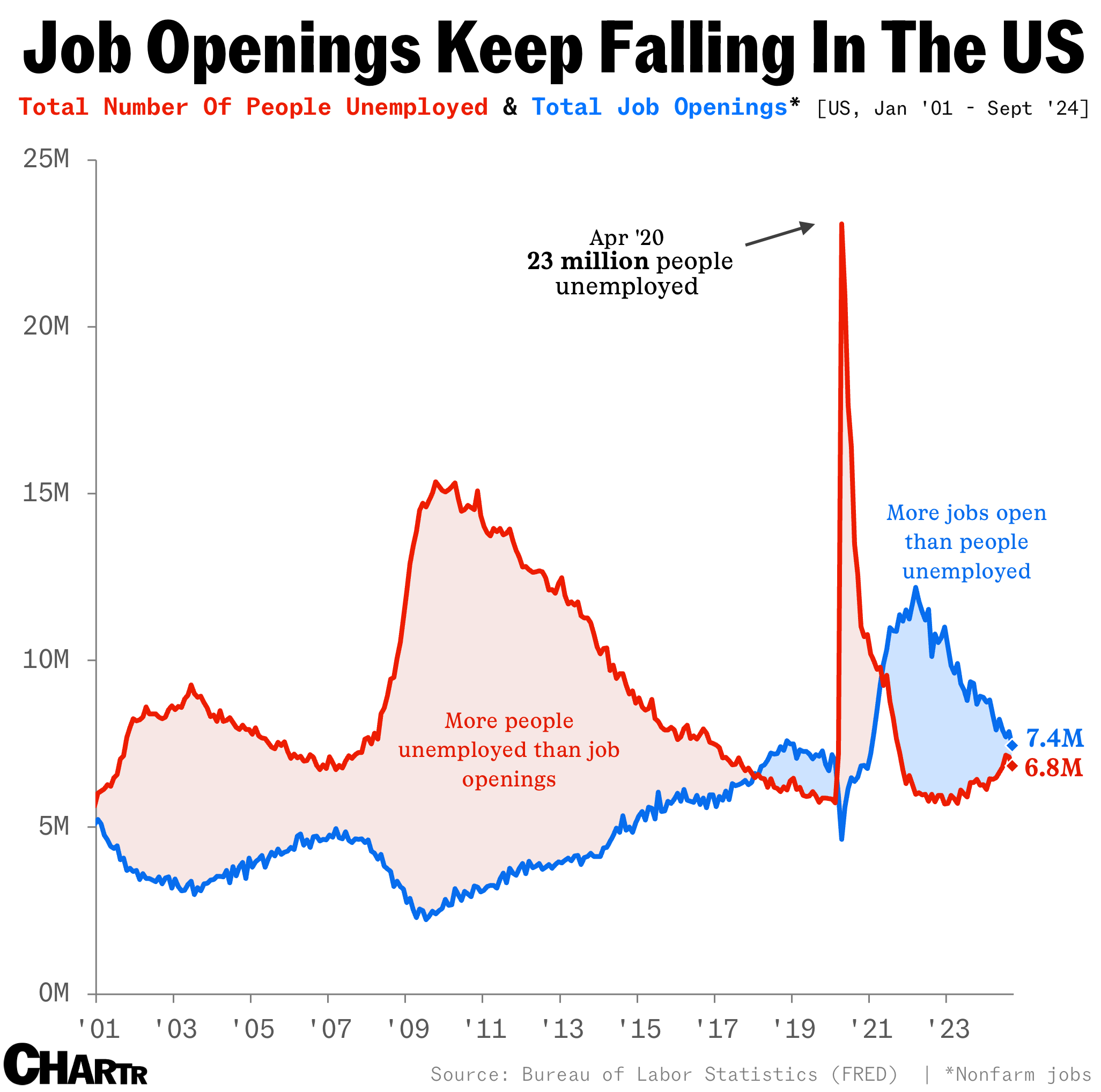
Job openings vs unemployment chart
Sherwood News

Though it might not have always felt like it, for much of the past six years (pandemic-craziness aside), it’s been a job seeker’s market, with more job openings than people unemployed. The latest JOLTS data revealed that the ratio of job openings to job seekers is narrowing, as job growth has continued to slow.


The last major economic report before America heads to the polls, the smaller-than-expected growth is explained in part by the unprecedented impact of hurricanes Helene and Milton, as well as recent national strike action. But, as Luke Kawa noted, what was more worrying were the revisions to previous months: August job growth, first reported as +142K, was revised to +78K, the worst reading since December 2020.

Job openings vs unemployment chart
Sherwood News

Though it might not have always felt like it, for much of the past six years (pandemic-craziness aside), it’s been a job seeker’s market, with more job openings than people unemployed. The latest JOLTS data revealed that the ratio of job openings to job seekers is narrowing, as job growth has continued to slow.

More Markets

See all Markets
markets

Poet Technologies surges as CFO confirms purchase order from Marvell, calls short sellers “maggots”

Shares of POET Technologies are continuing their parabolic surge after CFO Thomas Mika confirmed to StockTwits that the company would be booking revenues from custom chip and networking specialist Marvell Technology.

“We’re a supplier to Marvell now that they’ve acquired Celestial AI who has been a customer of ours for a couple of years,” he said. “And what we supply to Celestial AI are light sources, high-bandwidth, multi-frequency, high-power light sources that light up the photonic fabric that Celestial AI talks about as being the communication device between GPUs and one GPU and another GPU, a GPU and a memory device.”

Mika also said “I hate shorts” when asked about Wolfpack Research’s bet against the company, and said that short sellers were “maggots.” Wolfpack alleged that Poet’s US-based investors would be exposed to an “IRS tax nightmare.”

Personally, this explanation strikes me as pretty thin gruel. We’ve known since early December that Marvell was buying Celestial AI, and that Celestial AI is a Poet customer. Indeed, the stock got to surge when the deal was announced for that very reason! I can confirm that the sky is blue, I don’t know if that should be considered a catalyst to bid up the atmosphere.

On the other hand, you could do worse for a thesis these days than, “Hey, everything in the AI infrastructure supply chain seems to have mooned at one point or another recently, maybe let’s look for some names that mooned in 2025 that haven’t had their time in the sun in 2026!”

Poet’s in the connectivity space, which has been on fire in 2026. But shares had been down year-to-date before more than doubling over the past nine sessions.

The company’s rally once again includes massively bullish options action:

On a related note, Navitas Semiconductor is up double digits today and nearing its closing high from October, the latest in a series of current conditions we’re flagging as being eerily reminiscent of the market backdrop six months ago. Navitas is up more than 80% over the past nine sessions.

The Future of the AI boom is coming into view

GE Vernova and Vertiv are giving us a glimpse into the future of the AI boom

GEV’s backlogs are bursting at the seams. One analyst told us he thinks that by the end of this year, GEV could be completely sold out of production capacity for heavy-duty turbines until 2029 or 2030.

markets

Low-cost airlines plunge on report Trump administration is close to $500 million rescue deal for Spirit

Low-budget US airlines are sinking on Wednesday morning following a Wall Street Journal report that the Trump administration is close to making a rescue deal for Spirit Airlines, which is said to be nearing liquidation amid high fuel costs.

Shares of Frontier, Allegiant, JetBlue, and Southwest Airlines all dropped notably.

Per the WSJ, the US government could soon loan Spirit up to $500 million in return for warrants to take a sizable stake in the airline, which has filed for bankruptcy twice since late 2024. Those warrants could give the US government the ability to purchase as much as 90% ownership of Spirit, Bloomberg reports. The carrier has made efforts to emerge from its latest bankruptcy, filed in August, but fuel costs amid the war in Iran have upset the math.

On Tuesday, President Trump told CNBC he would “love somebody to buy Spirit.”

Per the WSJ, the US government could soon loan Spirit up to $500 million in return for warrants to take a sizable stake in the airline, which has filed for bankruptcy twice since late 2024. Those warrants could give the US government the ability to purchase as much as 90% ownership of Spirit, Bloomberg reports. The carrier has made efforts to emerge from its latest bankruptcy, filed in August, but fuel costs amid the war in Iran have upset the math.

On Tuesday, President Trump told CNBC he would “love somebody to buy Spirit.”

markets

Boeing reports better-than-expected Q1 earnings, revenue

Plane maker Boeing reported its first-quarter earnings before the market opened on Wednesday. Its shares climbed more than 3% in premarket trading.

For Q1, Boeing reported:

  • An adjusted loss of $0.20 per share, compared to the loss of $0.68 per share expected by Wall Street analysts polled by FactSet.

  • Revenue of $22.22 billion, compared to estimates of $21.85 billion.

Boeing reported -$1.45 billion in free cash flow in Q1, compared to the -$2.34 billion expected by Wall Street. Prior to Wednesday, Boeing had reported two consecutive quarters of positive FCF following six straight quarters of negative results. The company is still guiding for full-year FCF of between $1 billion and $3 billion.

Earlier this month, Boeing announced it had delivered 143 commercial jets in Q1, up 10% from the same period last year and ahead of rival Airbus, which delivered 114. This was Boeing’s first time outdelivering Airbus since 2018.

Latest Stories

Sherwood Media, LLC produces fresh and unique perspectives on topical financial news and is a fully owned subsidiary of Robinhood Markets, Inc., and any views expressed here do not necessarily reflect the views of any other Robinhood affiliate, including Robinhood Markets, Inc., Robinhood Financial LLC, Robinhood Securities, LLC, Robinhood Crypto, LLC, Robinhood Derivatives, LLC, or Robinhood Money, LLC. Futures and event contracts are offered through Robinhood Derivatives, LLC.
