
Markets
Salesman Moving Sales on Chart Up
Getty Images

How tech companies became the source – and death – of US stock market volatility

Tech stocks contain multitudes

Luke Kawa

Wall Street: “2024 is on track to have one of the highest numbers of fragility events among US tech companies since 1992.”

Also Wall Street: The behavior of the five tech megacaps atop the S&P 500 has created a “motionlessness” stock market.

These two seemingly contradictory ideas can both be right! 

Let’s tackle the first: it’s true that, on an individual level, certain tech stocks have had huge daily swings to the upside or downside.

“Salesforce and Dell experienced historic earnings-related moves last week, the latest examples of US Tech stocks exhibiting outsized jumps or price fragility,” write Bank of America analysts led by Benjamin Bowler. “In fact, such fragility shocks for Tech/US megacaps are near 30-year+ extremes today, both in terms of frequency and magnitude.”
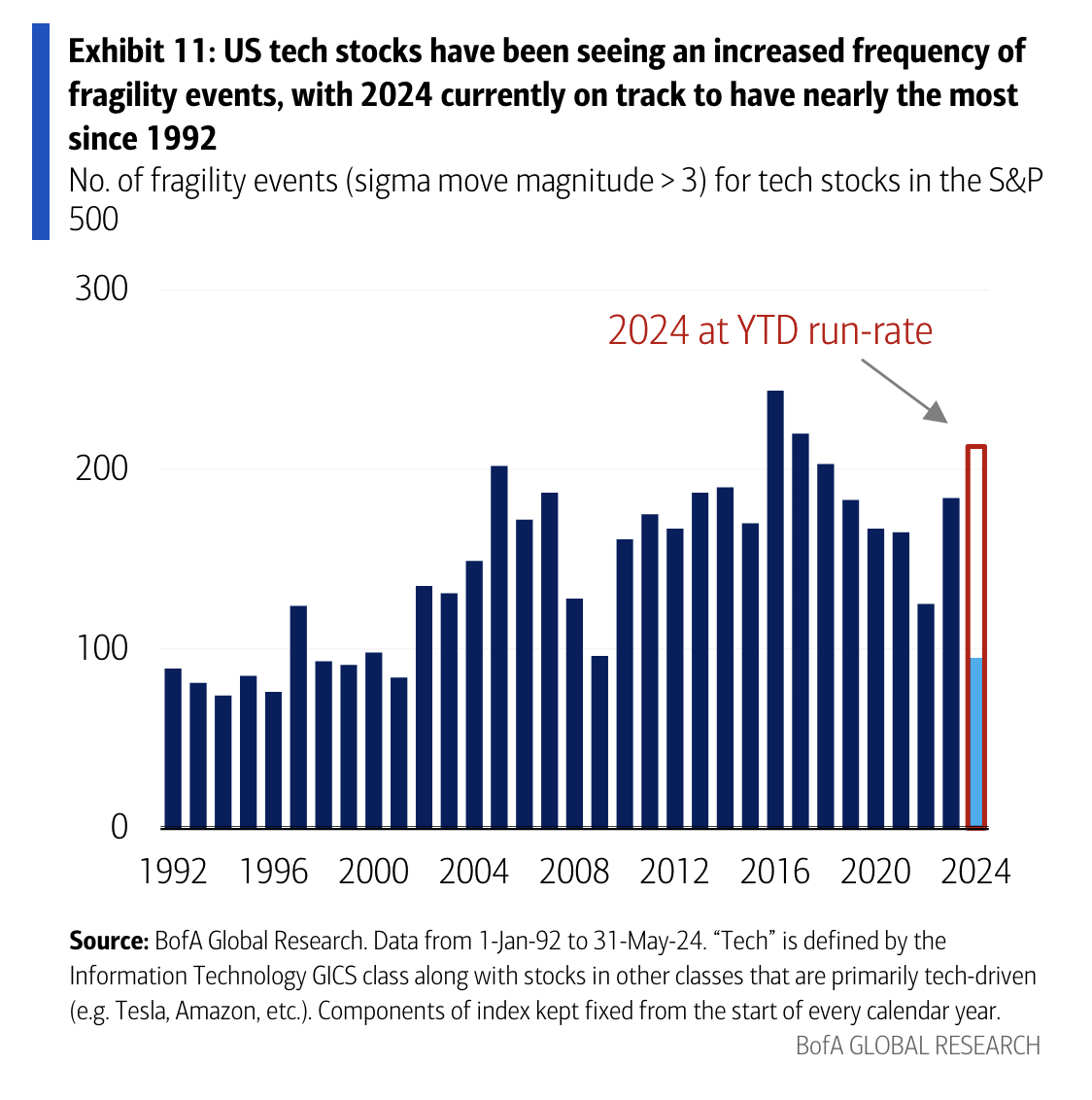
Fragility events in US tech stocks
Increasing frequency of so-called “fragility events” (BofA)

BofA deems it a so-called fragility event if a stock’s daily move is three times larger than its 21-day trailing realized volatility. In my view, this is a rather expansive definition, and periods of low volatility punctuated by hiccups can create these fragility events. Under this metric, a bump on the plains can appear more momentous than another incline on a mountain.

The analysts note that the extreme price moves this year have even been witnessed among the megacaps like Nvidia, Alphabet, and Meta. 

On the other hand, different major groups within the US stock market have been marching to the beat of their own drummers recently, and this dynamic has helped keep the stock market from lurching violently to the downside. 

Dean Curnutt, CEO of Macro Risk Advisors, takes this one step further and flags that even within technology giants, the components aren’t moving in unison.

“Stocks are zigging and zagging in a way that is unique even adjusted for a bull market,” he said on the Alpha Exchange podcast

This is true for the top five constituents: Microsoft, Apple, Nvidia, Alphabet, and Amazon. The average pairwise correlation between members of this group – loosely speaking, their tendency to move in the same direction — is just 43% over the past six months.

To be sure, it’s a little puzzling that correlations among these constituents are so low, given three of the five (Microsoft, Amazon, and Alphabet) are spending tens of billions on AI and another one of the five (Nvidia) is reaping the benefits of those outlays.

“Today’s paltry level of realized correlation among the supercaps comes at a time when the volatility of the stocks is also quite low,” Curnutt added. “The average of the six month realized volatility levels on these five corporate beasts is just 28%, again, one of the lowest readings over the last decade.”

So while BofA has been able to pick out some episodes where tech stocks — and even the heavyweights — are putting in eye-popping moves, by and large, the daily price action in these stocks has been rather mild versus history.

These low levels of realized correlation among major S&P 500 constituents are being extrapolated by market participants.

“In summary, option prices are really low because the motionlessness of indices like the S&P demands that be the case,” concludes Curnutt.

While BofA concedes that, to date, significant individual stock swings haven’t had major ramifications for the market as a whole, they think it’s just a matter of time until these massive moves in individual stocks happen in concert to the downside.

“So far, these fragility shocks have been idiosyncratic (occurring on different days), however, the risk is of a correlated shock among these companies that control so much of US as well as global equity indices,” they write. “Index vol continues to underprice this correlated shock risk, thus offering value as a fragility or broader market hedge.”

More Markets

See all Markets
Chicago Bulls player Michael Jordan is surrounded by NBA Championship trophies after his team defeated the Utah Jazz 90-86 to win the 1997 NBA Finals at the United Center in Chicago, IL.

Stock climb on US-Iran peace deal; semiconductors rally

This morning, President Trump and Iranian President Masoud Pezeshkian signed a memorandum of understanding aimed at ending the war.

markets

Intel surges after Trump announces US chip deal with Apple

Intel is soaring in early trading after President Donald Trump posted on Truth Social that Apple has agreed to work with the semiconductor giant to design and manufacture its chips domestically.

President Trump positioned the agreement as the latest victory for his administration’s industrial policy after the federal government acquired a 9.9% equity stake in Intel last year.

"Stupid Presidents took our Economy for granted, and let Taiwan and others steal our Semiconductor Factories," Trump wrote in the post. "We design everything, but we need to BUILD it here, NOW! So I decided to help Intel because we need to design and build our Chips right here in America... and, finally, Apple has agreed to work with Intel to design and build its Chips in America."

Intel reportedly reached a preliminary agreement back in May to manufacture chips for the Apple, which has been facing supply constraints for its iPhone as well other products. The deal could help Apple reduce its reliance on longtime partner TSMC by bringing more of its chip manufacturing stateside.

"This partnership helps Apple with chip development and manufacturing on US soil with greater focus on reducing dependence on Asian manufacturing facilities." Wedbush's Dan Ives commented in a company report. He has a $400 price target for Apple this year.

The timing aligns with Intel's technical roadmap. Earlier this week, Intel confirmed that its advanced, performance-boosted 18A-P process node officially entered its risk production phase. This move serves as a blueprint for both Intel chips and processors the company plans to build for foundry customers.

“The current capacity crunch is probably emboldening customers to give Intel a harder look at this stage than perhaps they might ordinarily be inclined to do as the prospect of more advanced capacity will take on higher value in a constrained environment,” wrote Bernstein analyst Stacy Rasgon. “We are sure that Trump’s encouragement is at least not going to hurt though.”

Momentum was built around Intel Foundry services as surging global AI demand continuously outpaced capacity. Earlier this month, Google reportedly placed an order with Intel to manufacture more than 3 million of its increasingly popular tensor processing unit chips in 2028. According to the report, Nvidia is also testing to see if Intel could manufacture its next-gen Feynman chips.

markets

Stocks rise after US, Iran sign peace plan

Stocks rose Thursday morning after President Trump and Iranian President Masoud Pezeshkian signed a memorandum of understanding aimed at ending the war, in another sign that a months-long war that caused energy prices to spike could be coming to an end.

Trump signed the MOU before a dinner in Versailles, France on Wednesday evening. The president previously announced that a deal had been reached on Sunday evening, saying that traffic through the Strait of Hormuz would resume and that the US naval blockade would be lifted.

The deal comes after both sides exchanged attacks last week, escalating tensions to some of the highest levels since the US and Israel struck Iran in late February.

The price of Brent Crude ticked even lower after dropping on Sunday, sitting at about $76 a barrel. Oil giants like Shell, Chevron and Exxon fell on the news, as average gas prices in the US dropped below $4 for the first time in months.

Futures for the S&P 500 and Nasdaq Composite rose 0.9% and 1.5%, respectively. Last week, inflation readings for May showed both wholesale inflation and consumer prices rose in large part because of higher energy costs.

Signs of the peace deal have also lead to buying of momentum stocks this week. iShares MSCI USA Momentum Factor ETFrose another 1.46% in premarket trading.

Latest Stories

Sherwood Media, LLC and Chartr Limited produce fresh and unique perspectives on topical financial news and are fully owned subsidiaries of Robinhood Markets, Inc., and any views expressed here do not necessarily reflect the views of any other Robinhood affiliate, including Robinhood Markets, Inc., Robinhood Financial LLC, Robinhood Securities, LLC, Robinhood Crypto, LLC, Robinhood Money, LLC, Robinhood U.K. Ltd, Robinhood Derivatives, LLC, Robinhood Gold, LLC, Robinhood Asset Management, LLC, Robinhood Credit, Inc., Robinhood Ventures DE, LLC and, where applicable, its managed investment vehicles.