
Markets
US-TECHNOLOGY-AI-MICROSOFT-COMPUTERS
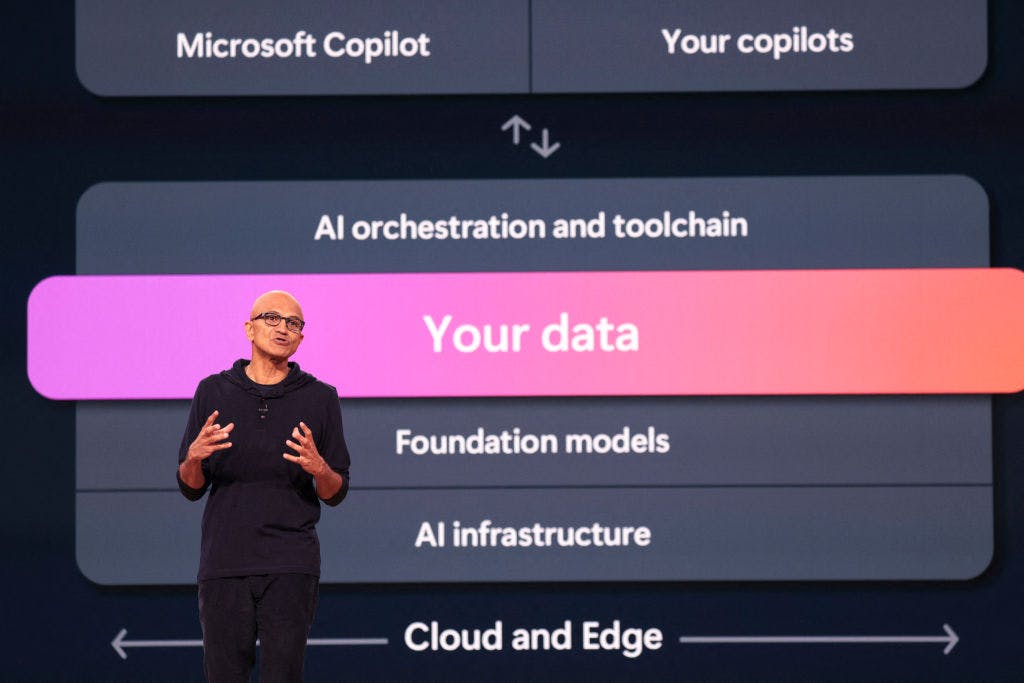
Microsoft CEO Satya Nadella (Jason Redmond/Getty Images)

TD Cowen warns that Microsoft might already have too many data centers

Despite CEO Satya Nadella making comments to the contrary last fall, analysts say the tech giant may now be in an oversupply position.

Microsoft’s boom in AI data center spending may have gotten out over its skis, according to a TD Cowen report published Friday that’s causing aftershocks across Wall Street and all the way over in Europe.

“Our recent channel checks indicate that Microsoft has terminated select leases with at least two private data center operators across multiple US markets to the tune of ‘a couple of hundred MW,’” wrote analysts led by Michael Elias, also saying that some of its real estate management tactics mirror measures that Meta took while curtailing its metaverse-related capex binge. Separately, they flagged that Microsoft may be reallocating some of its international spending budget to the US.

“Our initial reaction is that this is tied to Microsoft potentially being in an oversupply position,” they concluded.

European stocks with a link to the AI data center trade are taking one on the chin on Monday.

Chatter around this report, as well as the monthly options expiry, likely contributed to the magnitude of the losses across chip stocks on Friday, with Nvidia, Micron, Intel, and Microchip Technology all down 4% to 5%.

Of note: these are communication infrastructure analysts; Elias & Co. don’t cover Microsoft, but rather the likes of telecom infrastructure companies like American Tower, Crown Castle, and Equinix.

Last October, Microsoft CEO Satya Nadella said that supply constraints weighed on the company’s revenue generation from AI services “because data centers don’t get built overnight.” That message on the need to scale up was affirmed by the company’s massive capital outlay plans.

A Microsoft spokesperson reiterated Microsoft’s plans to spend over $80 billion on infrastructure this year, though they noted that the tech giant “may strategically pace or adjust” such spending.

The continued willingness of megacap tech companies to spend hundreds of billions on capex has been a massive boon for S&P 500 profit generation, and is probably one of the most critical factors to monitor in terms of judging whether the AI boom has gotten a little long in the tooth.

More Markets

See all Markets
markets

Lionsgate closes higher on Netflix acquisition rumor

Shares for the film production company Lionsgate soared on Tuesday following rumors of a potential buyout.

According to a person familiar with the possible merger and acquisitions deal, streaming giant Netflix is one of the companies that may be interested in buying Lionsgate Studios, per reporting by Semafor.

Neither Lionsgate nor Netflix confirmed the news, but nevertheless the stock climbed, closing up 14%.

Netflix closed lower on news that Fox will acquire Roku in an approximately $22 billion deal after it was also rumored that the streaming company was interested in that acquisition. “Netflix did not make a bid for Roku,” a spokesperson told Semafor. This comes after Netflix withdrew its buyout bid for Warner Bros. Discovery earlier this year.

Lionsgates shares are up 77% since January. Lionsgate owns massive franchises like John Wick and The Hunger Games. The film company has a market cap of approximately $4.7 billion, making it roughly 5x smaller than Roku and 13x smaller than Warner Bros.

markets

Oil tumbles below $80 to 3-month low on US-Iran deal

Oil prices slid to their lowest levels in more than three months today after a preliminary ceasefire agreement between the US and Iran raised expectations that more crude could return to global markets and key shipping routes through the Strait of Hormuz could reopen.

Brent crude fell below $78 a barrel while West Texas Intermediate dropped to $73.31, extending losses as traders priced in lower geopolitical risk premiums tied to Middle East supply disruptions.

The preliminary pact announced by President Donald Trump and Iranian leaders establishes a 60-day ceasefire to end the active hostilities that have choked the Middle East since late February. A formal memorandum of understanding is scheduled to be officially signed in Switzerland this Friday, according to Bloomberg report.

Trump said on Sunday that the Strait of Hormuz would be opened when the agreement is signed in Switzerland on Friday, writing on Truth Social, “Ships of the World, start your engines. Let the oil flow!

US Energy Department data, meanwhile, showed that Americas strategic oil stockpiles sank last week to their lowest level since 1983, indicating sustained demand to rebuild them even if the Mideast conflict ends.

Stocks that moved lower:

markets

Eos Energy surges on commercial launch of second battery production line

Eos Energy Enterprises is surging in early trading after announcing the official start of commercial production at its second automated battery manufacturing line.

In a statement, the company said this milestone positions it to scale production of its proprietary zinc-based long-duration energy storage systems to meet rising commercial demand.

Management touted the enhanced efficiency of this facility, with design upgrades slashing raw material travel by 86% and shortening the physical production line length by 40% compared to Line 1.

“Battery Line 2 demonstrates our ability to continuously improve as we scale,” said John Mahaz, Chief Operating Officer of Eos. “It validates that our manufacturing system can be replicated and scaled with discipline.”

The battery energy storage company confirmed that while subassemblies will continue coming online through the early third quarter, full production capacity is targeted for the fourth quarter of 2026. The ultimate goal is to hit an aggregate 4 gigawatt-hours of annual manufacturing capacity by the end of 2026. Management also highlighted that Battery Line 1 already surpassed its full-year 2025 output within the first 164 days of 2026.

Today’s announcement builds on recent operational momentum for Eos, which posted better-than-expected Q1 sales and announced a joint venture with Cerberus Capital Management in May. However, shares are still down 37% year to date.

For the full year, Eos still expects to achieve revenues between $300 million and $400 million, in line with its previously provided guidance.

markets
Luke Kawa

Qualcomm reportedly in talks to acquire AI chip design company Tenstorrent

Qualcomm is in talks to acquire AI chip design firm Tenstorrent for $8 billion to $10 billion, according to The Information.

This transaction, if completed, would be another concrete signal of the San Diego-based chip company’s attempt to carve out a niche in the upstream AI space (data centers), rather than focusing on end-user devices.

Qualcomm’s key business of handset chips has fallen on hard times, particularly in China, due to the memory chip shortage.

Less than eight weeks ago, the chip company was the lowlight in the Philadelphia Semiconductor Index, down about 20% year to date.

Shares proceeded to surge over 60%, buoyed by optimism that the rising AI tide will lift all boats. With the release of Q2 earnings, CEO Cristiano Amon said that initial shipments of AI chips to a “leading hyperscaler” were on track for later this year, and to expect more on the company’s AI growth plans at its investor day on June 24 (next week). Last month, Bloomberg reported that Qualcomm is poised to sell “millions” of AI chips to TikTok parent ByteDance.

Established AI chip giants and hyperscalers alike have reached agreements with or gobbled up burgeoning AI chip companies as the boom rolls on. In December, Nvidia announced a major licensing deal with AI inference specialist Groq, while Meta bought AI chip startup Rivos in September.

Latest Stories

Sherwood Media, LLC and Chartr Limited produce fresh and unique perspectives on topical financial news and are fully owned subsidiaries of Robinhood Markets, Inc., and any views expressed here do not necessarily reflect the views of any other Robinhood affiliate, including Robinhood Markets, Inc., Robinhood Financial LLC, Robinhood Securities, LLC, Robinhood Crypto, LLC, Robinhood Money, LLC, Robinhood U.K. Ltd, Robinhood Derivatives, LLC, Robinhood Gold, LLC, Robinhood Asset Management, LLC, Robinhood Credit, Inc., Robinhood Ventures DE, LLC and, where applicable, its managed investment vehicles.

