
Markets
Seinfeld
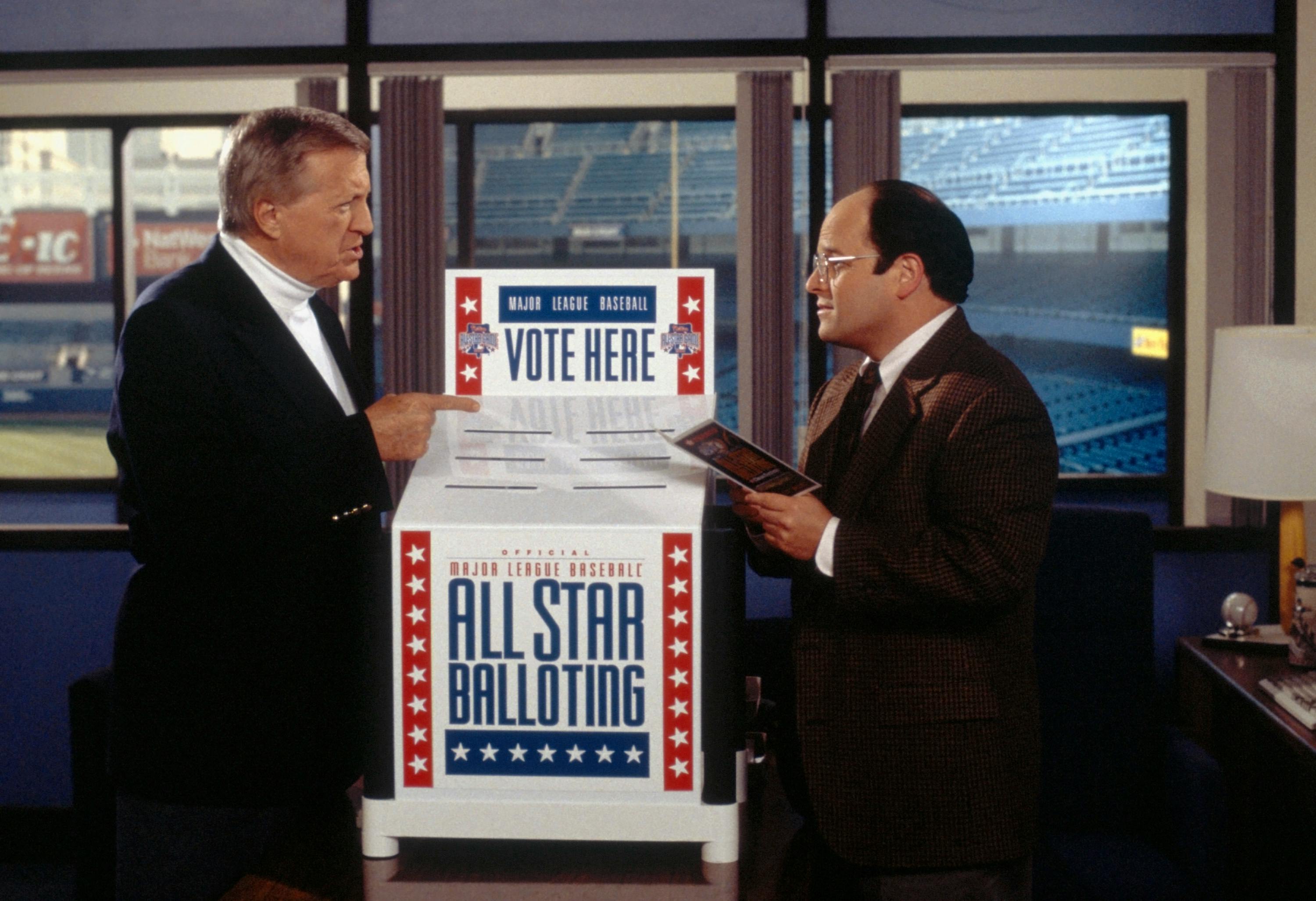
Scene from “Seinfeld” with George M. Steinbrenner III as himself (left) and Jason Alexander as George Costanza (Alice S. Hall/Getty Images)
We’ll do nothing!

Tariffs have us heading for a “do nothing” economy

To play the game, you’ve got to know the rules, and in trade, those rules are being rewritten in a very haphazard fashion.

Luke Kawa

The reciprocal tariffs that turned financial markets upside down haven’t even gone into effect yet. Even so, there’s an emergent theme in what kind of reactions we’re seeing — and realistically, would expect to see — from Corporate America.

The strategy is, to borrow from Seinfeld character George Costanza’s TV show pitch: “We’ll do nothing!” Tariffs this large are paralyzing (or worse) for corporate decision-makers, because the rules of global trade are being rewritten to an uncertain end for a potentially indefinite period of time. Or not.

By contrast, Covid — in financial terms — was primarily a liquidity crisis, with companies racing to get their hands on cash and investors seeking safety in the most riskless asset there is. From the February 19, 2020, prepandemic peak in stocks through the end of March, money market fund assets increased by a whopping $763 billion. Long and short positions in futures were liquidated en masse to meet margin calls. Swaths of companies began to draw on their revolving credit facilities to bolster their cash reserves. Buybacks went on hold. And so on.

There is always room for any downturn to become a liquidity crisis, but for now, the defining characteristic of what we’re in the midst of is that it’s causing economic actors to want to do nothing. 

Here are the not-so-sweet nothings:

̶I̶n̶i̶t̶i̶a̶l̶ ̶P̶u̶b̶l̶i̶c̶ ̶O̶f̶f̶e̶r̶i̶n̶g̶s̶

The “PO” in IPO now stands for “put off.” Swedish BNPL company Klarna delayed its initial public offering, as did StubHub. Media reports indicate that Ryan Reynolds-connected TV ad platform and fintech company Chime is also reportedly staying away, likely due to (to use a euphemism) “market conditions.”

“Expect management teams to strike a cautious tone, validate a pause in customer activity,” Bank of America analysts led by Ebrahim H. Poonawala wrote in a recent note previewing bank earnings, in which they cut profit estimates for the group.

Tapped Out

In a very related bad-news story for Corporate America in general and financials in particular, the credit market is seemingly drying up. High yield and investment grade cumulative issuance barely inched higher last week. Patterson Cos was the only new high-yield sale last week, and investment-grade issuance had its slowest week of the year. Per Bloomberg, one ready borrower passed on tapping the market on Friday after China announced retaliatory tariffs.

Act of God

According to a letter seen by Reuters, Howmet Aerospace has declared a “force majeure event” and is aiming to excuse itself “from supplying any products or services that are impacted by this declared national emergency and/or the tariff executive order.” Force majeure is typically invoked due to an “act of God,” wherein tornados or tsunamis disrupt operations and leave companies unable to make good on contracts.

And, in a small — but meaningful, for millions of gamers — example of how tariffs can undermine the best-laid corporate plans, Nintendo said it’s delaying Switch 2 preorders in light of the levies.

Just imagine thinking of sending cargo across the Pacific from Asia, where devices like the Switch are being manufactured, when you’re staring at massive tariffs once you get there. Understandably, many shippers aren’t, per the CEO of supply chain logistics company Flexport:

Even worse than doing nothing, some companies are already going to be doing less, with fewer workers. Notably, Stellantis announced plans to lay off 900 US workers.

Sitting, Waiting, Wishing

Faced with a looming shock to both prices and activity, the latest message delivered by Federal Reserve Chair Jerome Powell on Friday was that it was “not clear what the appropriate path for monetary policy will be.” He added that central bankers were “waiting for greater clarity before we consider adjustments” and that it doesn’t feel like they need to be in a hurry to act.

Reply Hazy, Try Again

Earnings season unofficially kicks off this Friday with JPMorgan, Wells Fargo, and Morgan Stanley reporting before the bell. One thing you shouldn’t expect a lot of this reporting period, according to Wedbush tech analyst Dan Ives, is management teams providing a picture of what their financials will look like through the rest of the year.

“At the current situation we do not expect most tech companies to give any guidance on the 1Q conference calls over the next month including Apple given too much uncertainty,” he wrote in a note slashing his price target on the iPhone maker. “The sheer uncertainty of this tariff announcement will cause demand destruction for consumers globally (recession fears, etc) and the price consequences of this tariff action are hard to grasp and model.”

More Markets

See all Markets
markets

AMD shares climb on double Citi upgrade to “buy” with $575 price target

AMD’s shares are rising in premarket trading following a double upgrade from Citi. Citi analyst Atif Malik raised AMD’s investment rating to “buy” from “neutral” and boosted the bank’s 12-month price target to $575 from $460 per share, per Barron’s.

Malik argued that the broader market currently misprices AMD by looking at it primarily as a CPU producer, underestimating its massive GPU potential. Citi says that AMD is uniquely “poised to win the lion’s share” of Meta’s customized graphics chip business. Meta is leaning into AMD’s custom MI450 chips, which deliver a lower total cost of ownership compared to buying traditional off-the-shelf merchant hardware, according to Investing.com.

Citi highlighted a massive multiyear deal between the two tech giants involving a 160 million-share common stock warrant. As the first phase ramps up through 2027, Citi expects each gigawatt of data center infrastructure to translate into roughly $15 billion in revenue. Consequently, Citi hiked its 2027 AMD AI sales forecast to $33 billion (up 137% year over year) and projects GPU sales to reach $50.8 billion by 2028.

CEO Lisa Su recently delivered an optimistic demand forecast, predicting that the global market for CPUs will grow by more than 35% annually over the next five years. The chipmaker delivered a robust Q1 earnings report back in May that beat Wall Street expectations across key data center segments.

markets

Astera Labs, CoreWeave, Nebius, Rocket Lab, Teradyne rise on Nasdaq 100 Index inclusion announcement

Tech stocks Astera Labs, CoreWeave, Nebius, Rocket Lab, and Teradyne have risen as much as 8.9% in premarket trading on Friday, thanks in part to Nasdaq’s announcement that the five companies will join its flagship Nasdaq 100 Index starting June 22.

As part of the index operator’s quarterly rebalance, which affects some $1.4 trillion in assets within the Nasdaq 100 ecosystem, the companies will replace Charter, Zscaler, Cognizant, Insmed, and Verisk — relatively slow-growth legacy businesses that have lingered around the bottom of the index in market cap terms of late. Most of those stocks slipped slightly on the news.

With CoreWeave and Nebius as two of the major players in the neocloud space, and Astera Labs and Teradyne specializing in making AI hardware and semiconductors, the latest additions reflect how the index is upping its exposure to the AI infrastructure stack. Back in December, Nasdaq also added AI data storage names Seagate Technology Holdings and Western Digital, as well as AI server manager Monolithic Power Systems, as part of its quarterly rebalance.

markets
Jon Keegan

Adobe beats on Q2 earnings, revenue; CFO to step down

Adobe reported fiscal Q2 results Thursday, beating analysts’ estimates for revenue and earnings, as its stock plumbed its lowest levels since 2019.

For Q2 2026, the creative software company posted:

  • Revenues of $6.62 billion (estimate: $6.45 billion).

  • Adjusted earnings per share of $5.96 (estimate: $5.82).

  • Annual recurring revenue of $27.1 billion (estimate: $26.6 billion).

  • Subscription revenue of $6.42 billion (estimate: $6.27 billion).

  • Remaining performance obligations of $22.27 billion (estimate: $21.86 billion).

The company also said its CFO, Dan Durn, would step down next week “to pursue a new professional opportunity.” And it boosted its full-year guidance for earnings and revenue.

Shares fell 5.5% in after-hours trading.

Adobe is feeling the pressure from AI, as the April release of Anthropic’s Claude Design threatens the company’s core design software business. Shares have tanked lately, with the stock down by nearly half over the past 12 months, putting it at levels not seen in years.

Last quarter, Adobe announced that CEO Shantanu Narayen, who had been at the company for 18 years, would be leaving after his successor was appointed. Today, Adobe announced that CFO Dan Durn would also be leaving the company — this month.

Adobe announced a $25 billion stock buyback in April, which gave the stock a boost. The company said it repurchased about 8.5 million shares during the quarter.

In a press release, Narayen said:

“Adobe delivered record revenue of $6.62 billion in Q2 reflecting strong AI-driven demand across our customer groups and we are raising our full-year fiscal 2026 revenue and non-GAAP EPS targets on the strength of that performance.”

markets

Trump says he’s called off impending strikes on Iran, sending stocks higher and oil plunging

President Trump on Thursday afternoon said he is calling off upcoming planned strikes on Iran. In a Truth Social post, Trump said “discussions with the Islamic Republic of Iran have been brought to the highest level of Iranian leadership and approved.”

Stocks broadly popped, with the S&P 500 moving from roughly flat to up 1.4% on the day, and oil plunged on the news.

“Discussions and final points have been, in both concept and great detail, approved by all parties involved, including the United States, Israel, Saudi Arabia, UAE, Qatar, Turkey, Pakistan, Bahrain, Kuwait, Jordan, Egypt, and others. The Naval Blockade will remain in full force and effect until this Transaction is finalized — Time and place of the signing to be announced shortly,” the president added.

West Texas Intermediate crude futures are down 3% on Thursday afternoon, dropping sharply following the post.

Oil-sensitive stocks reacted accordingly, with airlines including Delta Air Lines, American Airlines, United Airlines, Southwest Airlines, JetBlue, Alaska Air, and Frontier all climbing significantly. Carnival, Norwegian, and Royal Caribbean similarly jumped.

Freight companies including UPS, FedEx, XPO, and Old Dominion Freight were also up on oil’s movement.

Oil-adjacent companies including Exxon, ConocoPhillips, and Occidental Petroleum dipped.

Latest Stories

Sherwood Media, LLC and Chartr Limited produce fresh and unique perspectives on topical financial news and are fully owned subsidiaries of Robinhood Markets, Inc., and any views expressed here do not necessarily reflect the views of any other Robinhood affiliate, including Robinhood Markets, Inc., Robinhood Financial LLC, Robinhood Securities, LLC, Robinhood Crypto, LLC, Robinhood Money, LLC, Robinhood U.K. Ltd, Robinhood Derivatives, LLC, Robinhood Gold, LLC, Robinhood Asset Management, LLC, Robinhood Credit, Inc., Robinhood Ventures DE, LLC and, where applicable, its managed investment vehicles.

