
Markets
CHINA-US-TRADE-DIPLOMACY
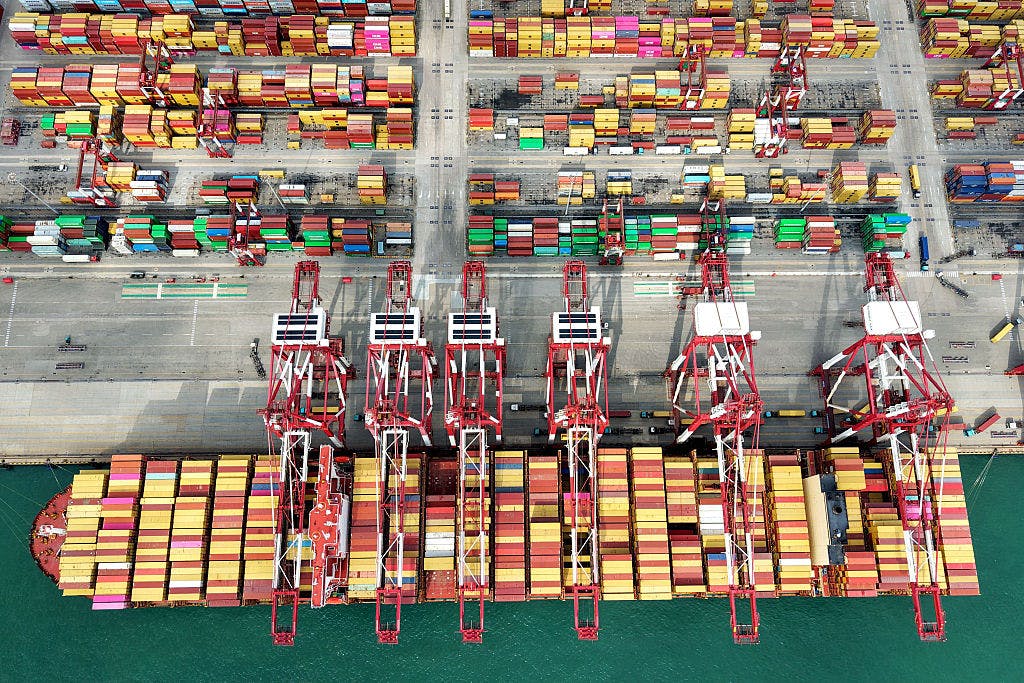
A ship is seen at the container terminal of the port in Qingdao, in China's eastern Shandong province, on October 9, 2025 (AFP/Getty Images)
TACO MONDAY?

Stocks bounce back in the futures market, regaining some of Friday’s lost ground after Trump softens China stance

Here we go again.

David Crowther

US equity markets are starting the federal holiday broadly in the green, recapturing some of the losses from Friday, after President Trump signaled some softening in his stance on China just two days after threatening an additional 100% tariff on Chinese goods. Amid a flurry of Israel-Gaza posts, the president told his followers on Truth Social not to worry:

Don’t worry about China, it will all be fine! Highly respected President Xi just had a bad moment. He doesn’t want Depression for his country, and neither do I. The U.S.A. wants to help China, not hurt it!!!

The reemergence of tariffs as a threat to the economy on Friday roiled traders, who have largely been treating trade hiccups as a solved problem, with the S&P 500 Index down 2.7%. That was the worst day for the index since April, when the impact of the Liberation Day tariff announcements first punctured the global economic order.

Currently, trading in the futures markets suggests that more than half of that loss could be clawed back once the full session begins, with S&P 500 futures up ~2% from the lows of last week.

High-growth winners of the AI trade were caught up in Friday’s carnage, but many of those same high-beta momentum stocks are also leading the bounce back in early trading this morning: Nvidia, Tesla, AMD, Micron, IREN, and Palantir were among the most heavily traded names as of 7:05 a.m. ET, and were up between 2.5% and 6.5%.

So, where do we go from here?

In a note published yesterday, analysts at Goldman Sachs said that the policy moves suggest “a wider range of outcomes than was the case ahead of prior US-China talks over the last few months, with the possibility of greater concessions (and possibly lower tariffs) but also a risk of substantial new export restrictions and higher tariffs, at least temporarily.”

Led by the firm’s chief economist, Jan Hatzius, the Goldman team also noted that the events of the last few days could simply be an attempt to “gain negotiating leverage ahead of bilateral talks on the sidelines of the APEC meeting in South Korea late this month” — an interpretation that they leaned toward, most likely leading to an extension of the current tariff pause in some shape or form.

While some of the trade concerns seem to have abated in the last 24 hours, traders are continuing to bet that rare earth stocks will be ongoing beneficiaries of the US-China spat. At the time of writing, MP Materials, Critical Metals, USA Rare Earth, and Lithium Americas were all trading higher. MP Materials in particular has seen a substantial amount of volume — some $93 million and change, as of 7:15 a.m. ET — more than tech giants like Palantir, Oracle, and Intel.

Last week, the president decried what he described as Chinese efforts to control the pipeline of the sought-after minerals.

More Markets

See all Markets
markets

United beats Q1 earnings and revenue estimates, lowers full-year profit guidance amid surging jet fuel prices

United Airlines reported its first-quarter earnings results after the bell on Tuesday. The carrier’s shares ticked down in after-hours trading.

For Q1, United reported:

  • Adjusted earnings of $1.19 per share, compared to the Wall Street estimate of $1.08 per share compiled by FactSet.

  • $14.6 billion in revenue, compared to the $14.39 billion consensus estimate.

In the first quarter, United’s fuel expense grew 12.6% from the same period last year to $3.04 billion.

For the second quarter, United expects adjusted earnings per share of between $1 and $2, shy of Wall Street expectations of $2.08. For the full year ahead, United said it expects earnings between $7 and $11 per share, compared to its prior guidance of between $12 and $14 per share.

“Guidance assumes United’s revenue recovers 40% to 50% of the fuel price increases in the second quarter, 70% to 80% of the fuel price increases in the third quarter and 85% to 100% of the fuel price increases in the fourth quarter 2026,” read the company’s investor update.

Earlier this month, United was among the first major US airlines to hike its bag fees amid higher fuel costs. Its shares have fallen more than 15% from a February high days before the war in Iran began.

United has also made waves this month following reports that CEO Scott Kirby had floated the idea of a merger with American Airlines to President Trump. A merger between two of the big four airlines would create a true US behemoth, controlling more than a third of the American market. American Air last week said it wasn’t interested in merging with United and hadn’t held talks on the idea. On Tuesday, Trump told CNBC that he doesn’t like the idea either.

markets

Hedge funds are following retail traders into the Magnificent 7

Hedge funds are following retail traders into the stocks the masses never stopped buying.

“As we kick off earnings for megacap tech stocks, this stood out: [hedge funds] have started buying Mag7 stocks again this month though positioning remains well below the peak levels seen in early 2016,” wrote Goldman Sachs’ Cullen Morgan.

Goldman PB Mag 7
Source: Goldman Sachs

In early April, JPMorgan strategist Arun Jain noted that retail investors had basically been selling everything but the Magnificent 7 stocks as part of a more cautious stance due to the Iran war.

(Apple has been a long-standing exception to this trend, presumably because retail traders arent fond of its hands-off approach to AI.)

JPM Retail flows

Last August, Jain discussed how retail activity tended to “crowd in” institutional buyers in meme stocks, while Goldman’s John Marshall advised clients to piggyback on stocks beloved by retail traders. Speculative, retail-geared assets proceeded to go on a tremendous run that soured in October.

But there are some early indications that a similar bout of speculative fervor is bubbling up once more.

markets

POET Technologies surges above $10 for first time in 4 years amid explosion in call volumes

POET Technologies is up nearly 40% this week as options market activity goes haywire in a faint echo of what got the stock on retail traders’ radars in October.

As of 11:12 a.m. ET, more than 10 calls have changed hands for every put traded. This bullish impulse has propelled the stock above the $10 threshold for the first time since March 2022.

Shares of the optical communications firm briefly dipped last week after Wolfpack Research said it was short the company because its investors would be exposed to an “IRS tax nightmare.”

The company responded that day saying it was taking measures for US shareholders that “should mitigate certain potential adverse US federal income tax consequences to it that could otherwise result from the Company’s status as a passive foreign investment company.”

Latest Stories

Sherwood Media, LLC produces fresh and unique perspectives on topical financial news and is a fully owned subsidiary of Robinhood Markets, Inc., and any views expressed here do not necessarily reflect the views of any other Robinhood affiliate, including Robinhood Markets, Inc., Robinhood Financial LLC, Robinhood Securities, LLC, Robinhood Crypto, LLC, Robinhood Derivatives, LLC, or Robinhood Money, LLC. Futures and event contracts are offered through Robinhood Derivatives, LLC.

