
Markets
Brunette crying
(Getty Images)
Wake me up when September ends

Welcome to September, when stocks go usually down

We’re entering a pretty ugly month for financial assets.

Yiwen Lu

Welcome to September. Although given the track record of recent years, perhaps we should say beware, instead: the S&P 500 and the STOXX 600 have lost ground in each of the last 4 Septembers.
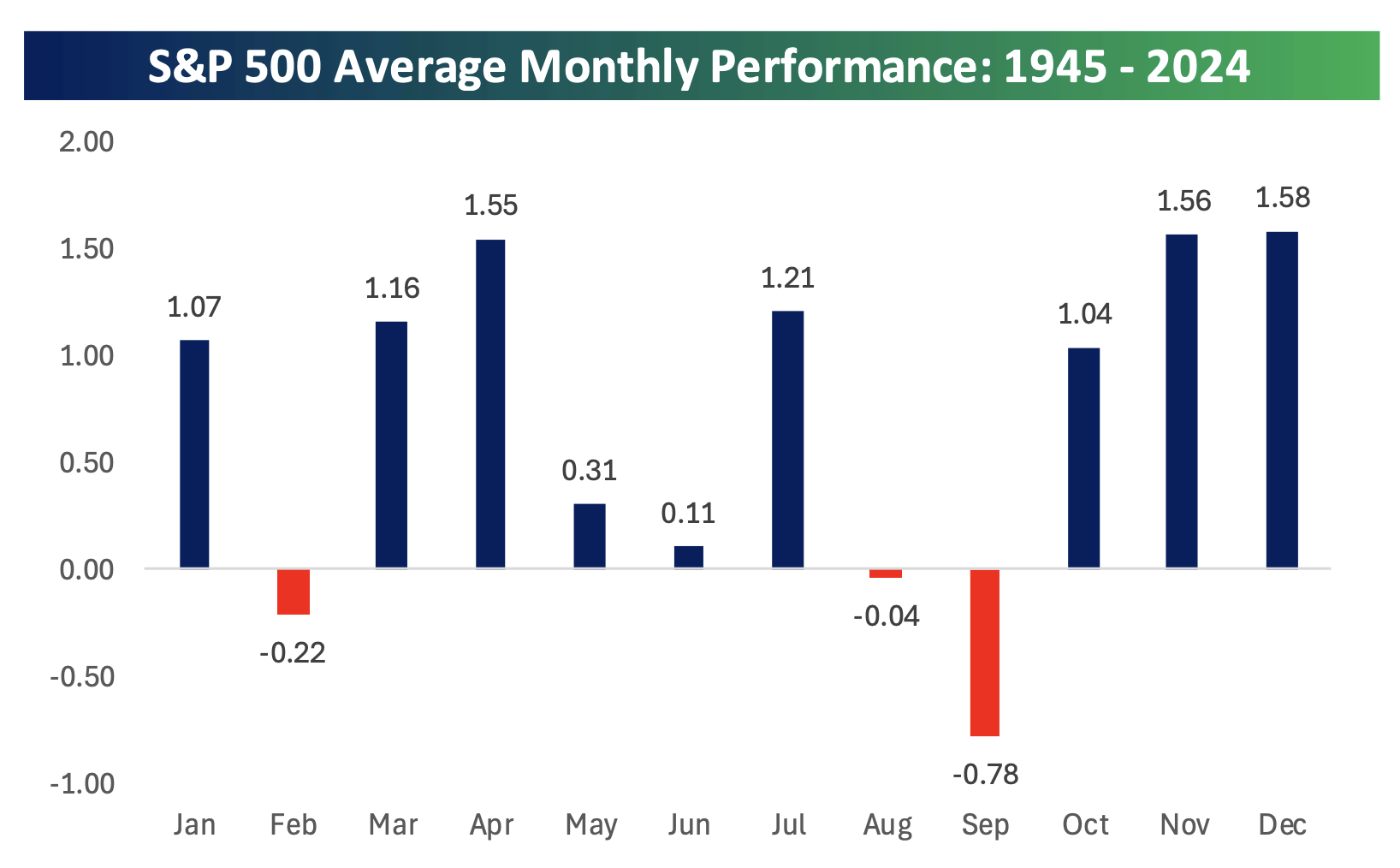
S&P Average Performance
Bespoke Investment Group

And if you’re hoping for respite in fixed income, there hasn’t been any there, either. In fact, Bloomberg’s global bond aggregate is down in each of the last 7 Septembers. So any gains this month would certainly be bucking the trend.
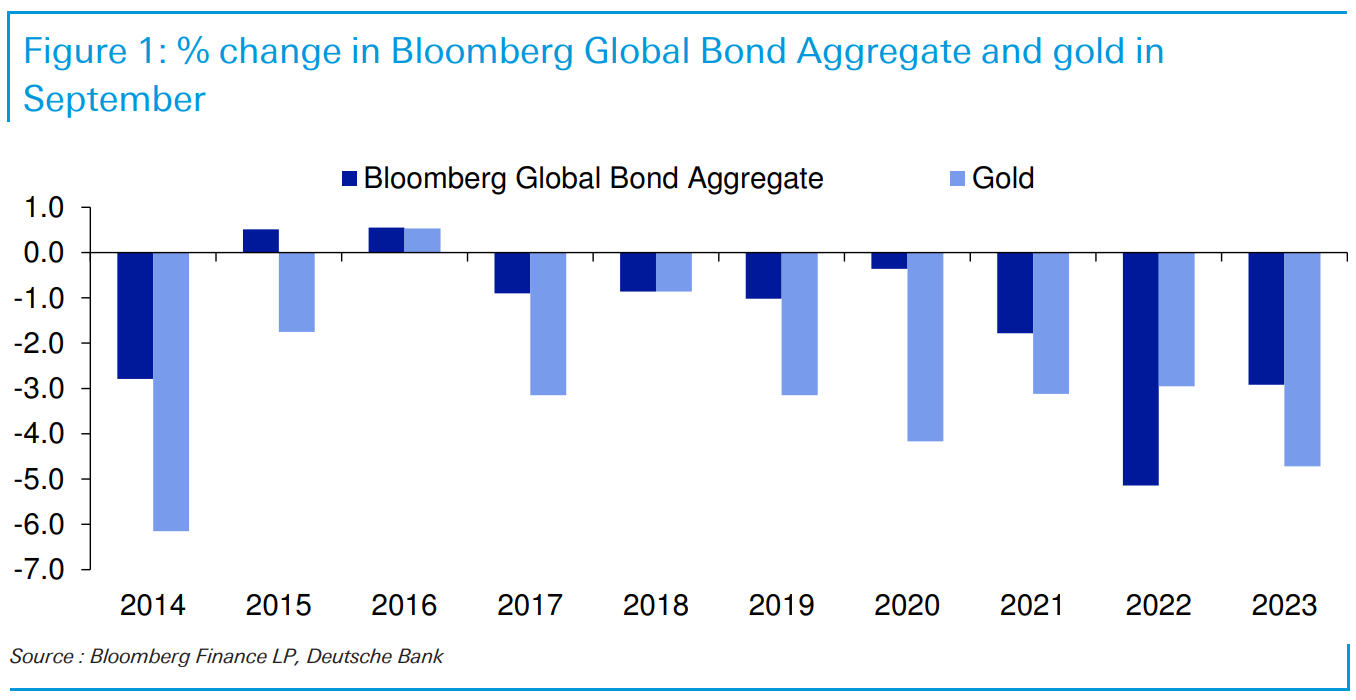
Global Bond Aggregate down in each of the past 7 Septembers, while gold has been lower in 10 of the last 11 Septembers. (Source: Deutsche Bank Research)

Since 1945, the S&P 500 averaged a decline of 0.78% in September. But this negative performance has been exacerbated over the past decade, where the S&P 500’s median performance in September was -2.6%, per Bespoke Investment Group. Only 3 out of 12 months have averaged declines, and September is by far the worst of the three. For the past four Septembers, S&P 500 was down 4.9%, 9.3%, 4.8%, and 3.9%. 

While bulls pushed August into positive territory with a 1.3% gain, “seasonal weakness in September could spoil the momentum,” wrote Adam Turnquist, chief technical strategist for LPL Financial.

One key event this month is the Federal Reserve meeting on September 18, where US monetary policymakers are expected to join many other developed-market central banks in cutting rates. This coincides with the midway point of September, which, historically, is a time when losses begin to crescendo. 
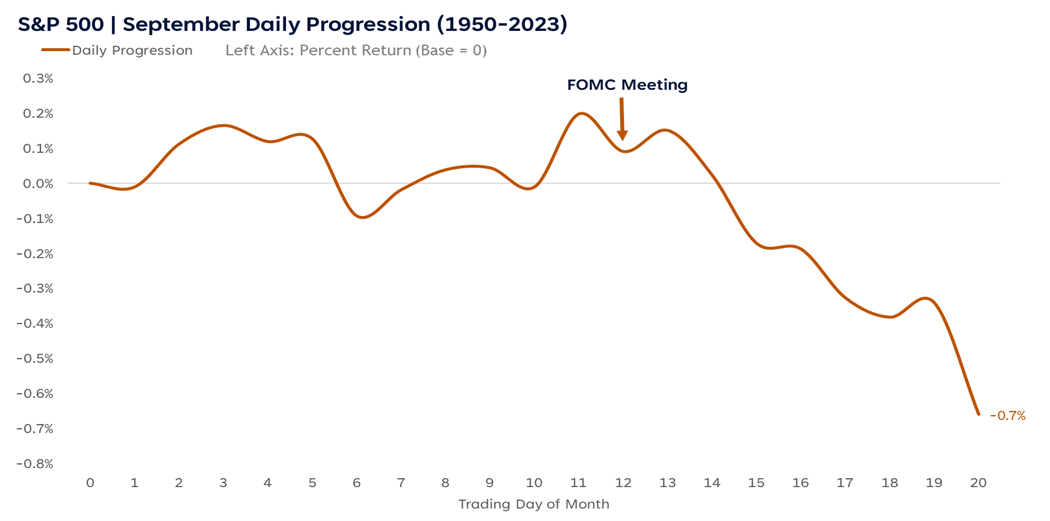
September seasonal setup for S&P 500
(Source: LPL Financial Research; Bloomberg 08/29/24)

The month is starting just the way you’d expect, given history: S&P 500 is off as much as 1.6% on Tuesday morning. The last time S&P 500 was positive on the first trading day after Labor Day was 2016.
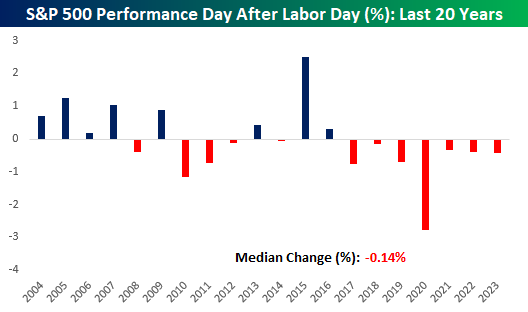
(Source: Bespoke Investment Group)

While everyone is watching seasonality, beneath the hood of the stock market is the big battle: whether tech stocks can carry the rest of the market, or if the world falls off Atlas’ shoulders.

Michael Purves, the founder of Tallbacken Capital Advisors, said that “it’s the elections, not the Fed meeting, which gets our focus.” He noted that if the stocks of the big tech companies couldn’t lead the market, then the overall market could be subject to further volatility due to the election. 

Jim Reid, global head of macro research at Deutsche Bank added that the end of September will mark a five-week countdown to the US election, and close races usually lead to lower stock markets before a rally. 

The final week of August showed how Magnificent Seven stocks dragged the S&P 500 lower, even the majority of S&P 500 stocks went up. Nvidia’s earnings report, which disappointed relative to high expectations, will “contribute to the whipsaws on the index level and delay re-entry to all-time high territory,” according to John Kolovos, the head of technical strategy at Macro Risk Advisors.

More Markets

See all Markets
markets

SpaceX gets a wave of bullish ratings from Wall Street analysts

SpaceX received more than a dozen positive analyst calls on Tuesday — including from major Wall Street banks — as they initiate coverage on Elon Musk’s space and AI company.

SpaceX went public on June 12 at a $2.2 trillion valuation, the largest debut in history. While the company hasn’t yet posted a profit, it seems to have convinced Wall Street that it will get there and grow its valuation on the way.

Of the at least 17 analysts that gave a rating on Tuesday, all but one gave it a “buy” or “outperform” rating. MoffettNathanson was "neutral."

The ratings come as SpaceX joined the Nasdaq 100 index, a benchmark tech-heavy basket of companies that underpins millions of portfolios. The inclusion adds built-in demand for the stock from index funds and ETFs.

Still, SpaceX fell more than 5% on Tuesday amid a broader sell-off, and is currently effectively flat from its opening price of $150 a share.

markets

Nike sinks to lowest level since 2014 after warning of “challenged” sales environment in Q4 report

Did Nike do it?

Investors had a mixed reaction after the global sports apparel company reported its fourth quarter earnings on Tuesday after the bell. Shares initially rose 5% as Nike beat out Wall Street expectations amid a hefty tariff refund bonus. However, the stock then sank to its lowest level since August 2014 in postmarket trading.

Here are the Q4 numbers:

  • Revenue of $11.0 billion (estimate: $10.8 billion).

  • Adjusted earnings per share of $0.20 (estimate: $0.12).

Ahead of this report, Nike warned that results would be flattered by a one-time tariff refund (now estimated at roughly $0.52 per share for the bottom line). That gave the company an extra cushion in snapping its streak of seven quarters of year-over-year profit declines.

Over the past year, the company had been punished by tariffs on imported goods, stagnant consumer spending, and increasing competition from other footwear brands like New Balance, Adidas, and Hoka.

Outgoing CFO Matthew Friend deemed it an “increasingly challenging operating environment, where sell-through remains challenged.”

Latest Stories

Sherwood Media, LLC and Chartr Limited produce fresh and unique perspectives on topical financial news and are fully owned subsidiaries of Robinhood Markets, Inc., and any views expressed here do not necessarily reflect the views of any other Robinhood affiliate, including Robinhood Markets, Inc., Robinhood Financial LLC, Robinhood Securities, LLC, Robinhood Crypto, LLC, Robinhood Money, LLC, Robinhood U.K. Ltd, Robinhood Derivatives, LLC, Robinhood Gold, LLC, Robinhood Asset Management, LLC, Robinhood Credit, Inc., Robinhood Ventures DE, LLC and, where applicable, its managed investment vehicles.

