
Markets
Salesforce slump shows why the AI software trade remains interesting
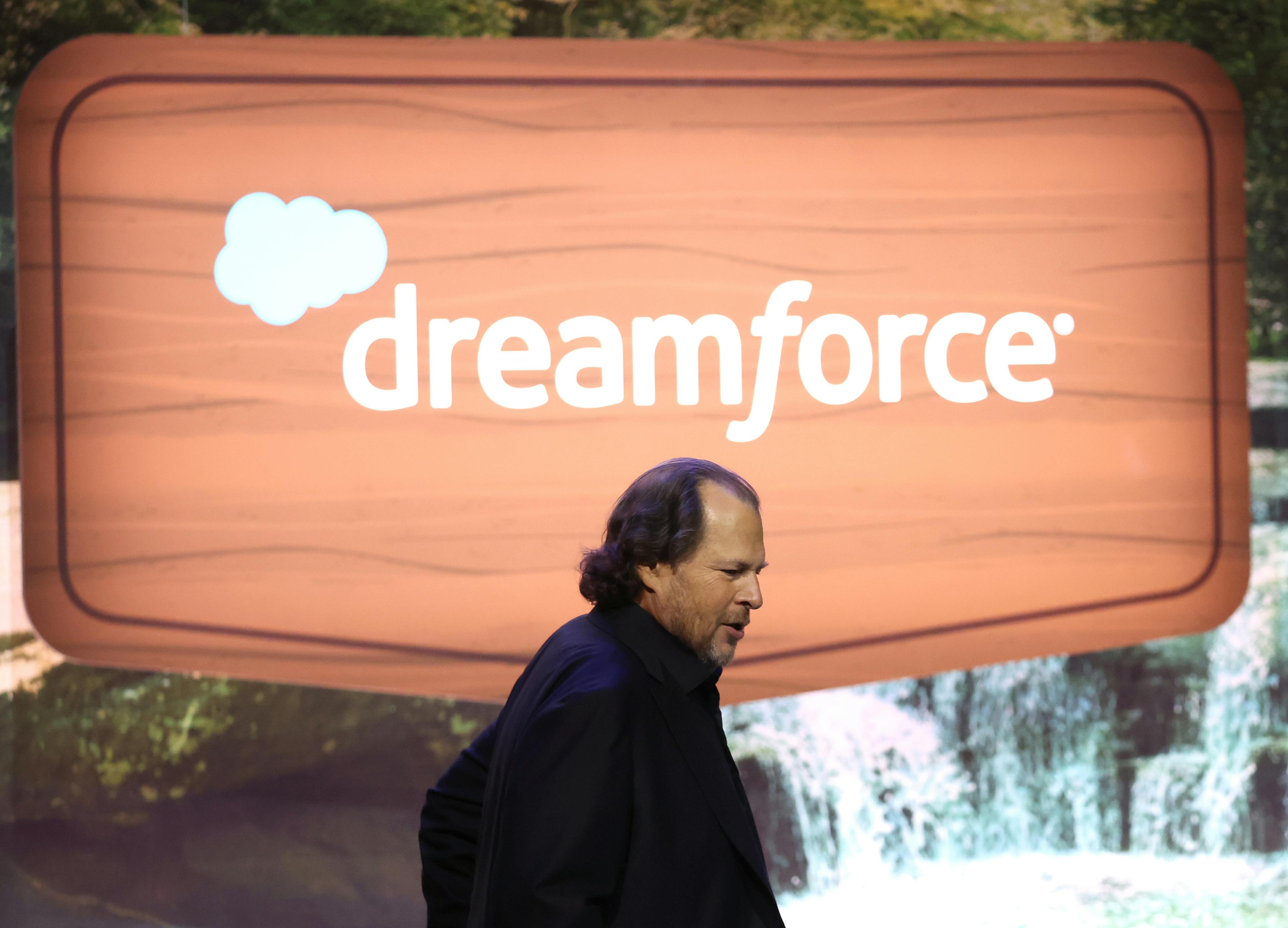
(Justin Sullivan/Getty Images)

Salesforce’s slump shows the market still thinks AI is coming for software. But what if it doesn’t?

There wasn’t much proof of disruption in Salesforce’s numbers. Meanwhile, it’s trading around its lowest price-to-earnings ratio ever.

Matt Phillips

Yesterday, we mentioned recent chatter suggesting that the next big phase of the moveable market feast that is AI could be centered on the software business.

Well if it is, nobody told Salesforce shareholders.

Shares of the maker of customer relationship management software tumbled Thursday despite the company posting better-than-expected fiscal Q2 earnings that beat on both the top and bottom lines.

A somewhat lackluster forecast for next quarter’s sales was universally blamed for the roughly 5% tumble.

But the broader picture is that the market remains skeptical that dominant players in the highly lucrative “software as a service” (SaaS) business, like Salesforce, can avoid being disrupted by cheaper, AI-native companies. The threat is that such companies can develop software quicker and sell it for less, eating the incumbents’ lunch.

That seems worth considering. But there was scant proof of disruption to be found in Salesforce’s numbers. Sales, order backlogs, and operating margins continue to grow at a solid clip. And while the guidance might have been light compared to Wall Street expectations, it still suggests acceleration out of Salesforce’s recent slow patch.

At the same time, Salesforce spotlighted progress on its own AI offerings, noting that the Q2 annual run rate for its Agentforce and Data Cloud products hit $1.2 billion, up 120% from the previous year.

The stock’s tumble Thursday suggests investors haven’t been won over by such numbers about Salesforce’s next chapter as an agentic AI giant.

Morgan Stanley analysts suggest the company’s detailed presentation at its October Agentforce conference — where it will demo the next generation of the software and offer testimonials from customers about its value — could bolster confidence in the stock.

But in the meantime, Salesforce, down about 27% this year, remains pretty cheap for a large-cap tech name. It’s trading at roughly 20x expected earnings over the next year, near the lowest level in its 20-odd years as a publicly traded company.

“Bottom line, this strong positioning to benefit from the expanded capabilities of GenAI remains unappreciated in a marketplace thinking ‘SaaS is dead,” Morgan Stanley analysts wrote. “We see a positive risk/reward in [Salesforce] and remain firmly overweight.”

More Markets

See all Markets
markets

SpaceX gets a wave of bullish ratings from Wall Street analysts

SpaceX received more than a dozen positive analyst calls on Tuesday — including from major Wall Street banks — as they initiate coverage on Elon Musk’s space and AI company.

SpaceX went public on June 12 at a $2.2 trillion valuation, the largest debut in history. While the company hasn’t yet posted a profit, it seems to have convinced Wall Street that it will get there and grow its valuation on the way.

Of the at least 17 analysts that gave a rating on Tuesday, all but one gave it a “buy” or “outperform” rating. MoffettNathanson was "neutral."

The ratings come as SpaceX joined the Nasdaq 100 index, a benchmark tech-heavy basket of companies that underpins millions of portfolios. The inclusion adds built-in demand for the stock from index funds and ETFs.

Still, SpaceX fell more than 5% on Tuesday amid a broader sell-off, and is currently effectively flat from its opening price of $150 a share.

markets

Nike sinks to lowest level since 2014 after warning of “challenged” sales environment in Q4 report

Did Nike do it?

Investors had a mixed reaction after the global sports apparel company reported its fourth quarter earnings on Tuesday after the bell. Shares initially rose 5% as Nike beat out Wall Street expectations amid a hefty tariff refund bonus. However, the stock then sank to its lowest level since August 2014 in postmarket trading.

Here are the Q4 numbers:

  • Revenue of $11.0 billion (estimate: $10.8 billion).

  • Adjusted earnings per share of $0.20 (estimate: $0.12).

Ahead of this report, Nike warned that results would be flattered by a one-time tariff refund (now estimated at roughly $0.52 per share for the bottom line). That gave the company an extra cushion in snapping its streak of seven quarters of year-over-year profit declines.

Over the past year, the company had been punished by tariffs on imported goods, stagnant consumer spending, and increasing competition from other footwear brands like New Balance, Adidas, and Hoka.

Outgoing CFO Matthew Friend deemed it an “increasingly challenging operating environment, where sell-through remains challenged.”

Latest Stories

Sherwood Media, LLC and Chartr Limited produce fresh and unique perspectives on topical financial news and are fully owned subsidiaries of Robinhood Markets, Inc., and any views expressed here do not necessarily reflect the views of any other Robinhood affiliate, including Robinhood Markets, Inc., Robinhood Financial LLC, Robinhood Securities, LLC, Robinhood Crypto, LLC, Robinhood Money, LLC, Robinhood U.K. Ltd, Robinhood Derivatives, LLC, Robinhood Gold, LLC, Robinhood Asset Management, LLC, Robinhood Credit, Inc., Robinhood Ventures DE, LLC and, where applicable, its managed investment vehicles.

