

Markets
markets
Luke Kawa

Retail traders are forcing institutional investors into their favorite stocks

JPMorgan’s note on retail trading activity is so nice, I have to write about it twice.

In addition to leaving a big mark on how stocks trade on earnings releases, strategists led by Arun Jain also flagged how in meme stock land and beyond, retail traders are basically forcing institutions to play a game of follow-the-leader.

“As an interesting pattern within ‘Meme’ stocks (e.g. Opendoor Technologies), retail buying in prior months is followed by non-retails joining the trade more recently,” they wrote. “This is in line with our reading on the broader market — retail investors benefitted from ‘buying-the-dip’ as we entered the sharp V-shaped recovery post-Liberation Day, while the High Beta rally (which also included Meme stocks) was fueled by non-retail investors catching up via higher beta exposure.”
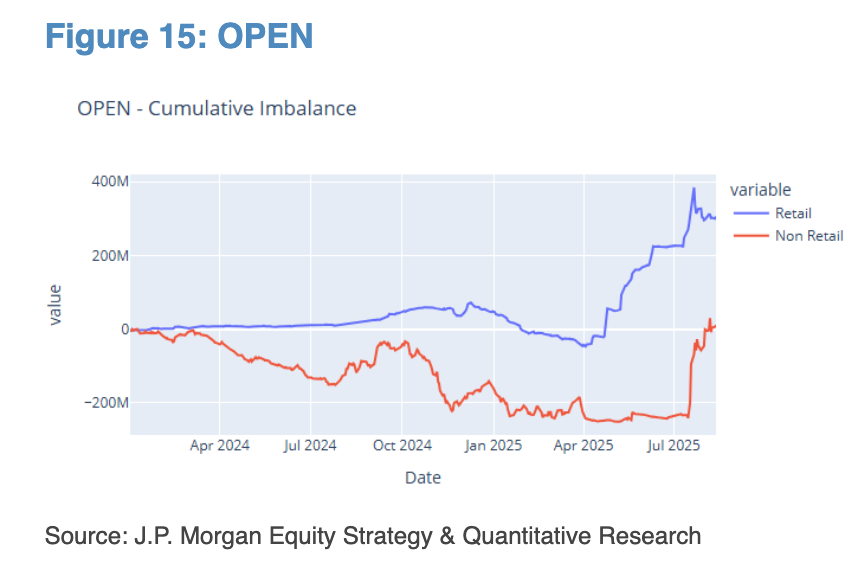
OPEN retail and non-retail activity

I would also be remiss not to say that retail buying outstrips non-retail buying by a substantial margin, further underscoring the notion that “buyer’s binges” are a more important part of so-called “short squeezes” than investors who bet against the stock actually closing their positions.

However, Jain and co. caution that “as a result, High Beta Crowding is at all-time highs and is likely to experience snapbacks as sentiment sours with policy uncertainty or weak economic data.”

Along these lines, Goldman Sachs strategist John Marshall is telling clients to buy large-cap meme stocks including Palantir Technologies and Advanced Micro Devices(?!?).

In the case of the latter, we’re really stretching the definition of what “meme stock” means. AMD, while trading at about a 40% premium to the Philadelphia Semiconductor Index as a whole, isn’t outrageously valued and has a fairly well-established and successful business model. However, per Goldman, it is a name with elevated retail activity.

The phenomenon of “herding behavior” is well known in nature. It’s just a little surprising to see retail traders being portrayed as the shepherds and professionals as the sheep!

More Markets

See all Markets
markets

Rivian dips on R2 launch day, as shoppers point out “out of control” lease prices

Rivian is sinking on Tuesday, the launch day of its highly-anticipated R2 SUV.

The EV maker’s shares are down more than 7% on Tuesday afternoon, erasing a chunk of the gains they raked in during their recent 10-day winning streak.

Aside from a broad market selloff and some selling the R2 launch news, online chatter also reveals some customer disappointment with lease prices for the new model. The performance trim lease prices are listed at $829/month on Rivian’s site, close to the monthly price of the more expensive R1S. A Reddit post referred to those rates as “out of control” and “a huge disappointment.”

The R2 was announced as a lower cost $45,000 SUV but is launching at higher-trim levels priced closer to $60,000. Rivian’s larger R1S starts at around $77,000. Rivian has implied annual R2 deliveries of between 20,000 and 25,000 units this year.

markets

Chip stocks and high-flying tech shares plunge, sending the Nasdaq, S&P 500 lower

Chip makers, artificial intelligence giants, and other highly-valued tech stocks plunged Tuesday, dragging major US stock indices deep into the red as the recent chip and AI complex comeback abruptly fizzled.

The Invesco QQQ Trust, which tracks the Nasdaq 100, is off around 3% on the day, and S&P 500 is down almost 2%.

The iShares Semiconductor ETF is also sinking, effectively giving up all the gains it saw yesterday as it surged to one of its best days of the year.

Wall Street initially opened in positive territory, but enthusiasm rapidly deteriorated midday as investors seemed to aggressively lock in profits on volatile, high-growth semiconductor stocks that, until recently, had been shooting upwards.

This pivot follows a brutal trading day last Friday when momentum stocks collided with a rosy jobs report, profit taking, and perhaps some very-belated pessimism triggered by disappointing guidance from Broadcom, sending a host of previously bid-up names falling.

Many of those same shares are tumbling on Tuesday:

  • Micron completely flipped its intraday trajectory, plummeting over 9% at one point after gaining in early morning trading. The memory provider has still more than tripled its valuation since the beginning of 2026. AMD shares also plummeted.

  • Marvell Technology jumped nearly 10% yesterday and advanced further soon after the opening bell, but reversed course midday and was down double-digits, on pace for its second-worst day this year. The company was recently selected to join the S&P 500 index effective June 22.

  • Intel is sinking after jumping in the yesterday's session on a report that Google and Nvidia are considering turning to the chipmaker as a backup supplier to TSMC.

  • Apple’s shares are selling down following the kickoff of its Worldwide Developers Conference (WWDC26) yesterday where it showcased the new AI-powered version of Siri and the trust and safety features of iOS 27.

The tech-driven slide overshadowed a positive macroeconomic buffer from the energy sector, with oil prices sliding. The relief in crude costs came after ongoing negotiations signaled that shipping traffic through the crucial Strait of Hormuz is normalizing according to Reuters, although this drop was tempered by a threat from President Trump to retaliate against Iran for an attack on a US helicopter in the Strait.

markets

China reportedly planning $295 billion data center network to power AI build-out

Beijing may spend roughly $295 billion (2 trillion yuan) over the next five years to build a nationwide network of AI-focused computing hubs, according to a Bloomberg report.

The blueprint would connect data centers across the country into a unified computing network while prioritizing domestic suppliers such as Huawei for much of the underlying technology. State-owned telecom giants, including China Mobile and China Telecom, would operate much of the infrastructure, per the report.

The proposal, still under discussion, would mark one of China’s most aggressive efforts yet to build an AI infrastructure stack largely independent of US technology.

The AI race is increasingly becoming a competition not just over models and chips, but over access to computing power itself.

China’s latest push suggests Beijing has increasingly treated computing power as a strategic national resource, similar to electricity or transportation infrastructure. The latest blueprint would push that strategy further by connecting fragmented regional data centers into a national computing network.

The latest Digital China Development Report issued by the China National Data Administration found that the country had more than 13.7 million standard server racks in operation by the end of 2025, and had built 42 large-scale AI computing clusters. Chinas total intelligent computing capacity has reached 1.59 million PFLOPS, ranking second globally.

A Chinese planning document from the Ministry of Industry and Information Technology targets 2028 for connecting major computing hubs into a unified national system. Much of that infrastructure is expected to be concentrated in regions such as Inner Mongolia, Ningxia, and Gansu, where abundant land and relatively inexpensive power can support energy-intensive AI workloads.

The Chinese documents also highlight the scale of Chinas AI ambitions. The country now has more than 6,200 AI companies and an AI industry worth more than $176.9 billion (1.2 trillion yuan), official data shows.

The timing is notable. In May, Washington cleared around 10 Chinese firms to buy Nvidia’s H200 chips, easing some restrictions aimed at slowing Chinas AI development.

Bloomberg reported the project could be funded primarily through sovereign debt and state-backed investment funds, underscoring China’s willingness to continue spending on strategic technologies even as broader economic growth slows.

markets

AST SpaceMobile rises after announcing June 17 launch date for its BlueBird 8, 9, and 10 satellites

AST SpaceMobile is up 6% in the premarket action just before the start of regular trading, after the space-based cellular broadband network operator announced that its Bluebird 8, 9, and 10 satellites will be launched on June 17 from Cape Canaveral, Florida.

Adding its BlueBird 8, 9, and 10 to its constellation, each satellite featuring the largest commercial communication array ever of ~2,400 square feet, is expected to further expand AST SpaceMobile’s direct-to-device broadband reach and nearly double the peak data speeds compared to its own initial Block 1 BlueBird satellites, per the company’s press release.

The company has seen its shares plummet in recent weeks after a Blue Origin rocket, which was to carry AST’s Block 2 BlueBird satellite, exploded while testing.

markets

Applied Digital leaps on $5.2 billion deal with undisclosed US hyperscaler

Like other AI-adjacent stocks, Applied Digital has hit a bit of a speed bump of late, caught up in the malaise that sent the wider market tumbling at the end of last week. However, after unveiling a new lease agreement with an undisclosed US-based hyperscaler worth at least $5.2 billion, the stock is soaring once again today in premarket trading, up more than 11%.

The deal is with a “high investment-grade hyperscaler,” per the company’s press release, and will cover 210 megawatts of critical IT load at the company’s Delta Forge 2 AI Factory campus under a take-or-pay structure (in which the buyer is obliged to pay a minimum of $5.2 billion over 15 years) with renewal options.

If all renewal options are exercised, the deal would be worth approximately $12.7 billion over a 30-year total term. Initial operations at the Delta Forge 2 site are expected to commence in the first quarter of 2028.

Emphasizing the company’s “franchise model — a core team of design, construction, and operations professionals replicated across every campus, in every market,” CEO Wes Cummins noted that the latest lease is Applied Digital’s third long-term agreement with the same hyperscaler. The agreement also brings the company’s total base-term lease revenue to $36 billion, rising to $86 billion if all options are taken up.

Latest Stories

Sherwood Media, LLC and Chartr Limited produce fresh and unique perspectives on topical financial news and are fully owned subsidiaries of Robinhood Markets, Inc., and any views expressed here do not necessarily reflect the views of any other Robinhood affiliate, including Robinhood Markets, Inc., Robinhood Financial LLC, Robinhood Securities, LLC, Robinhood Crypto, LLC, Robinhood Money, LLC, Robinhood U.K. Ltd, Robinhood Derivatives, LLC, Robinhood Gold, LLC, Robinhood Asset Management, LLC, Robinhood Credit, Inc., Robinhood Ventures DE, LLC and, where applicable, its managed investment vehicles.
