
Markets
Jamie Dimon JPMorgan
Jamie Dimon (Getty Images)
Weird Money

Why pension funds’ love affair with private equity is bad for the environment

Jamie Dimon highlighted that pension funds' private market investments are hindering their ESG goals.

Jack Raines

Back in April, I highlighted some concerns I had with pension funds doubling down on private equity. My issue, at the time, was that I thought it was a risky investment. For context, funding ratios (a pension’s assets divided by its liabilities) for state and local pensions had declined from 100%+ to 78% from 2001 to 2022, despite a strong performance from the stock market over that time.

In an attempt to improve their returns, many funds turned to private equity, as it had outperformed the S&P 500 on a 20-year, 10-year, 5-year, and 3-year horizon. However, with private equity funds now distributing less to investors than they are raising through new funds, and capital being tied up in funds longer and longer, some pensions have had to sell their PE fund stakes on secondary markets at an average of 85% of their recent valuations, creating a drag on returns.
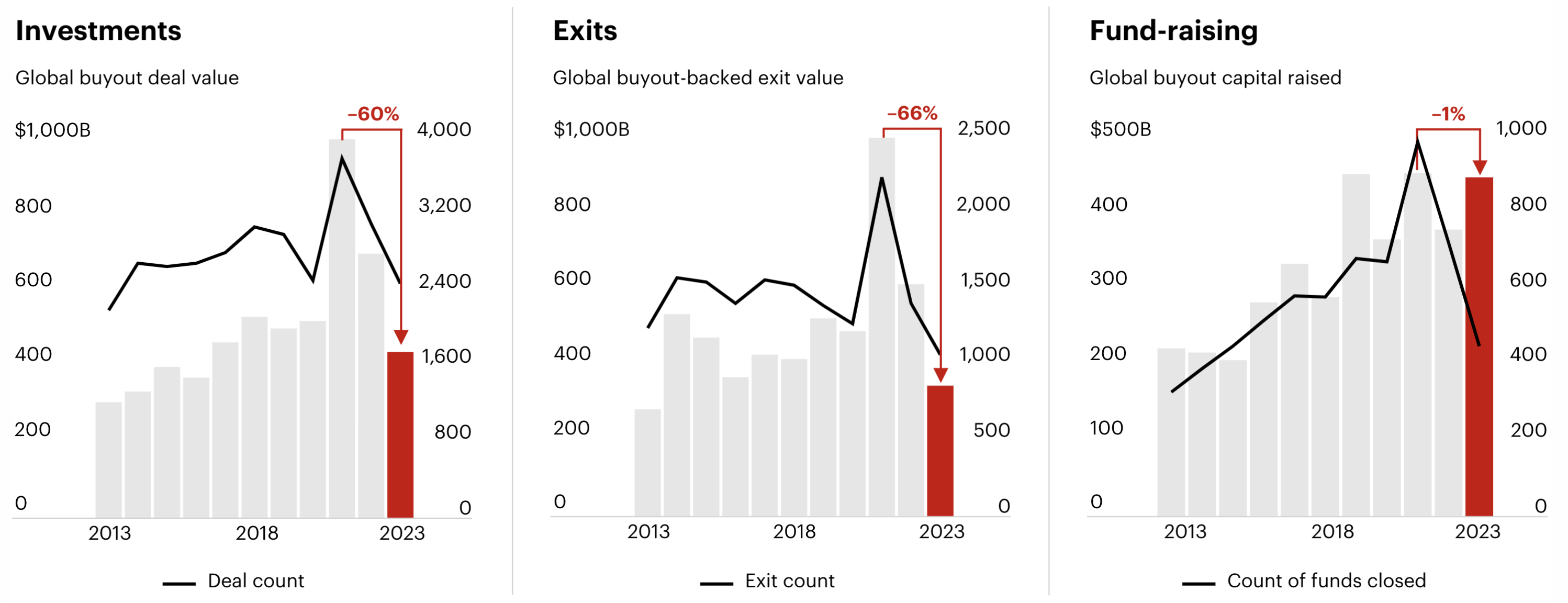
Bain Projections
Source: Bain Capital

However, another consequence that I hadn’t thought of was that pension funds’ love affair with private equity could be hindering their environmental activism. On October 9, Reuters reported that JPMorgan CEO Jamie Dimon recently called out pension fund managers for increasing their allocations to private equity while simultaneously voicing environmental and social concerns:

'You call me up and talk to us about all the issues you're interested in. But when you make huge investments in the private side, you don't get that kind of transparency,’ he told a meeting of the Council of Institutional Investors in New York on Sept 10…

There could be 15,000 publicly traded companies in the U.S. rather than around 4,500 today, Dimon suggested. Instead private markets have taken up a major share of new investments without nearly as much disclosure, liquidity or research, the JPMorgan CEO said.

‘You all are huge causes of that, because you make huge investments on the private side,’ Dimon told the audience that included representatives from Democratic-leaning state and local pension systems that have taken activist stances on environmental and social issues.

Many public pension funds, such as CalPERS, have been outspoken about their environmental activism, with the US’s largest pension plan taking an activist stance against ExxonMobil in May of this year after the company filed a lawsuit to block a vote on a climate proposal.

Unlike public companies, which are beholden to more shareholder disclosures and face increased shareholder scrutiny regarding their ESG disclosures, private companies are less transparent with their operations, making it more difficult for investors to track their environmental impacts.

Given the increased transparency and increased liquidity of public markets, it seems like it would be a win-win, from both a financial and activist perspective, to allocate more capital toward public markets, not less. But considering that CalPERS voted to increase total private market allocation from 33% to 40% in March, it looks like more of the same for the near future.

More Markets

See all Markets
markets

BlackBerry is on one of its hottest rallies of all time

History suggests that BlackBerry does extremely well when 1) it’s considered to be pioneering a transformative technology, or 2) there’s widespread retail enthusiasm for stocks.

If you squint (or dream), you could argue that both are going on right now.

Shares of the once-upon-a-time smartphone giant are up more than 160% over the past three months. The only times the shares have had a hotter run of form than this are at the tail end of the dot-com bubble, and in early 2021 when was it part of the meme stock craze headlined by GameStop.

Let’s start with the easy part first — here’s Scott Rubner, head of equity and equity derivatives strategy at Citadel, on retail’s significant footprint in the shares’ rally:

“Retail traders are the new price setters in the market. May volumes across our retail cash equities and options platforms are currently tracking at record levels. Daily volumes on our cash platform are setting new highs and are on pace to finish nearly ~10% above the previous record established during the January 2021 meme-stock era.”

And then there’s the harder part, part of the story that the traders bidding up BlackBerry now are dreaming about: the QNX division, which offers software that the company is positioning as an operating system for robots.

QNX’s software has early uptake in the field of autonomous driving, with BlackBerry eyeing a much more widespread role: in April, it announced a partnership to deploy this technology on Nvidia’s robotics platform. Nvidia’s Jensen Huang, for his part, has long been calling for agentic AI adoption to be followed by physical AI (i.e., robots).

In a QNX press release unveiling a report this week, the company argued that software, not hardware, is the real problem in terms of making sure robotics works.

I supposed it would be poetic, in a way, if the company at the leading edge of the smartphone revolution also plays a big role in the proliferation of robotics.

markets

Micron and Sandisk rally on new Street-high price targets from Susquehanna

Micron and Sandisk both hit fresh all-time highs in early trading after Susquehanna bestowed new Wall Street-high price targets on the two memory stocks.

Analyst Mehdi Hosseini upped his view on the former to $1,750 from $600, and to $3,250 from $2,000 for the latter.

“Supply is now expected to remain tight through 2027, sustaining elevated margins and thus warranting valuation re-rating,” he wrote, per Bloomberg.

It’s the fifth time in the past year that the average price target on Micron has gone up by more than 10% in a week. UBS’s Tim Arcuri more than tripled his price target on Micron earlier this week, and has already lost the title of “most bullish.”

But even as analysts are tripping over themselves to raise their price targets on these stocks, the ferocity of the rally in Micron has outpaced their best efforts.

The high-bandwidth memory specialist traded at a record premium to the consensus Wall Street price target this week, based on data going back to 2008.

markets

Okta soars on Q1 earnings beat, raised outlook driven by AI security demand

Okta shares are surging in early trading Friday after the identity security provider posted Q1 fiscal 2027 financial results that exceeded Wall Street estimates. The strong results are fueled by accelerating corporate demand for cybersecurity software, as well as the deployment of autonomous AI systems.

Key numbers:

  • Adjusted earnings per share of $0.91 compared to analysts estimate of $0.85.

  • Revenue of $765 million compared to an estimate of $752.7 million.

The company generated subscription revenue of $750 million, up 11% year over year. Okta also has $271 million in free cash flow, up from $238 million in the prior years quarter.

While standard cybersecurity software protects human workers, the latest catalyst sparking Oktas strong corporate performance is the rapid emergence of autonomous AI agents that can access sensitive corporate databases and interact with privileged executive accounts.

“AI agents are rapidly becoming a new workforce inside every organization, creating a wave of identities that must be secured and governed alongside human users,” said Todd McKinnon, CEO and cofounder of Okta. “We’re expanding our opportunity as the world’s leading independent and neutral identity provider and helping customers make identity the unified control plane for their secure agentic enterprise.”

Okta raised its fiscal 2027 revenue guidance to between $3.185 billion and $3.205 billion, roughly in line with estimates of $3.18 billion. The company formally dropped its long-term projected non-GAAP tax rate from 26% down to 21%. This adjustment is a direct byproduct of the federal corporate tax frameworks under the One Big Beautiful Bill Act.

Shares of Okta have risen around 9% since the beginning of this year.

markets

HPE, SMCI surge after Dell’s Q1 beat on strong AI server demand

HP Enterprise and Super Micro Computer shares are surging in premarket trading, getting a big boost from rival Dell’s strong Q1 results.

Dell’s $16.1 billion in AI-optimized server sales for the quarter alone proved that enterprise data center demand is accelerating faster than Wall Street had anticipated. The company posted revenue of $43.8 billion, exceeding Street estimates of $35.5 billion. Management now sees full-year sales of about $167 billion, well above the $142 billion expected by analysts.

The read-through is particularly relevant for Super Micro, one of the largest suppliers of Nvidia-powered AI server systems, and HPE, which has been expanding its AI infrastructure and liquid-cooling offerings through its partnership with Nvidia.

The moves suggest investors view AI infrastructure as a broad spending cycle that benefits server makers across the entire ecosystem.

Latest Stories

Sherwood Media, LLC and Chartr Limited produce fresh and unique perspectives on topical financial news and are fully owned subsidiaries of Robinhood Markets, Inc., and any views expressed here do not necessarily reflect the views of any other Robinhood affiliate, including Robinhood Markets, Inc., Robinhood Financial LLC, Robinhood Securities, LLC, Robinhood Crypto, LLC, Robinhood Money, LLC, Robinhood U.K. Ltd, Robinhood Derivatives, LLC, Robinhood Gold, LLC, Robinhood Asset Management, LLC, Robinhood Credit, Inc., Robinhood Ventures DE, LLC and, where applicable, its managed investment vehicles.

