Markets
Close-up Of Snow-Dusted Zugspitze Massif Peaks In The Wetterstein Mountains In Tyrol
A snow-dusted peak, leading to a valley of who the heck knows (Michael Nguyen/Getty Images)

Options markets signal “optimism peaks” for Magnificent 7 stocks

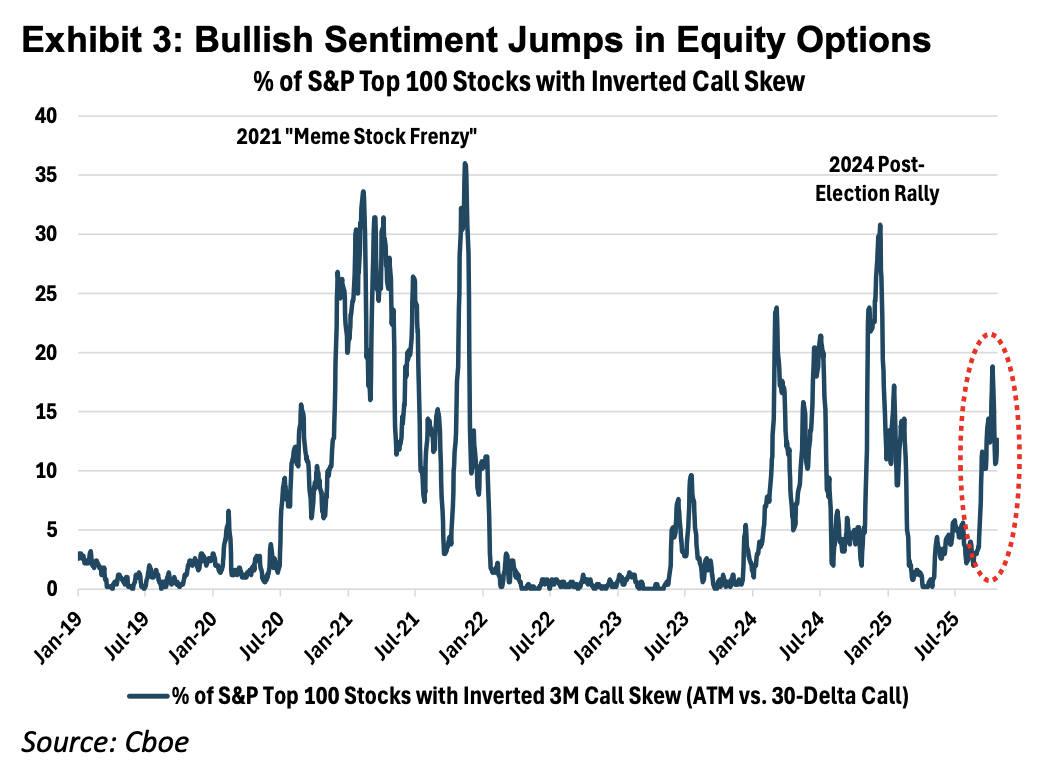
“The number of stocks in the S&P top 100 trading with inverted call skew (a sign of extremely bullish sentiment where the OTM call trades at a higher volatility than the ATM call) has surged to a high of ~20% (vs. historical average of just 3%),” per Cboe.

Luke Kawa

Of all the many ways to measure investor sentiment — surveys, futures positioning, and more — one of my favorites might be through the answer to this question: how much are traders willing to pay for options that offer upside in stocks compared to those that protect against downside?

Cboe’s head of derivatives market intelligence, Mandy Xu, noted that about three weeks ago, skew in the S&P 500 spiked amid renewed market jitters over a fraying of America’s trade relationship with China. Skew, in this case, tracks the ratio between the implied volatility of puts versus calls, a proxy for the relative demand for bearish versus bullish options. Now, that’s completely flipped on its head, for the index in general and for its largest components in particular.

She wrote (emphasis added):

The decline in skew over the past few weeks has been notable: SPX 1M skew (25-delta ratio) has fallen from the 99th percentile high three weeks ago to a 6th percentile low early last week, before steepening at the end of last week following the Fed meeting to now the 48th percentile. Longer-dated skew screens even cheaper, with SPX 6M skew now in the 16th percentile low. The flattening in index skew is consistent with the pickup in bullish sentiment we’ve observed in single stock options. The number of stocks in the S&P top 100 trading with inverted call skew (a sign of extremely bullish sentiment where the OTM call trades at a higher volatility than the ATM call) has surged to a high of ~20% (vs. historical average of just 3%). While the metric is not yet at the extremes we saw in 2021 or late last year, it certainly signals a high level of investor optimism going into year-end.

Cboe inverted call skew

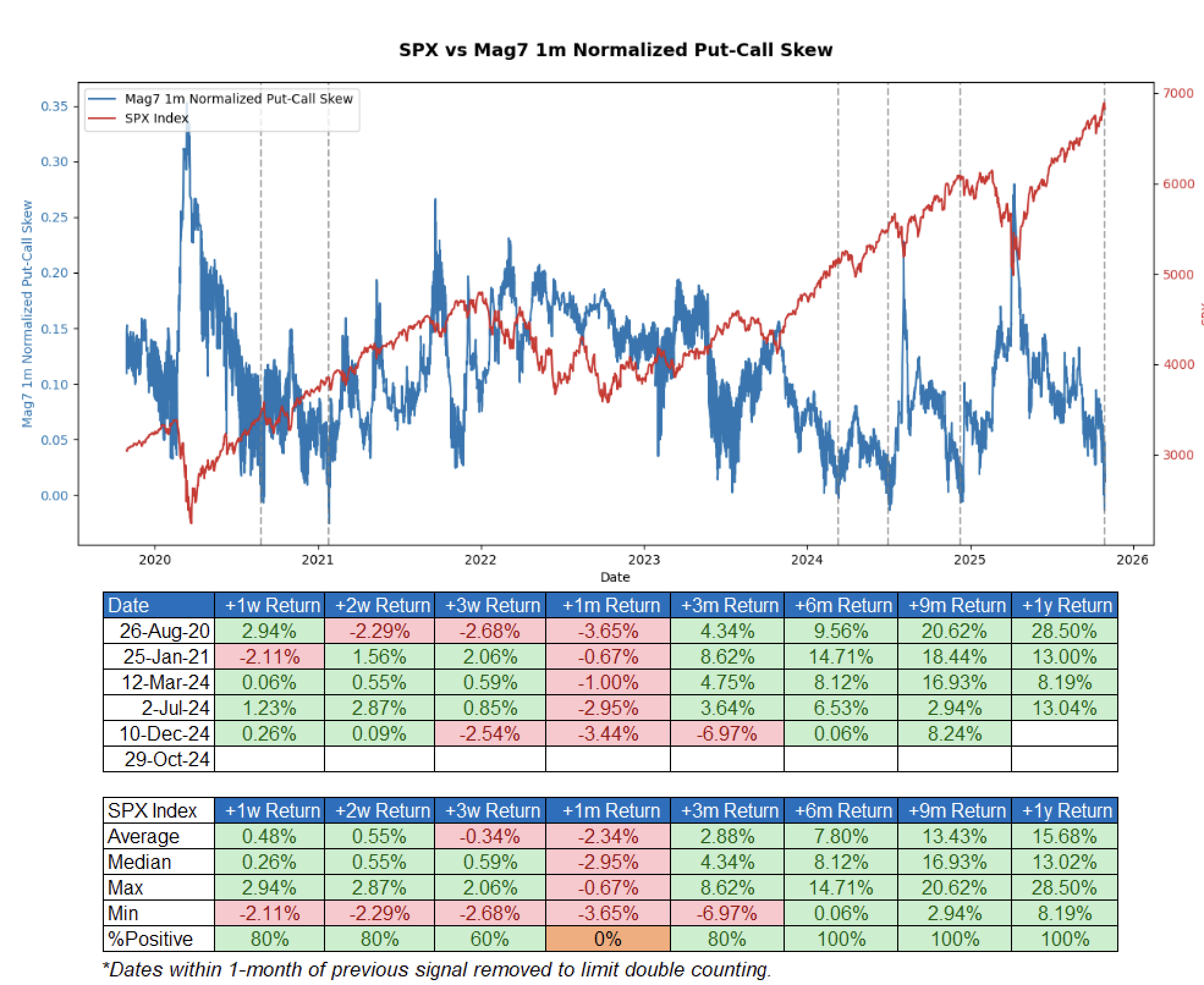
Zooming in on a similar measure, Goldman Sachs analyst Cullen Morgan shows that sentiment is particularly ebullient for the so-called Magnificent 7: the cohort of Nvidia, Apple, Microsoft, Amazon, Alphabet, Meta, and Tesla.

In an October 31 note, he wrote:

Coming into earnings this week, put-call skew in the Mag7 complex inverted for the first time since December of last year (i.e. implied volatility of calls traded over puts). This phenomenon has only happened a handful of times. The move implies investors are overwhelmingly positioned for continued upside. Historically, such low skew readings have tended to coincide with short-term consolidation or reversals as optimism peaks.

Goldman on put-call skew inversion
Source: GS Research, GS FICC & Equities, Bloomberg as of Oct 31

More Markets

See all Markets
markets

SpaceX gets a wave of bullish ratings from Wall Street analysts

SpaceX received more than a dozen positive analyst calls on Tuesday — including from major Wall Street banks — as they initiate coverage on Elon Musk’s space and AI company.

SpaceX went public on June 12 at a $2.2 trillion valuation, the largest debut in history. While the company hasn’t yet posted a profit, it seems to have convinced Wall Street that it will get there and grow its valuation on the way.

Of the at least 17 analysts that gave a rating on Tuesday, all but one gave it a “buy” or “outperform” rating. MoffettNathanson was "neutral."

The ratings come as SpaceX joined the Nasdaq 100 index, a benchmark tech-heavy basket of companies that underpins millions of portfolios. The inclusion adds built-in demand for the stock from index funds and ETFs.

Still, SpaceX fell more than 5% on Tuesday amid a broader sell-off, and is currently effectively flat from its opening price of $150 a share.

markets

Nike sinks to lowest level since 2014 after warning of “challenged” sales environment in Q4 report

Did Nike do it?

Investors had a mixed reaction after the global sports apparel company reported its fourth quarter earnings on Tuesday after the bell. Shares initially rose 5% as Nike beat out Wall Street expectations amid a hefty tariff refund bonus. However, the stock then sank to its lowest level since August 2014 in postmarket trading.

Here are the Q4 numbers:

  • Revenue of $11.0 billion (estimate: $10.8 billion).

  • Adjusted earnings per share of $0.20 (estimate: $0.12).

Ahead of this report, Nike warned that results would be flattered by a one-time tariff refund (now estimated at roughly $0.52 per share for the bottom line). That gave the company an extra cushion in snapping its streak of seven quarters of year-over-year profit declines.

Over the past year, the company had been punished by tariffs on imported goods, stagnant consumer spending, and increasing competition from other footwear brands like New Balance, Adidas, and Hoka.

Outgoing CFO Matthew Friend deemed it an “increasingly challenging operating environment, where sell-through remains challenged.”

Latest Stories

Sherwood Media, LLC and Chartr Limited produce fresh and unique perspectives on topical financial news and are fully owned subsidiaries of Robinhood Markets, Inc., and any views expressed here do not necessarily reflect the views of any other Robinhood affiliate, including Robinhood Markets, Inc., Robinhood Financial LLC, Robinhood Securities, LLC, Robinhood Crypto, LLC, Robinhood Money, LLC, Robinhood U.K. Ltd, Robinhood Derivatives, LLC, Robinhood Gold, LLC, Robinhood Asset Management, LLC, Robinhood Credit, Inc., Robinhood Ventures DE, LLC and, where applicable, its managed investment vehicles.