
Markets
Complex Simplicity
Getty Images

OpenAI doesn’t have the cash to pay Oracle $300 billion — raising it will test the very limits of private markets

The ChatGPT maker plans to burn though $115 billion by 2029. No company in history has ever lit that much money on fire intentionally, let alone tried funding such a splurge through private markets alone.

There’s a playbook in Silicon Valley: raise some money; build something people want; raise a lot more money; burn it in the pursuit of growth. The core of this strategy is to swap money for time by acquiring talent, companies, infrastructure, and technologies, all in the pursuit of leapfrogging your competition in the burgeoning field you’re disrupting.

Then, if you’re successful in ascending to the top: kick back, up your prices, and rake in the billions.

From Uber to Amazon, Tesla to Facebook, this game plan has worked time and time again. Jokes on late-night talk shows about companies losing money year after year, or paying a billion dollars for then boutique apps like Instagram, have become unfunny fast, as Big Tech has swallowed advertising, apparel, and everything in between.

But no company has ever burned as much money as OpenAI is planning to.

In the last few weeks, major deals with Broadcom and Oracle have thrown into sharp relief just how insane OpenAI’s ambitions are. The Oracle deal alone is worth $300 billion over five years starting in 2027. OpenAI does not have that kind of cash.

In fact, four of the tech world’s big “cash incinerators” — Uber, Tesla, Snap, and Netflix — together burned a pathetic ~$42 billion during their respective heavily cash-burning periods.
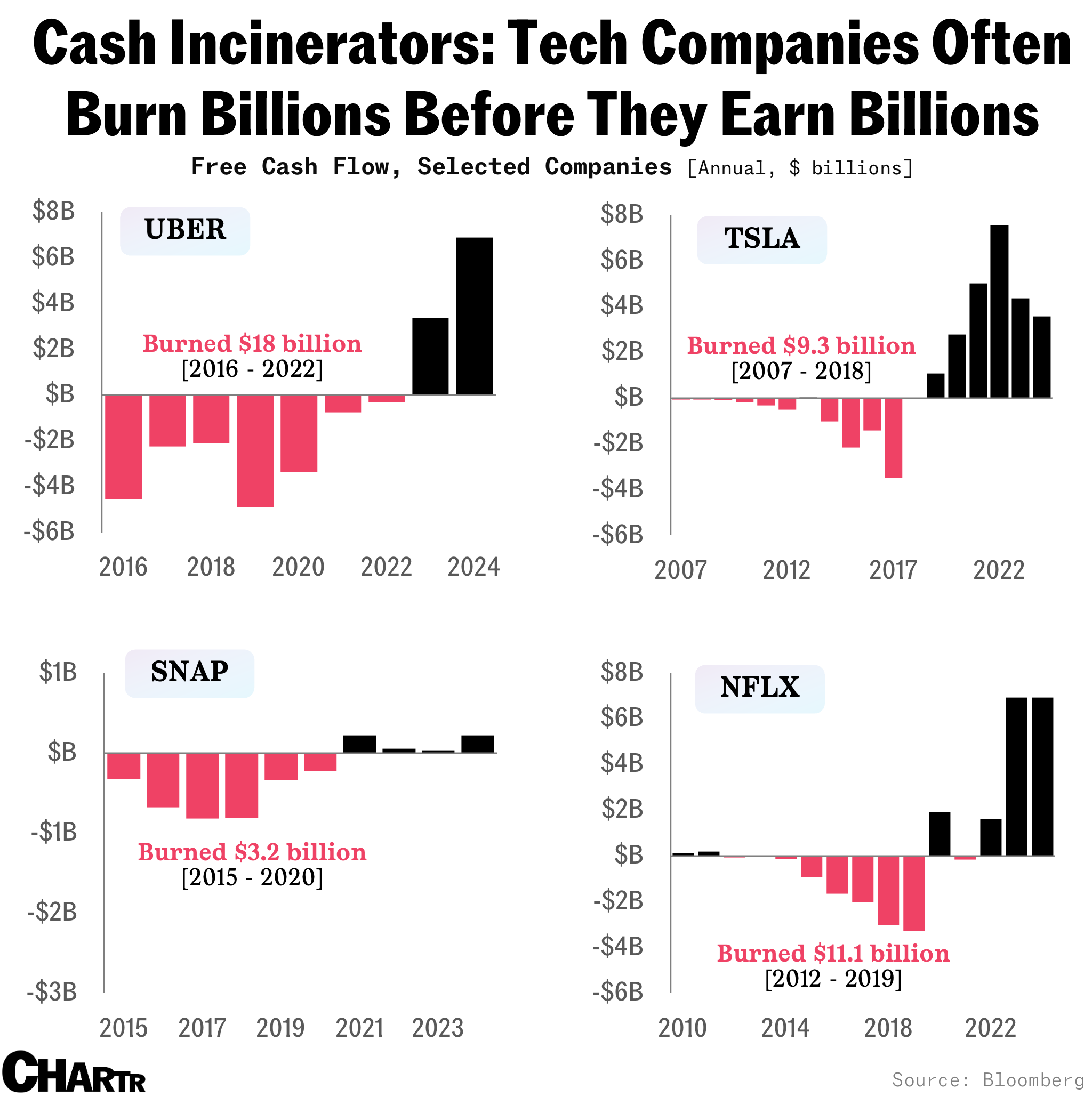
Lossmaking big tech burning cash
Sherwood News

Per The Information, OpenAI is planning on burning $115 billion through 2029. Given that the company raised “only” $40 billion earlier this year — and $64 billion in its lifetime to date, per Pitchbook data — it’s fair to assume that OpenAI will have to dip into the capital markets again to raise another $50 billion to $75 billion to fund its spending splurge.

And OpenAIs funding needs might not stop there — after that monstrous 2029 spending figure is reached, the company could still be on the hook for hundreds of billions of dollars as part of the freshly inked deal with Oracle, which runs for five years and only starts in 2027.

We’re going to need a bigger cap table

Just a few years ago, the idea of raising that amount on the deeply liquid public markets would have been remarkable; the biggest IPO ever was 2014’s Alibaba, which raised $25 billion — a figure that might not cover even a single year of OpenAI’s peak cash burn. Doing it in private markets would have been near unthinkable. Doing it as a complicated entity controlled by a “not-for-profit” entity? Insane.

Last week, the company revealed it had made progress on that last point. The Financial Times reported that OpenAI and Microsoft had signed a “non-binding memorandum of understanding” marking “a significant step forward in the start-up’s effort to convert to a more investor-friendly, for-profit structure.” That could unlock a potential IPO, giving institutional and retail investors the ability to invest directly in the company.

But in August, CEO Sam Altman said that an IPO was not a priority, suggesting there’s a very good chance that OpenAI continues to fund its runway via the private scene.

If the company pulls it off — raises all that money and finds a way to make the unit economics of its chatbot work along the way — it will raise a major question: is the stock market doing its primary job? If the most capital-hungry business of all time doesn’t need to raise on the public markets, we may need to rethink our textbook definitions of the stock market. The capital-allocating conduit that’s been the bedrock of American capitalism for more than a century is increasingly about price discovery, liquidity, and risk transfer, and less about capital formation.

What’s most remarkable, though, is that this might be quite an easy feat for OpenAI. Given the pervasive AI mania that we find ourselves experiencing in 2025, it’s hard to imagine that the world’s leading consumer-facing AI company will struggle to find investors for its cap table in the private markets, even at a nosebleed valuation of $500 billion and even with evidence that AI adoption might be cooling.

Related reading: Where did all the stocks go?

More Markets

See all Markets
markets

United beats Q1 earnings and revenue estimates, lowers full-year profit guidance amid surging jet fuel prices

United Airlines reported its first-quarter earnings results after the bell on Tuesday. The carrier’s shares ticked down in after hours trading.

For Q1, United reported:

  • Adjusted earnings of $1.19 per share, compared to the Wall Street estimate of $1.08 per share compiled by FactSet.

  • $14.6 billion in revenue, compared to the $14.39 billion estimates.

In the first quarter, United’s fuel expense grew 12.6% from the same period last year to $3.04 billion.

For the second quarter, United expects adjusted earnings per share of between $1 and $2, shy of Wall Street expectations of $2.08. For the full year ahead, United said it expects earnings between $7 and $11 per share, compared to its prior guidance of between $12 and $14 per share.

“Guidance assumes United’s revenue recovers 40% to 50% of the fuel price increases in the second quarter, 70% to 80% of the fuel price increases in the third quarter and 85% to 100% of the fuel price increases in the fourth quarter 2026,” read the company’s investor update.

Earlier this month, United was among the first major US airlines to hike its bag fees amid higher fuel costs. Its shares have fallen more than 15% from a February high days before the war in Iran began.

United has also made waves this month following reports that CEO Scott Kirby had floated the idea of a merger with American Airlines to President Trump. A merger between two of the big four airlines would create a true US behemoth, controlling more than a third of the American market. American Air last week said it wasn’t interested in merging with United and hadn’t held talks on the idea. On Tuesday, President Trump told CNBC that he doesn’t like the idea either.

markets

Hedge funds are following retail traders into the Magnificent 7

Hedge funds are following retail traders into the stocks the masses never stopped buying.

“As we kick off earnings for megacap tech stocks, this stood out: [hedge funds] have started buying Mag7 stocks again this month though positioning remains well below the peak levels seen in early 2016,” writes Goldman Sachs’ Cullen Morgan.

Goldman PB Mag 7
Source: Goldman Sachs

In early April, JPMorgan strategist Arun Jain noted that retail investors had basically been selling everything but the Magnificent 7 stocks as part of a more cautious stance due to the Iran war.

(Apple has been a longstanding exception to this trend, presumably because retail traders aren't fond of its hands-off approach to AI.)

JPM Retail flows

Last August, Jain discussed how retail activity tended to “crowd in” institutional buyers in meme stocks, while Goldman’s John Marshall advised clients to piggyback on stocks beloved by retail traders. Speculative, retail-geared assets proceeded to go on a tremendous run that soured in October.

But there are some early indications that a similar bout of speculative fervor is bubbling up once more.

markets

POET Technologies surges above $10 for first time in 4 years amid explosion in call volumes

POET Technologies is up nearly 40% this week as options market activity goes haywire in a faint echo of what got the stock on retail traders’ radars in October.

As of 11:12 a.m. ET, more than 10 calls have changed hands for every put traded. This bullish impulse has propelled the stock above the $10 threshold for the first time since March 2022.

Shares of the optical communications firm briefly dipped last week after Wolfpack Research said it was short the company because its investors would be exposed to an “IRS tax nightmare.”

The company responded that day saying it was taking measures for US shareholders that “should mitigate certain potential adverse US federal income tax consequences to it that could otherwise result from the Company’s status as a passive foreign investment company.”

Latest Stories

Sherwood Media, LLC produces fresh and unique perspectives on topical financial news and is a fully owned subsidiary of Robinhood Markets, Inc., and any views expressed here do not necessarily reflect the views of any other Robinhood affiliate, including Robinhood Markets, Inc., Robinhood Financial LLC, Robinhood Securities, LLC, Robinhood Crypto, LLC, Robinhood Derivatives, LLC, or Robinhood Money, LLC. Futures and event contracts are offered through Robinhood Derivatives, LLC.

