
Markets
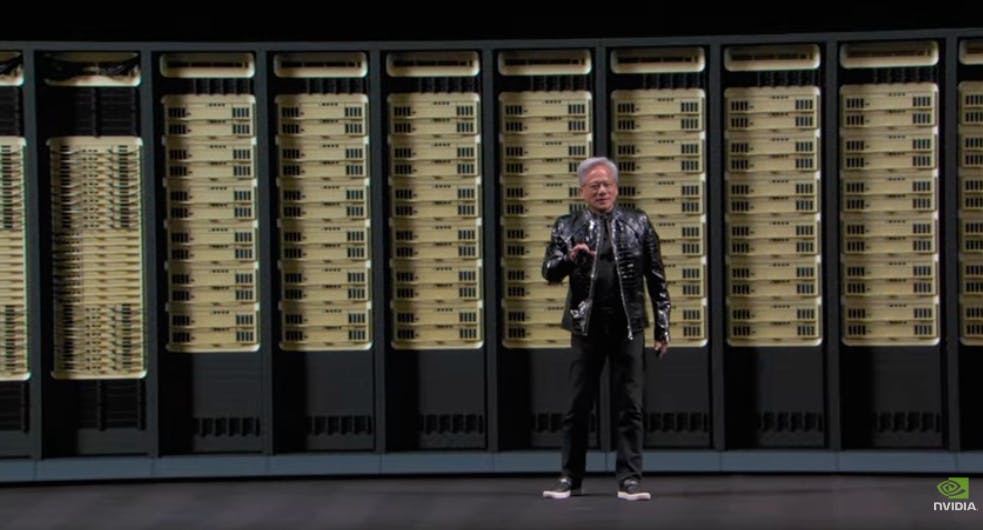
Jensen Huang in front of Vera Rubin at CES 2026
(Nvidia)

Why Nvidia’s terrific quarter is getting a terrible reaction

Nvidia’s CEO gave a deeply unsatisfying answer about his biggest customers’ ability to generate cash. But they might be investing more in AI GPUs in 2027 anyway.

Luke Kawa

Terrific quarter, terrible reaction.

That’s Wall Street’s read on another Nvidia earnings report that beat expectations and offered very optimistic sales guidance for the current quarter.

Shares were up as much as 4% after the release of its Q4 financials and Q1 outlook, but lost nearly all of that advance during the conference call. The stock is down 3% as of 10 a.m. ET.

“We aren’t sure what else investors want to hear at this point,” said Bernstein analyst Stacy Rasgon. “But we like what we heard.”

Management indicated high visibility into demand for not just this year, but 2027 as well — and they’re so confident in it that they’re already locking down the supply to be able to meet it. However, there still seems to be lingering doubt about the willingness of Nvidia’s biggest customers to enhance their multiyear capex binges, given the performance of their share prices and the pressure on their cash flow generation.

While it’s tough to ascribe strong causality, downward momentum on Nvidia shares during the conference call started as CFO Colette Kress talked about challenges accessing the Chinese market as well as rising competition from the AI players there, and then as CEO Jensen Huang responded to the first question from analysts.

BofA’s Vivek Arya asked Huang if he was confident in hyperscalers’ ability to grow capex going forward given how much their cash flows have come under pressure.

Huang said he was confident that hyperscalers’ cash flows would improve, and suggested that without more compute, these megacap tech giants would see their top lines stagnate.

“Without compute, there’s no way to generate tokens. Without tokens, there’s no way to grow revenues,” he said. “So in this new world of AI, compute equals revenues.”

But the thing about the cash flows...

They’re expected to grow for most publicly traded hyperscalers this year. And to be better in 2027 versus 2026. But the expectations for cash flow generation have been universally revised to the downside since the AI boom started.

Cumulative free cash flows for hyperscalers have been expected to be “better next year” at every point in time in the AI boom. And they never have.

It doesn’t take a rocket scientist or AGI to tell you that this probably has something to do with how much capex keeps going up, and surprising to the upside.

“The stock response suggests investors were left wanting more, which we think is tied to continued uncertainty around the growth trajectory for NVDA’s Data Center business in calendar year 27, given massively expanded capex budgets for key customers (aggregate capex for the top 5 US hyperscalers is now forecast to grow ~70% Y/Y to $650B+ in CY26) alongside significantly compressed free cash flow profiles,” JPMorgan analyst Harlan Sur wrote.

Meanwhile, Morgan Stanley analyst Joseph Moore noted that Huang’s answer appearing to be deeply unsatisfying (my words, not his!) may simply be immaterial to the company’s 2027 sales outlook.

“Nvidia believes that these cash issues will be resolved by the cash flows of AI factories being much better than expected — but that in turn requires token monetization that is also better than expected,” he wrote. “While we would stop short of believing the most bullish five year views, we do continue to think that there is no visibility to any pause in the current levels of strong demand.”

A more realistic answer from Huang might have gone something like: “I’m not sure what their free cash flows are going to, but they’re hell-bent on spending more. Look at the agreement we just reached with Meta!”

As such, we have a mediocre reaction to an objectively stellar set of numbers from a company that is not trading at an absurd valuation.

That tells us something important:

It’s a reminder that while Big Tech execs’ imagination over what this potentially transformative technology can be is boundless, the willingness of investors to buy into and fund that vision is not.

Capital markets will be the constraint on capital investment.

More Markets

See all Markets
markets

Hedge funds are following retail traders into the Magnificent 7

Hedge funds are following retail traders into the stocks the masses never stopped buying.

“As we kick off earnings for megacap tech stocks, this stood out: [hedge funds] have started buying Mag7 stocks again this month though positioning remains well below the peak levels seen in early 2016,” writes Goldman Sachs’ Cullen Morgan.

Goldman PB Mag 7
Source: Goldman Sachs

In early April, JPMorgan strategist Arun Jain noted that retail investors had basically been selling everything but the Magnificent 7 stocks as part of a more cautious stance due to the Iran war.

(Apple has been a longstanding exception to this trend, presumably because retail traders aren't fond of its hands-off approach to AI.)

JPM Retail flows

Last August, Jain discussed how retail activity tended to “crowd in” institutional buyers in meme stocks, while Goldman’s John Marshall advised clients to piggyback on stocks beloved by retail traders. Speculative, retail-geared assets proceeded to go on a tremendous run that soured in October.

But there are some early indications that a similar bout of speculative fervor is bubbling up once more.

markets

POET Technologies surges above $10 for first time in 4 years amid explosion in call volumes

POET Technologies is up nearly 40% this week as options market activity goes haywire in a faint echo of what got the stock on retail traders’ radars in October.

As of 11:12 a.m. ET, more than 10 calls have changed hands for every put traded. This bullish impulse has propelled the stock above the $10 threshold for the first time since March 2022.

Shares of the optical communications firm briefly dipped last week after Wolfpack Research said it was short the company because its investors would be exposed to an “IRS tax nightmare.”

The company responded that day saying it was taking measures for US shareholders that “should mitigate certain potential adverse US federal income tax consequences to it that could otherwise result from the Company’s status as a passive foreign investment company.”

markets

GE Aerospace falls after leaving earnings guidance unchanged

Jet engine maker GE Aerospace slid in early trading Tuesday, as its better-than-expected Q1 results were overshadowed by uninspiring guidance.

It reported:

  • Q1 adjusted revenue of $11.61 billion vs. the $10.71 billion consensus expectation.

  • Adjusted earnings per share of $1.86 vs. the $1.60 consensus estimate.

But management left full-year 2026 adjusted EPS guidance where it was at between $7.10 and $7.40, compared to a consensus expectation of $7.49 from analysts.

“Were holding our full-year guidance across the board, given the macro uncertainty, though, with our strong start to the year, we are trending toward the high end of that range,” CEO Larry Culp said on the conference call.

GE Aerospace hit an air pocket in March as the start of the US war against Iran sent energy prices soaring and hurt expectations for the profitability of commercial carriers. A rally in April had pushed the stock close to positive territory for the year, but it’s solidly in the red after the results today.

markets

Trump says he doesn’t like potential United-American merger but would “love somebody to buy Spirit”

President Trump on Tuesday told CNBC that he doesn’t like the idea of a United Airlines-American Airlines merger, but would “love somebody to buy Spirit.”

“Maybe the federal government should help that one,” Trump said on Tuesday, referring to Spirit’s attempts to emerge from bankruptcy.

Trump’s thoughts on United-American are an update from last week, when White House Press Secretary Karoline Leavitt said the potential megamerger was “not something the president or the White House have an ​opinion on or are weighing in on.”

American and United shares dipped following Trump’s comments, as did Spirit rival Frontier Airlines.

Latest Stories

Sherwood Media, LLC produces fresh and unique perspectives on topical financial news and is a fully owned subsidiary of Robinhood Markets, Inc., and any views expressed here do not necessarily reflect the views of any other Robinhood affiliate, including Robinhood Markets, Inc., Robinhood Financial LLC, Robinhood Securities, LLC, Robinhood Crypto, LLC, Robinhood Derivatives, LLC, or Robinhood Money, LLC. Futures and event contracts are offered through Robinhood Derivatives, LLC.

