
Markets
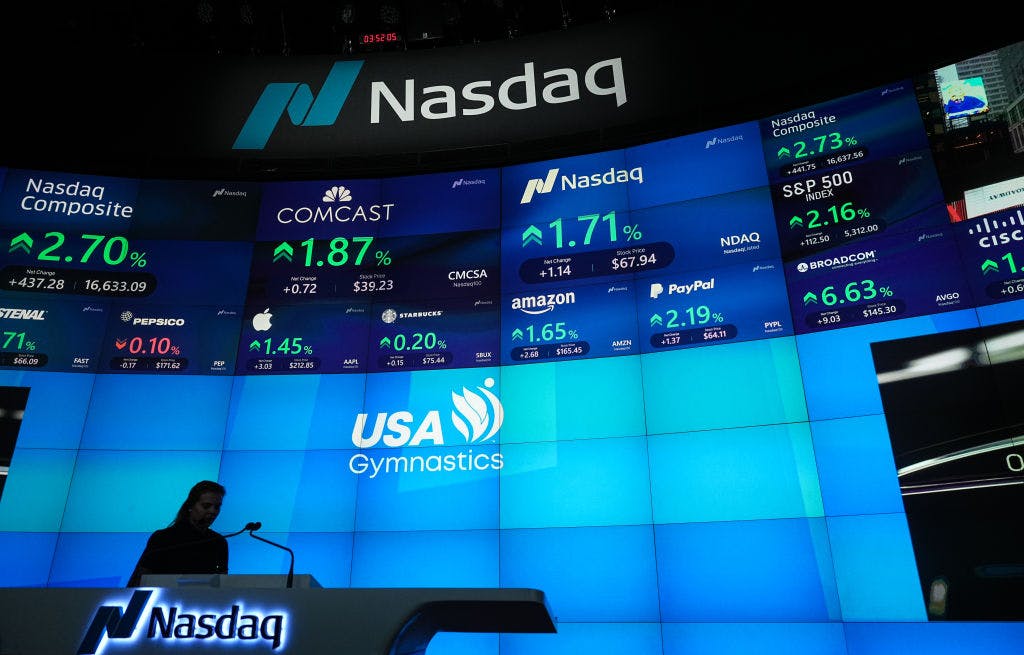
USA Gymnastics Rings Nasdaq Closing Bell
USA Gymnastics rings the Nasdaq closing bell (John Nacion/Getty Images)
Weird Money

Nasdaq is (finally) cracking down on reverse stock splits

Penny stocks' favorite feat of financial engineering is about to get a little bit harder.

Jack Raines

Over the last couple of years, you may have seen a stock chart that looks something like this, where the current price is down 90% or more from a peak of more than $1,000 per share.

But this chart is deceiving: Nikola Motors was never worth $1,977 per share. In an effort to stay listed on the Nasdaq, Nikola issued a 1-30 reverse stock split after its stock price collapsed below $1, a practice that has become increasingly popular over the last few years.

For context, stock exchanges like the Nasdaq and the New York Stock Exchange (NYSE) have continued listing standards for companies whose shares trade on their exchanges, and of the main requirements is a share price above $1. When a company’s share price closes below $1 for 30 consecutive trading days, the Nasdaq issues the company a noncompliance warning and gives it 180 days to remedy the situation. However, a delinquent company can request another 180 day grace period when the first period ends, effectively giving it a year to increase its share price. Given that companies can stay listed below $1 for a while, many have, and as of last Thursday, there were 509 stocks listed on US exchanges trading below $1 per share, with 421 of those listed on the Nasdaq. For reference, there were fewer than 12 sub-$1 stocks in the US in early 2021.

Unsurprisingly, companies whose share prices have declined below $1 tend to continue declining, so, to maintain their listings, they have turned to one of the more interesting feats of financial engineering: reverse splits.

Normal stock splits are typically viewed as a positive sign. Companies that have witnessed their share prices climb to the hundreds (or thousands) of dollars often announce stock splits (see Nvidia in 2021 and again in 2024) to maintain a more accessible price.

Reverse splits, however, tend to signal a struggling stock. While General Electric’s stock has done well since its 2021 1-for-8 reverse split, it wasn’t facing delisting warnings, and this move may have been a precursor to the conglomerate’s decision to later split into three separate companies.

A reverse split to avoid delisting usually means the company couldn’t do anything else to keep its stock price above $1. Reverse split volume has continued to increase as more companies’ stock prices slid below $1, with companies carrying out 495 reverse splits in 2023, compared to 102 in 2021.

Last month, electronic trading firm Virtu Financial filed a petition with the SEC asking the Nasdaq to adopt stricter listing requirements:

The bottom line is that current SEC rules that allow high-risk penny stocks to be listed on major stock exchanges present serious investor protection concerns. We believe that it is long past due for the Commission to take a fresh look at its rules around the listing of such securities and ensure that investors are armed with the information they need to assess the investment risks. 

One of Virtu’s primary concerns is that the proliferation of reverse splits threatens to confuse retail investors, with the price increases disguising investment risks. It looks like Nasdaq took notice, and last week, The Wall Street Journal reported that Nasdaq had submitted rule changes to accelerate delistings:

Under one of the proposed changes, companies that reach the end of their second 180-day grace period wouldn’t be able to postpone delisting by seeking an appeal. Instead, their shares would move to the over-the-counter market—a sort of purgatory where companies land after being delisted—while they await the appeal. Effectively, the rule change caps the amount of time that sub-$1 stocks can be listed on Nasdaq to roughly a year.

The second proposed rule change would speed up the delisting process for companies that recently did a reverse stock split. Under the change, if a company carried out a reverse split to prop up its share price, but then its stock fell below $1 within a year, Nasdaq would immediately send the company a delisting notice.

This is, to me, a long-overdue change. The idea that a company facing delisting could simply change its stock price without an improvement in the underlying business felt a bit… scummy. 

More Markets

See all Markets
markets

BlackBerry is on one of its hottest rallies of all time

History suggests that BlackBerry does extremely well when 1) it’s considered to be pioneering a transformative technology, or 2) there’s widespread retail enthusiasm for stocks.

If you squint (or dream), you could argue that both are going on right now.

Shares of the once-upon-a-time smartphone giant are up more than 160% over the past three months. The only times the shares have had a hotter run of form than this are at the tail end of the dot-com bubble, and in early 2021 when was it part of the meme stock craze headlined by GameStop.

Let’s start with the easy part first — here’s Scott Rubner, head of equity and equity derivatives strategy at Citadel, on retail’s significant footprint in the shares’ rally:

“Retail traders are the new price setters in the market. May volumes across our retail cash equities and options platforms are currently tracking at record levels. Daily volumes on our cash platform are setting new highs and are on pace to finish nearly ~10% above the previous record established during the January 2021 meme-stock era.”

And then there’s the harder part, part of the story that the traders bidding up BlackBerry now are dreaming about: the QNX division, which offers software that the company is positioning as an operating system for robots.

QNX’s software has early uptake in the field of autonomous driving, with BlackBerry eyeing a much more widespread role: in April, it announced a partnership to deploy this technology on Nvidia’s robotics platform. Nvidia’s Jensen Huang, for his part, has long been calling for agentic AI adoption to be followed by physical AI (i.e., robots).

In a QNX press release unveiling a report this week, the company argued that software, not hardware, is the real problem in terms of making sure robotics works.

I supposed it would be poetic, in a way, if the company at the leading edge of the smartphone revolution also plays a big role in the proliferation of robotics.

markets

Micron and Sandisk rally on new Street-high price targets from Susquehanna

Micron and Sandisk both hit fresh all-time highs in early trading after Susquehanna bestowed new Wall Street-high price targets on the two memory stocks.

Analyst Mehdi Hosseini upped his view on the former to $1,750 from $600, and to $3,250 from $2,000 for the latter.

“Supply is now expected to remain tight through 2027, sustaining elevated margins and thus warranting valuation re-rating,” he wrote, per Bloomberg.

It’s the fifth time in the past year that the average price target on Micron has gone up by more than 10% in a week. UBS’s Tim Arcuri more than tripled his price target on Micron earlier this week, and has already lost the title of “most bullish.”

But even as analysts are tripping over themselves to raise their price targets on these stocks, the ferocity of the rally in Micron has outpaced their best efforts.

The high-bandwidth memory specialist traded at a record premium to the consensus Wall Street price target this week, based on data going back to 2008.

markets

Okta soars on Q1 earnings beat, raised outlook driven by AI security demand

Okta shares are surging in early trading Friday after the identity security provider posted Q1 fiscal 2027 financial results that exceeded Wall Street estimates. The strong results are fueled by accelerating corporate demand for cybersecurity software, as well as the deployment of autonomous AI systems.

Key numbers:

  • Adjusted earnings per share of $0.91 compared to analysts estimate of $0.85.

  • Revenue of $765 million compared to an estimate of $752.7 million.

The company generated subscription revenue of $750 million, up 11% year over year. Okta also has $271 million in free cash flow, up from $238 million in the prior years quarter.

While standard cybersecurity software protects human workers, the latest catalyst sparking Oktas strong corporate performance is the rapid emergence of autonomous AI agents that can access sensitive corporate databases and interact with privileged executive accounts.

“AI agents are rapidly becoming a new workforce inside every organization, creating a wave of identities that must be secured and governed alongside human users,” said Todd McKinnon, CEO and cofounder of Okta. “We’re expanding our opportunity as the world’s leading independent and neutral identity provider and helping customers make identity the unified control plane for their secure agentic enterprise.”

Okta raised its fiscal 2027 revenue guidance to between $3.185 billion and $3.205 billion, roughly in line with estimates of $3.18 billion. The company formally dropped its long-term projected non-GAAP tax rate from 26% down to 21%. This adjustment is a direct byproduct of the federal corporate tax frameworks under the One Big Beautiful Bill Act.

Shares of Okta have risen around 9% since the beginning of this year.

markets

HPE, SMCI surge after Dell’s Q1 beat on strong AI server demand

HP Enterprise and Super Micro Computer shares are surging in premarket trading, getting a big boost from rival Dell’s strong Q1 results.

Dell’s $16.1 billion in AI-optimized server sales for the quarter alone proved that enterprise data center demand is accelerating faster than Wall Street had anticipated. The company posted revenue of $43.8 billion, exceeding Street estimates of $35.5 billion. Management now sees full-year sales of about $167 billion, well above the $142 billion expected by analysts.

The read-through is particularly relevant for Super Micro, one of the largest suppliers of Nvidia-powered AI server systems, and HPE, which has been expanding its AI infrastructure and liquid-cooling offerings through its partnership with Nvidia.

The moves suggest investors view AI infrastructure as a broad spending cycle that benefits server makers across the entire ecosystem.

Latest Stories

Sherwood Media, LLC and Chartr Limited produce fresh and unique perspectives on topical financial news and are fully owned subsidiaries of Robinhood Markets, Inc., and any views expressed here do not necessarily reflect the views of any other Robinhood affiliate, including Robinhood Markets, Inc., Robinhood Financial LLC, Robinhood Securities, LLC, Robinhood Crypto, LLC, Robinhood Money, LLC, Robinhood U.K. Ltd, Robinhood Derivatives, LLC, Robinhood Gold, LLC, Robinhood Asset Management, LLC, Robinhood Credit, Inc., Robinhood Ventures DE, LLC and, where applicable, its managed investment vehicles.

