

S&P 500 futures and Nasdaq 100 futures are recovering to start the week after suffering their worst one-day losses since June 5 on Friday.
The VIX Index touched its highest level since April 7, the day the US and Iran reached an initial ceasefire, as routs in bellwether AI stocks sparked market fear just ahead of Halloween.
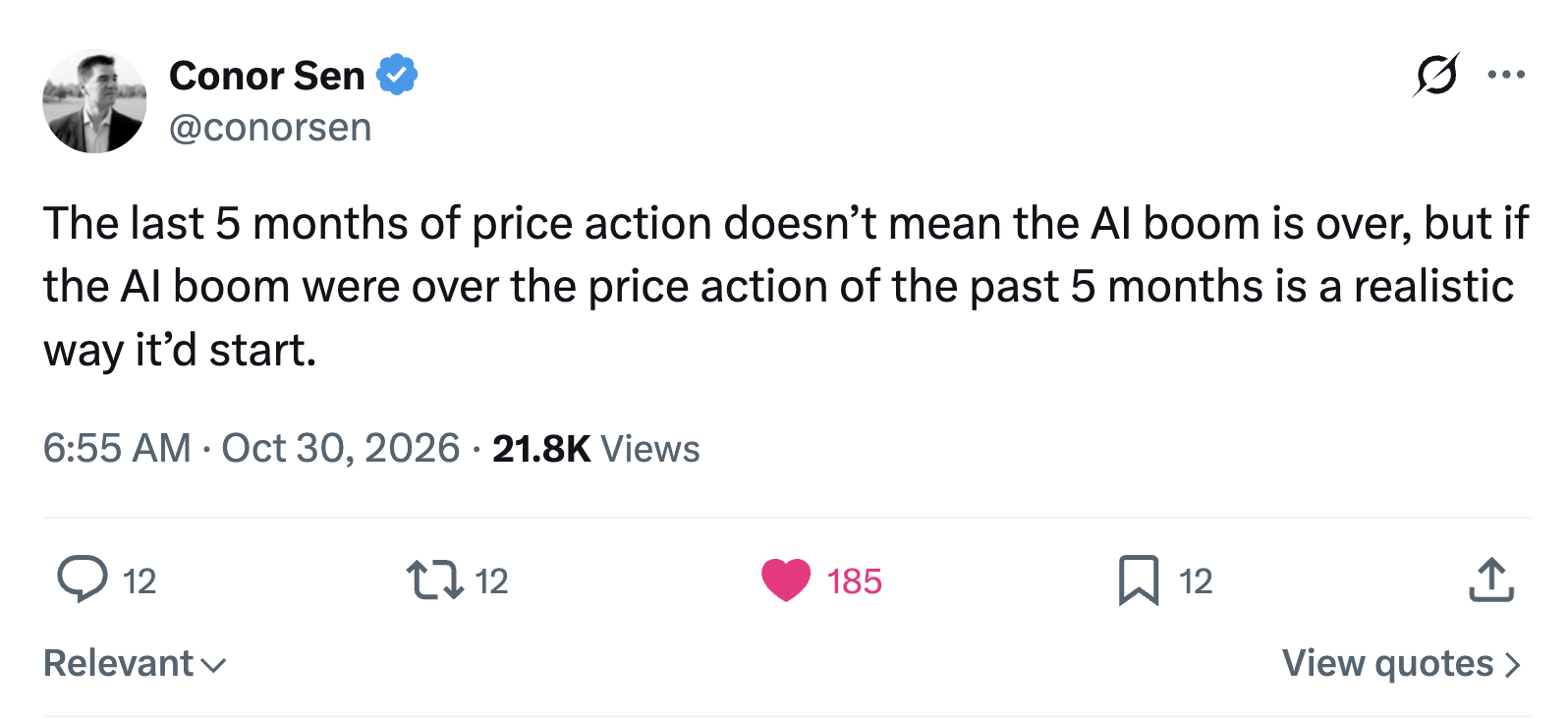
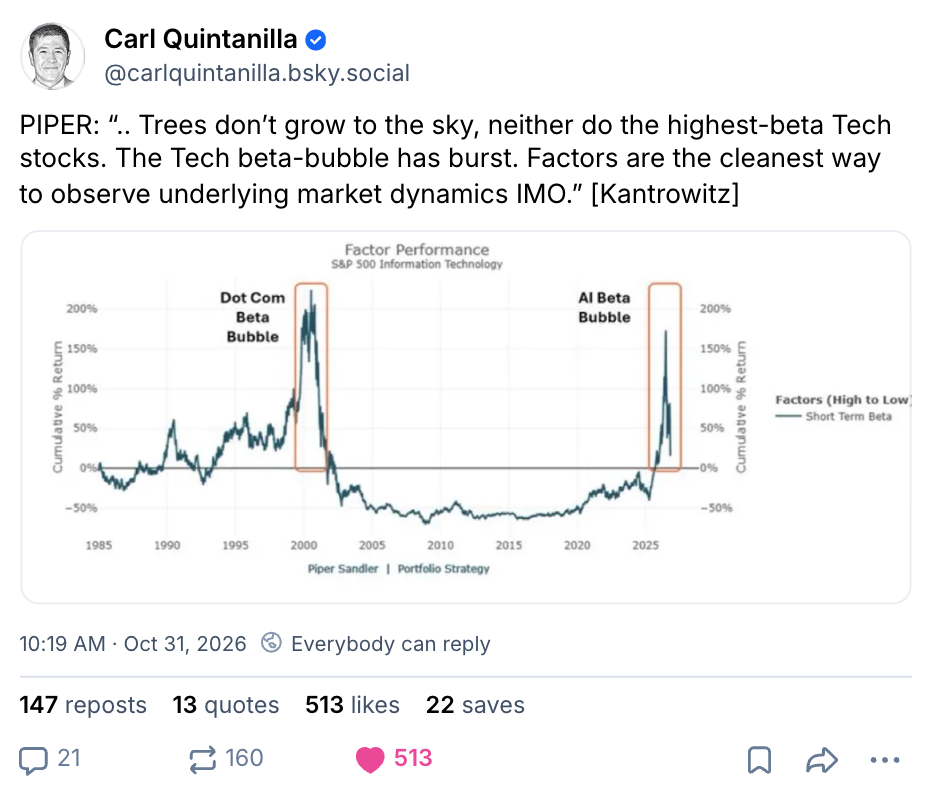
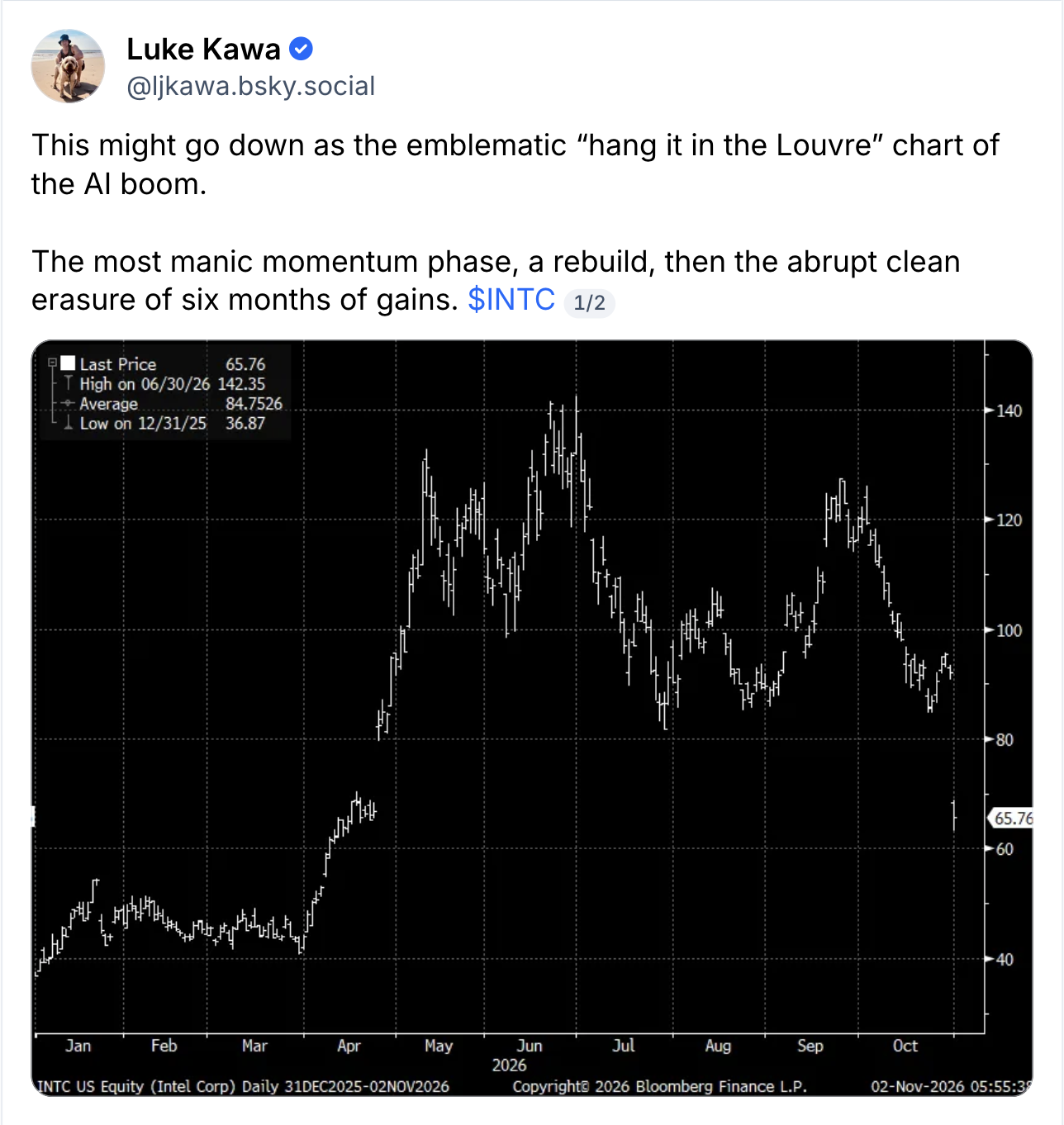
And if we have indeed passed the best-before date for the AI boom, the Intel chart is probably going to be the one we’ll use as a poster child for the era.
The stock was on an island for six months — spiking after impressive results in April then filling that gap with a record one-day drop on Friday after issuing soft guidance for Q4.
Friday was the sixth-highest day for Intel volumes going back to 1980, and the second most money that changed hands trading the stock ever. There must have been motivated sellers out there, but not the Robinhood crowd (at least in aggregate).
Daily net purchases of Intel were in the top 15 heading into earnings on Thursday, and then in the top 10 to close out the week as the stock plunged.
As a subsidiary of Robinhood, Sherwood Media is restricted from writing about any company in which Robinhood is or was a selling group member of the IPO during the regulatory "quiet period" for that company.
History says…
Prediction markets are giving the Democratic Party more than 70% odds of winning control of both houses of Congress ahead of Americans heading to the polls on Tuesday.
History says that just getting the midterms out of the way will be a positive for US stocks.
Brett Friedman of Winhall Risk Analytics looked at more than a century’s worth of midterm elections and found that “returns surrounding midterm election years are clearly higher than those observed during non-election years and have much greater positive frequencies,” with implied volatility tending to compress, as well.
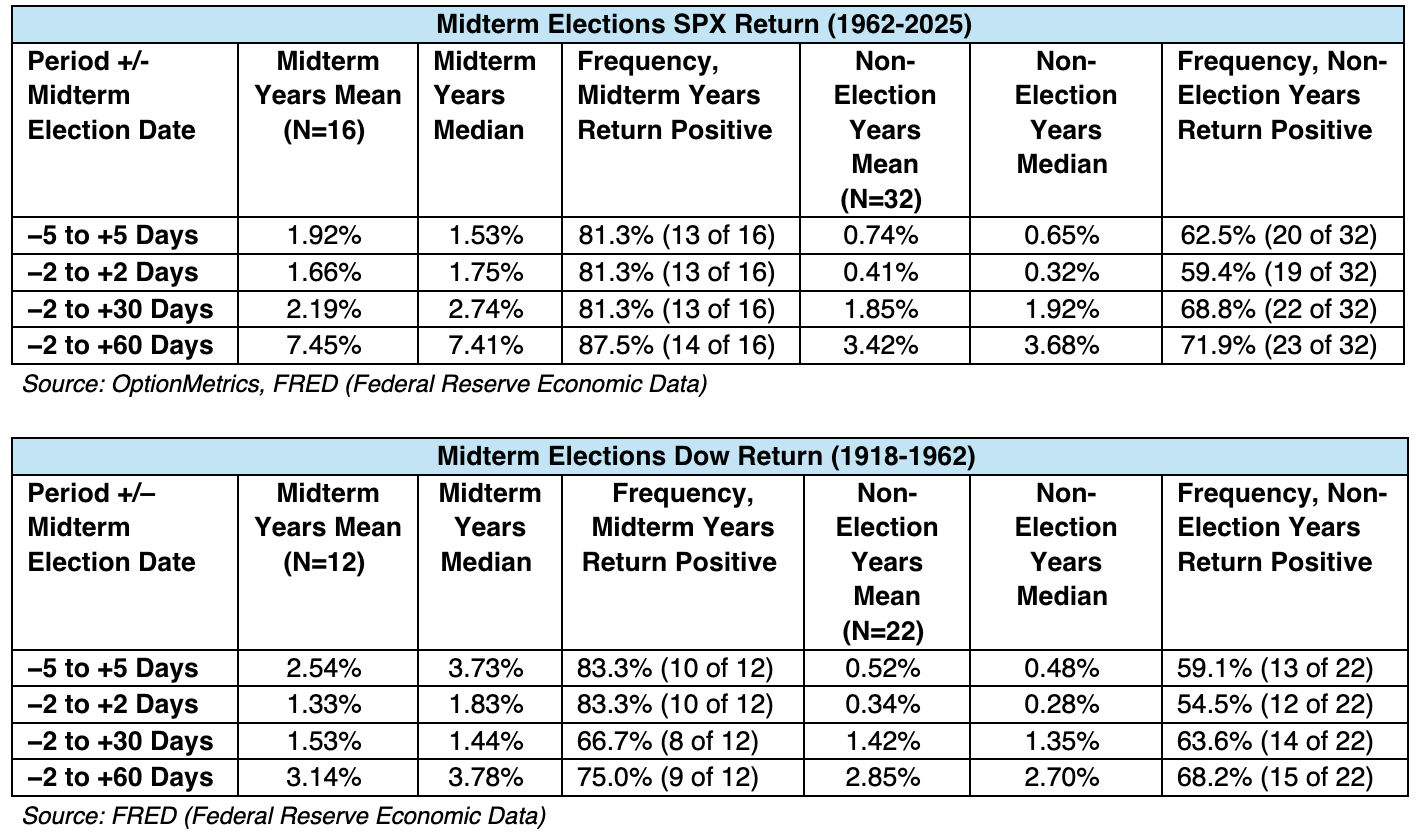
Morgan Stanley chief US equity strategist Michael Wilson also suggested that the midterms would be one of three “clearing events” that would help stocks regain their footing.
“Midterm elections are typically a market headwind initially and usually then lead to very strong 6-12 month returns post the event,” he wrote. “The path between here and there is likely a messy one and may linger a few days or weeks after election day with the administration hinting at a potentially more aggressive military stance once the election is over.”
One factor undermining this sort of analysis is that it might be difficult for something to be a clearing event when it’s not priced as an event at all!
“The US midterms take place tomorrow, and SPX options markets continue to treat it as a non-event,” writes JPMorgan analyst Bram Kaplan.

How to square these contradictory thoughts of the midterms being both a potential clearing event in the minds of analysts and a non-event in options pricing?
Well, stocks, in particular the AI trade, have been on the back foot in the run-up to this vote for many reasons, which may well include potential policy changes depending on who takes office.
Brent Donnelly, president of Spectra Markets, recently conceded that this election might be more consequential than he previously thought because of the potential read-through to business-unfriendly policies in 2028, uncertainty as to how much (or whether) President Donald Trump might re-escalate military action in the Middle East, the impact of the Texas governor’s race on data center construction, and scar tissue from 2018 (when stocks cratered following the midterms).
Andrew Bishop, global head of policy research at Signum Global Advisors, reckons there’s about a 35% probability of “major strikes” on Iran through year-end. That will certainly be a wildcard that’s front-of-mind on Tuesday night, no matter how the results go down.

The midterms, like every other event in recent memory, will be viewed through the lens of “what does this mean for the AI boom?”
In an Oct 20 note, Morgan Stanley analyst Ariana Salvatore highlighted the races with the most at stake for data center construction — where states, not Congress, are the key decision makers.
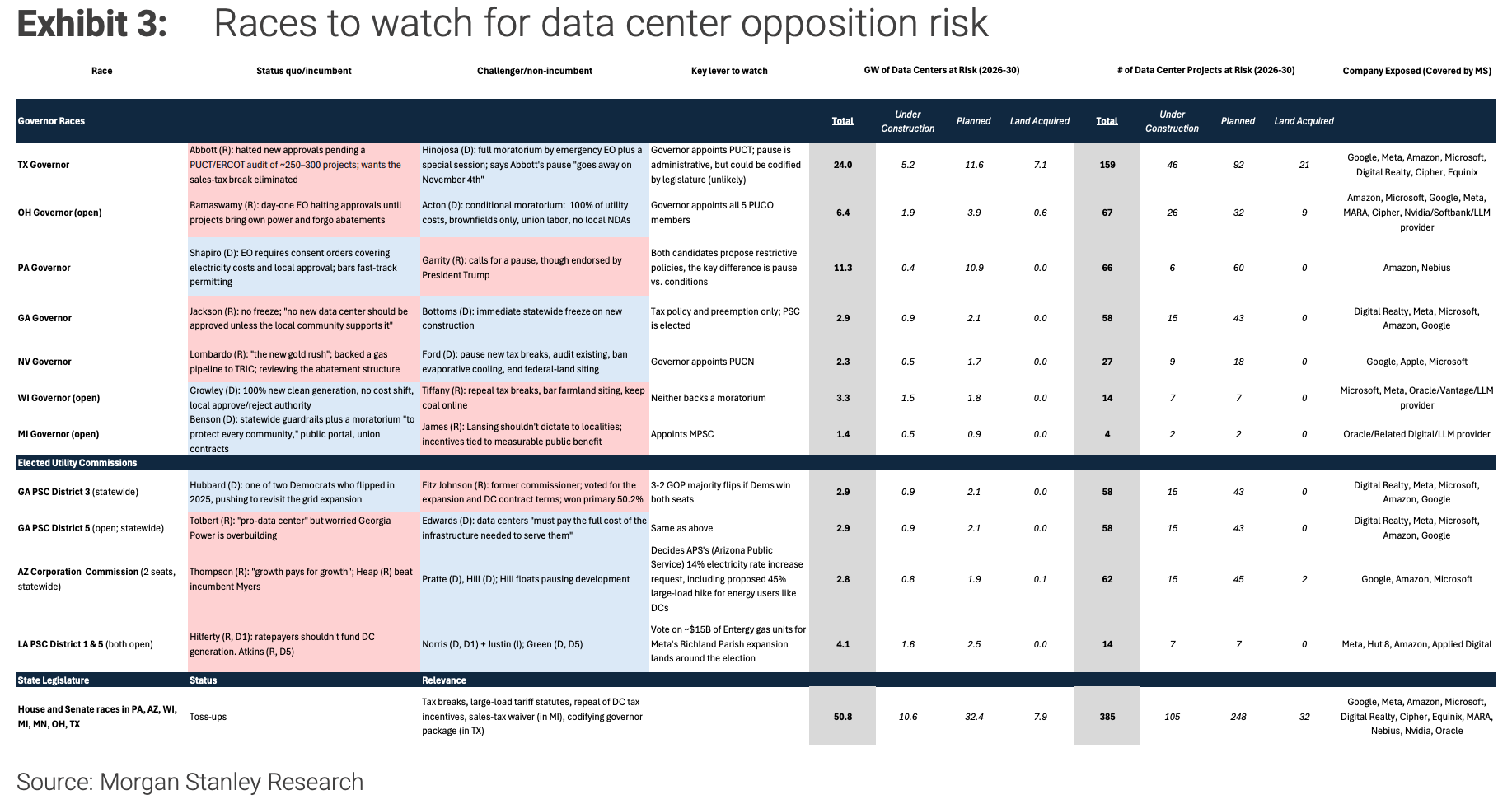
“LOI's, funding, deals and projects are effectively on hold (at least publicly) and to the extent we get the clearing event next week (Abbott win) then names tied to TX should have a positive initial reaction from this recent pressure,” wrote Dauvin Peterson, AI infrastructure analyst at 22V Research in a note to clients on Oct 28. “Powered shells like Cipher Digital, SpaceX could also be interesting - Musk and co likely holding back any details of future data center sites and plans until we are past this in order not to stoke further backlash in the state.”
And of course, our late July contribution to midterm discourse has been to highlight how bipartisanship has nosedived in the US over the past decade (in case you haven’t noticed). Midterms typically bring about a divided government that limits the scope for major policy initiatives. All else equal, not bad for bonds.
(The FT also jumped on board, highlighting a similar dynamic late last week).
Of course, all else is not equal. We’re in the midst of a dash for capital to put towards solving the continued scramble for compute. AI is in the driver’s seat for the bond market… so I suppose that brings us back to suggesting the midterms will matter to the extent they’re perceived as a clearing event, and how many constraints they place on the AI boom!
An Apple a day…
Apple, the world’s most valuable publicly traded company and the last $5 trillion market cap standing, reports earnings after the close on Monday.
Wall Street is looking for earnings per share of $2 on sales of $113.5 billion for its fiscal Q4; for the current quarter, analysts anticipate EPS and revenues rising to $2.91 and $152.6 billion, respectively.
Shares are priced to swing about +/- 4% on Tuesday in reaction to earnings. That’d be less than the one-day move last quarter, but more than the stock has gyrated in the wake of 10 of its last 12 quarterly reports.
It’s odd for me to even consider Apple as a business.
And based on how these results won’t do a great job of capturing fresh products released by the tech giant, maybe I won’t have to.
“In our view the September numbers are the appetizer and the December-quarter outlook is the main course, as it covers the first full period of iPhone 18 demand and the iPhone Duo launch (on sale October 23), and the stock will trade on how Ternus frames supply, memory costs, and the holiday quarter,” writes Dan Ives of Yorkville Ives.
I spend more of my time thinking about Apple’s role in the current market structure: An Apple a day keeps correlations at bay. There’s been a sharp decline in its correlation with the Nasdaq 100 as a whole, and in particular with GPU kingpin Nvidia and the Magnificent 7’s hyperscalers. Generally speaking, it does poorly when the megacap companies more tethered to the AI buildout do well, and vice versa.
The recent snap-back in correlations from “negative” to “uncorrelated” is a function of which days have just dropped out of the three-month lookback period. That would be the tail end of July and early days of August, when the iPhone maker fell out of bed after issuing underwhelming sales guidance while the AI trade bounced back with a vengeance amid strong results from Microsoft and the “Leopold low.”
To me, Apple is not a company that sells hardware and then locks me into sending increasingly large services and subscription fees in perpetuity. Apple is actually just a company that isn’t spending hundreds of billions on the AI boom. Just as Canadians often define themselves by listing out ways in which they’re not like Americans, Apple is defined by the ways in which it’s not like the rest of the Magnificent 7.
It’s the ultimate residual by virtue of its size and operational strategy: If you have high conviction in the ROI of AI returns over the medium term, you’re probably underweight Apple and overweight the hyperscalers.
No matter how well Apple does, it never seems to catch too much retail attention in the AI era. Even though it’s far and away the best performing Magnificent 7 component year to date, the last time it was the most net purchased member of this cohort on a rolling monthly basis was over a year ago (in the tail end of Q2 2025).
Whispers from Wall Street
US-midterms-and-markets history can cut both ways!
Lori Calvasina, head of US equity market strategy at RBC Capital Markets, flagged that if the S&P 500 manages to reverse its Q4 losses and post another quarter in the green, that might not be a stellar sign for forward returns.
Following the five midterm elections since 1970 in which the S&P 500 rose in both Q3 and Q4, the median one-year return was just 3.5%, far weaker than the 18.4% advance over the entire sample.
Seen on Socials
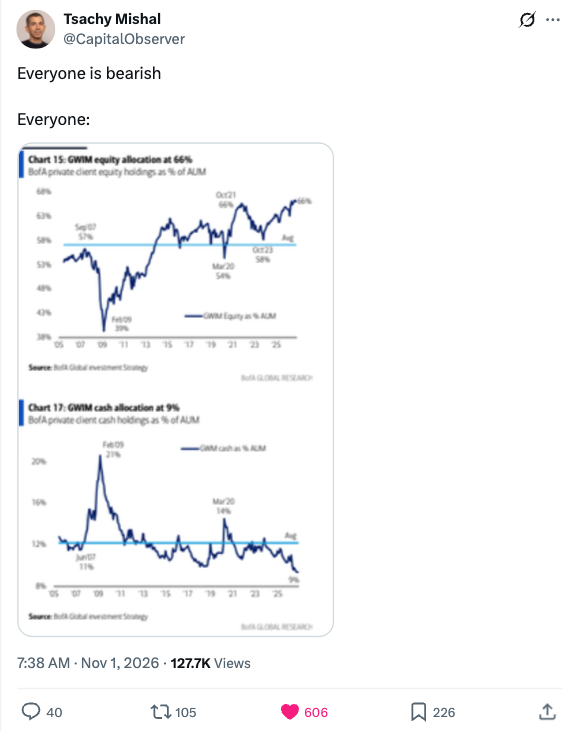
From @CapitalObserver on X.