
Markets
Para Alpine Skiing - Milano Cortina 2026 Winter Paralympic Games: Day 6
Let’s avoid going belly-up (Maja Hitij/Getty Images)

JPMorgan warns on the first “persistent signs of weakness” from retail traders in 2026

It takes a lot to shake the resolve of retail traders. War and oil price spikes might just be enough.

Luke Kawa

Scott Rubner, head of equity and equity derivatives strategy at Citadel Securities, recently called retail investors the “strongest hand in the entire market.”

War, and the ensuing spike in oil prices, looks to be prompting some of those strong hands to consider folding.

“For the first time this year, retail investors are showing persistent signs of weakness, with weekly purchases decelerating by ~30% after defying seasonal patterns and making February their 3rd largest month on record,” wrote JPMorgan strategist Arun Jain. “In fact, Monday marked the largest net-selling day in single stocks in a month, before purchases resumed at a positive, yet below YTD average pace on Tuesday and Wednesday.”
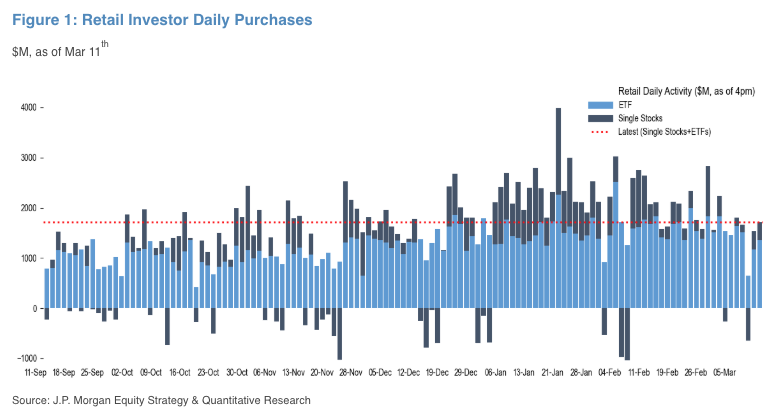
Retail purchases JPM

Extreme oil price volatility like the kind we’ve seen over the past month is typically accompanied by elevated stock market volatility and increased recession risk.

Of course, per the chart and Jain’s clear statement, deceleration is not contraction. Aggregate retail inflows are slowing, but not yet turning into outflows.

Retail traders crushed it last year due to both market timing and stock selection, with a heavy focus on AI-linked plays. In 2026, their stock preferences remain pretty much the same, per Jain. The cohort has also preferred to get exposure to the war-induced supply crunch in crude through ETFs like the United States Oil Fund LP, which offers exposure to the commodity through futures and swaps, rather than baskets of large energy companies like the Energy Select Sector SPDR Fund.

“Notably, their stock picking choices — aside from reduced sizes — remained relatively optimistic: retail investors were again positive Tech Mega Caps (incl. ORCL pre and post-earnings), while cutting their exposure in energy stocks,” Jain added. “The behavior resembles what we saw in 2022 during the Ukraine‑Russia conflict — an initial few weeks of buying energy stocks and ETFs, a brief turn negative, followed by a return to net buying in the case of Ukraine-Russia as the conflict unfolded.”

It takes a lot to break the resolve of retail traders. In 2025, the group was undaunted by the tribulations that the market encountered in the first four months of the year. The masses were buying the dip in megacap tech stocks well after their momentum had sputtered in Q1 2025, and were a net buyer of stocks through the entire month of March even as tariff risk escalated, per JPMorgan.

April 3, 2025, the worst day for stocks since 2020 — the session following the announcement of reciprocal tariffs on “Liberation Day” — was met with the largest level of retail stock purchasing in a decade, according to JPM.

More Markets

See all Markets
markets

SpaceX gets a wave of bullish ratings from Wall Street analysts

SpaceX received more than a dozen positive analyst calls on Tuesday — including from major Wall Street banks — as they initiate coverage on Elon Musk’s space and AI company.

SpaceX went public on June 12 at a $2.2 trillion valuation, the largest debut in history. While the company hasn’t yet posted a profit, it seems to have convinced Wall Street that it will get there and grow its valuation on the way.

Of the at least 17 analysts that gave a rating on Tuesday, all but one gave it a “buy” or “outperform” rating. MoffettNathanson was "neutral."

The ratings come as SpaceX joined the Nasdaq 100 index, a benchmark tech-heavy basket of companies that underpins millions of portfolios. The inclusion adds built-in demand for the stock from index funds and ETFs.

Still, SpaceX fell more than 5% on Tuesday amid a broader sell-off, and is currently effectively flat from its opening price of $150 a share.

markets

Nike sinks to lowest level since 2014 after warning of “challenged” sales environment in Q4 report

Did Nike do it?

Investors had a mixed reaction after the global sports apparel company reported its fourth quarter earnings on Tuesday after the bell. Shares initially rose 5% as Nike beat out Wall Street expectations amid a hefty tariff refund bonus. However, the stock then sank to its lowest level since August 2014 in postmarket trading.

Here are the Q4 numbers:

  • Revenue of $11.0 billion (estimate: $10.8 billion).

  • Adjusted earnings per share of $0.20 (estimate: $0.12).

Ahead of this report, Nike warned that results would be flattered by a one-time tariff refund (now estimated at roughly $0.52 per share for the bottom line). That gave the company an extra cushion in snapping its streak of seven quarters of year-over-year profit declines.

Over the past year, the company had been punished by tariffs on imported goods, stagnant consumer spending, and increasing competition from other footwear brands like New Balance, Adidas, and Hoka.

Outgoing CFO Matthew Friend deemed it an “increasingly challenging operating environment, where sell-through remains challenged.”

Latest Stories

Sherwood Media, LLC and Chartr Limited produce fresh and unique perspectives on topical financial news and are fully owned subsidiaries of Robinhood Markets, Inc., and any views expressed here do not necessarily reflect the views of any other Robinhood affiliate, including Robinhood Markets, Inc., Robinhood Financial LLC, Robinhood Securities, LLC, Robinhood Crypto, LLC, Robinhood Money, LLC, Robinhood U.K. Ltd, Robinhood Derivatives, LLC, Robinhood Gold, LLC, Robinhood Asset Management, LLC, Robinhood Credit, Inc., Robinhood Ventures DE, LLC and, where applicable, its managed investment vehicles.

