


Investors are growing bullish on weed stocks. But why?
We spoke to ATB Capital Markets analyst Frederico Gomes about why institutional investors are growing bullish on cannabis.
Cannabis investors — a group of people who have learned not to get their hopes up too much over the years — are cautiously optimistic that there are better days ahead.
The dominant narrative in the sector is that cannabis reform is coming, which would instantly make a group of battered US weed companies more profitable. In an ATB Capital Markets survey of 26 institutional investors, which was conducted September 8 through 15, 53.8% of investors were more bullish on US cannabis compared to just 6.7% six months ago.
According to the survey, about 96% expect rescheduling — meaning, moving weed from being a Schedule I drug (like heroin and LSD) to a Schedule III drug (like Tylenol and testosterone) — to happen during President Trump’s term, with about 60% expecting it to happen in the next 12 months.
“Rescheduling kind of dominates the narrative; we expect that to continue near term,” said Frederico Gomes, director of institutional research in life sciences at ATB.
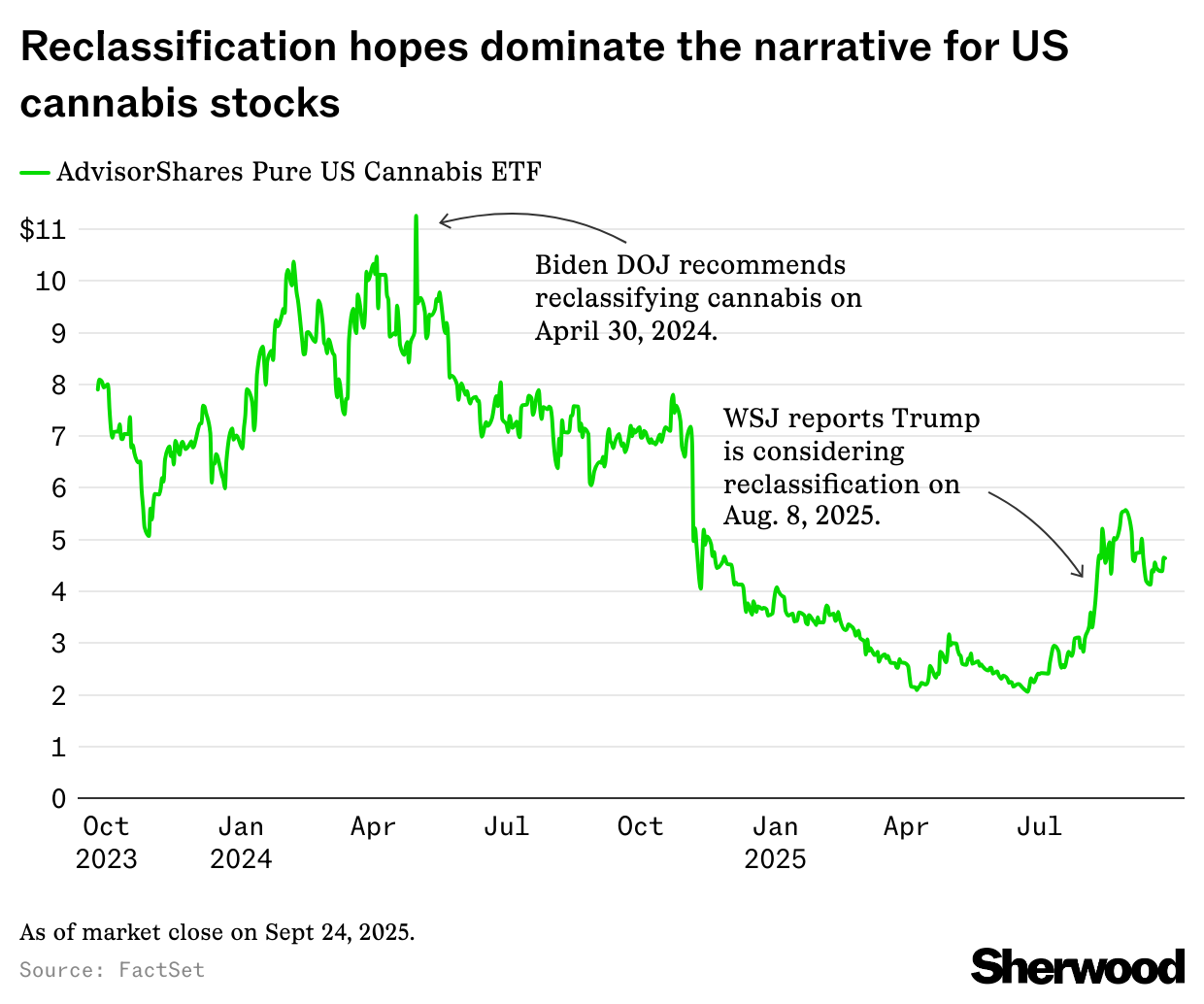
Under former President Biden, the Department of Justice announced in April 2024 that it would recommend reclassifying marijuana, though that process was bogged down. The Wall Street Journal reported on August 8 that Trump was “considering” reclassifying marijuana as a less dangerous drug. Trump said on August 11 that his administration would make a determination “over the next few weeks.”
Valuations have swelled since then. AdvisorShares Pure US Cannabis ETF, which uses the ticker symbol MSOS, and Roundhill Cannabis ETF, which uses the ticker symbol WEED, are both up more than 60% since six months ago.
Still, cannabis reform has a patchwork of support among Republicans and isn’t a particularly high political priority for either party. A group of Republicans in the House of Representatives, for instance, is seeking to include a measure in the upcoming spending bill that would thwart efforts to reschedule cannabis.
Under the current regulatory scheme, American cannabis operators struggle with limited access to banking, an unfriendly tax code, and high levels of debt without the benefit of bankruptcy protections. The high tax burden weighs on margins and a looming debt crisis threatens to take out smaller cannabis operators.
“The large operators are going to be OK” if there is no rescheduling, Gomes said. “But the smaller operators, they’re all leveraged.” (Just last month, Ayr Wellness, a midsize US cannabis operator, said it would wind down operations and sell off its assets.)
If rescheduling does happen, about 77% of investors expect MSOS — the benchmark for US cannabis companies — to exceed $10, up about 120% from where it is now. Gomes noted that valuations, while higher than six months ago, are not close to that point, highlighting the caution investors still have.
“Even though they think it’s going to happen, I think there’s a lot of uncertainty in the near term,” he said. “It’s sort of a dual view here, a very nuanced view.”
Gomes said if rescheduling doesn’t happen this year, valuations will likely give back some of their gains. “Sentiment is very volatile in this sector,” he said.
Rising bullish sentiment extends north of the border, too: about 33% of investors are bullish on Canadian cannabis companies — such as Tilray, SNDL Inc., and Canopy Growth — compared to 11% a year ago, citing improved fundamentals as the top factor. Still, they are generally holding rather than adding exposure.
Publicly listed Canadian cannabis companies cannot sell weed in the US. (That is largely why MSOS exists: because the US cannabis companies it indirectly holds cannot list on major exchanges.)
Amid regulatory uncertainty, cannabis companies have learned to get leaner. Last year, US cannabis retail sales jumped 4.5% year over year to $30.1 billion even as employment in the sector decreased by 3.4%, a report from Whitney Economics found.
The same is true for Canadian operators, Gomes said. The Canadian cannabis market is more mature, with low single-digit growth. The largest catalyst for Canadian cannabis companies has been exports to Europe, primarily Germany.
“We’ve seen some increased interest in Canada, so I think investors are coming back to the Canadian story because of growth in international markets,” Gomes said.




