
Markets
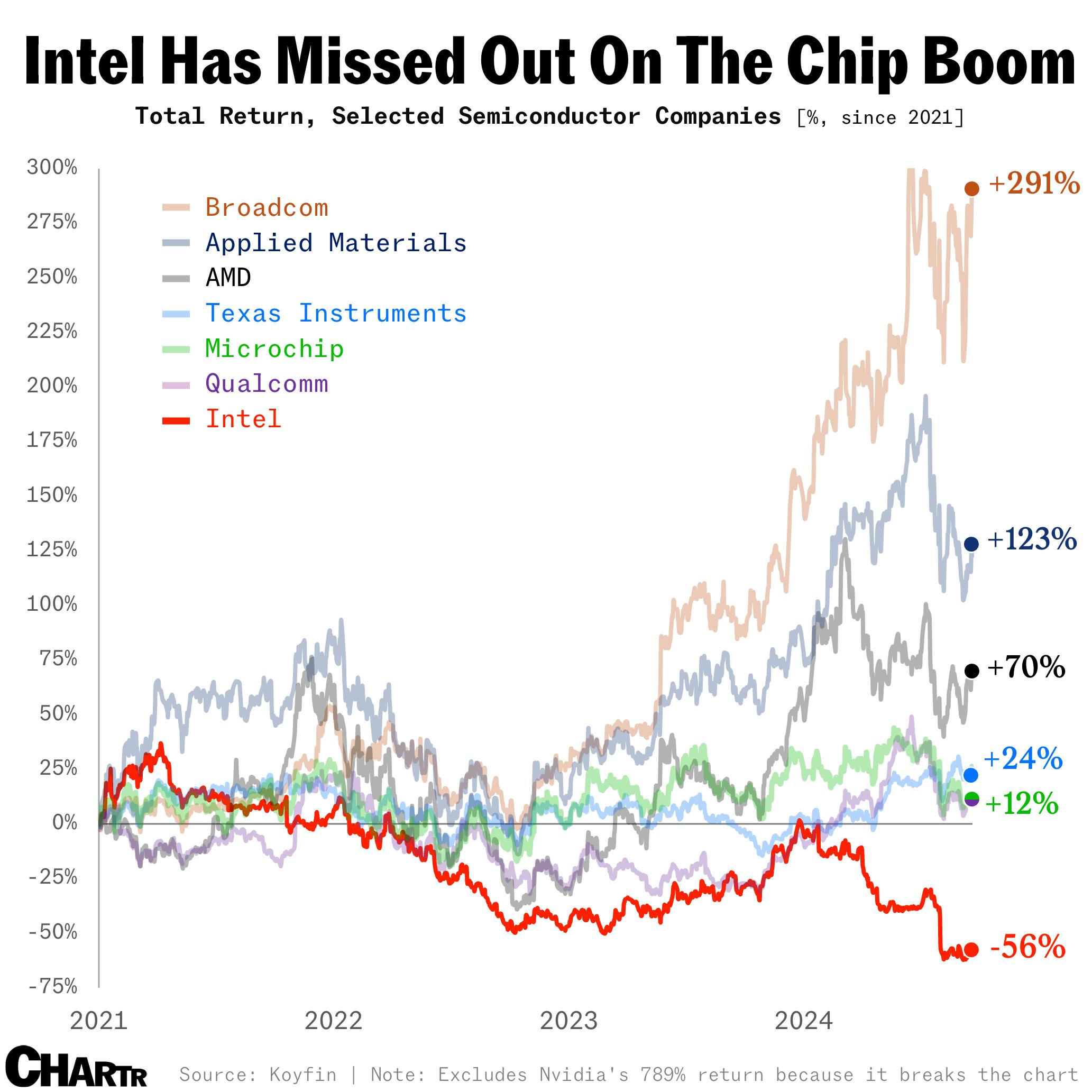
Intel share price vs. peers
Sherwood News

Intel missed the chip boom, now investors, and rivals, are circling

Multiple parties are exploring investing in, or buying all of, Intel, Inc.

It’s been a good few years to be in the chip-making business — but Intel missed the memo.

Once the most valuable US semiconductor company, Intel has missed most of the AI wave that has propelled the share prices of its competitors. And now private equity firms and competitors are circling. Late Friday, The Wall Street Journal reported that fellow chipmaker Qualcomm has approached Intel about a potential acquisition, while Apollo is reportedly considering a $5 billion investment as the company embarks on an ambitious turnaround plan.

Intel’s stock has shed more than 56% of its value since 2021, while the broader semiconductor sector has experienced explosive growth. In response, the company announced a series of drastic measures last month, including cutting 15,000 jobs, slashing capital expenditures, and eliminating its annual dividend.

Wires crossed

Per The Economist, while many competitors adopted a "fabless" model, outsourcing chip production to foundries like TSMC, Intel doubled down on both designing and manufacturing its own chips. This eventually left the company trailing behind in the race to produce the fastest chips with the smallest transistors — an ironic fate for the birthplace of Moore’s Law.

The AI revolution further laid bare Intel’s lack of innovation. As demand shifted towards graphics processing units (GPUs), Intel’s focus on central processors (CPUs) was unhelpful. Nvidia famously “bet the farm” on the AI trend, and has since surged to a multi-trillion-dollar valuation. Meanwhile, Intel reported a $1.6 billion operating loss last month, resulting in the worst single-day drop in its stock price.

Despite securing funding through the CHIPS Act and announcing a partnership with Amazon to produce chips for AWS last week, Intel shares continue to hover around a decade low. Clearly, investors within both Apollo & Qualcomm see some potential for a turnaround.

More Markets

See all Markets

Airlines and cruise stocks surge as oil prices plunge

Travel stocks are surging on Wednesday, with West Texas Intermediate crude futures down 5% as of 12 p.m. ET, largely on commodity traders’ hopes of a resolution to the US war with Iran.

The decline comes despite the US Energy Information Administration reporting a record plunge in US crude inventories last week. As the country expands its oil exports to reduce the impact of the war in Iran, inventories have fallen by 7.9 million barrels, according to the EIA, indicating a significant drop in domestic supply wiggle room ahead of the summer driving season. Per Reuters, analysts had expected a drop of 2.9 million.

Bloomberg noted that US oil exports have been crucial in keeping global petroleum prices in check, as supply remains historically constrained due to the effective closure of the Straight of Hormuz. Typically, such a sharper-than-expected drop in inventories would cause oil futures to rise.

Today, however, that is not the case and oil’s pain is travel stocks’ gain, with US airlines and cruise lines surging higher on Wednesday. Delta Air Lines, United Airlines, American Airlines, Southwest Airlines, and JetBlue were all up by at least 6%, while Carnival and Norwegian were up about 7%.

Royal Caribbean pared earlier losses from Mexico’s rejection of a large planned water park, but was still down about 1%.

markets

Micron jumps on looming Samsung strike

Micron shares are climbing early Wednesday, breaking a sharp multiday semiconductor pullback. The rally comes amid the potential for a critical supply-side disruption at one of its largest global competitors, Samsung Electronics, as well as building investor enthusiasm ahead of Nvidia’s highly anticipated earnings report.

As demand for AI compute accelerates, Micron is increasingly viewed as a top-tier beneficiary due to its role in the critical high-bandwidth memory (HBM) market. The operational catalyst sparking Micron’s rally is a massive looming labor dispute in South Korea. According to Reuters, roughly 48,000 Samsung workers are set to begin an 18-day strike Thursday after negotiations broke down.

As global HBM production is effectively controlled by Micron, Samsung Electronics, and SK Hynix, any manufacturing hiccup at Samsung shifts pricing leverage to Micron. This backdrop comes as South Korea’s broader chip ecosystem is benefiting from the global infrastructure boom, pushing the country to the seventh-largest stock market in the world.

Micron has been expanding its own AI memory footprint. In March, the company completed its acquisition of PSMC’s Tongluo P5 site, a strategic integration designed to scale its domestic HBM production capacity and meet accelerating hyperscaler demand.

Latest Stories

Sherwood Media, LLC and Chartr Limited produce fresh and unique perspectives on topical financial news and are fully owned subsidiaries of Robinhood Markets, Inc., and any views expressed here do not necessarily reflect the views of any other Robinhood affiliate, including Robinhood Markets, Inc., Robinhood Financial LLC, Robinhood Securities, LLC, Robinhood Crypto, LLC, Robinhood Money, LLC, Robinhood U.K. Ltd, Robinhood Derivatives, LLC, Robinhood Gold, LLC, Robinhood Asset Management, LLC, Robinhood Credit, Inc., Robinhood Ventures DE, LLC and, where applicable, its managed investment vehicles.

