
Markets
Formula 2 Championship - Round 8 Silverstone - Feature Race
Hometown skeptics called it Champagne problems (Malcolm Griffiths/Getty Images)

How some US companies are turning a potential tariff hangover into an even bigger profit party

By preparing for the worst, these management teams no longer have to hope for the best.

Luke Kawa

By preparing for the worst, some of America’s leading companies no longer have to hope for the best.

Sam Rines, macro strategist at WisdomTree and the brains behind its GeoAlpha Opportunities Fund, has a brilliant thesis that helps explain one of the thornier questions in markets: how have stocks done so well, and earnings estimates held up so much, despite a big rise in tariff rates (albeit in many cases not as bad as what was floated on April 2)?

One could be pithy and just say “AI,” but that would be incomplete.

Rines is one of my favorite strategists for the way he scours micro information from companies to inform macro, top-down views about the economy and financial markets, and his work in unpacking how management teams are adapting to tariffs of an unknown size and scope is a great example of just this.

Here’s an excerpt from his recent note:

“Then there are the companies with too much tariff priced in. And those are the ones to watch. Again, there is a particular cadence to the companies —

- Guided for the worst of all possible worlds. (the reverse Leibniz guide)

- Found out it was not quite that bad after various tariff announcements and internal adjustments.

- Are now guiding some of the impact back to the bottom line. (emerged from the Dark Night of Earnings)”

One thing that blue-chip companies are very good at is overcoming shocks. I mean, look at the chart:

(It helps that the ones that aren’t get expunged from the index and replaced by firms that are!)

When you tell management teams that they’re about to have a 500-pound cross to bear, they’ll prepare. And when that turns out to be 350 pounds, they’ll be able to run a sub-three-hour marathon carrying it.

Rines highlights a few examples of this phenomenon during this earnings season. The best one, without a doubt, is 3M.

“Guiding down the tariff impact from $0.20 to $0.40 of net impact to $0.10 might sound trivial,” he wrote. “But the interaction of expecting a larger impact and preparing for it led 3M to guide earnings higher than their pre-tariff (January) expectation.”
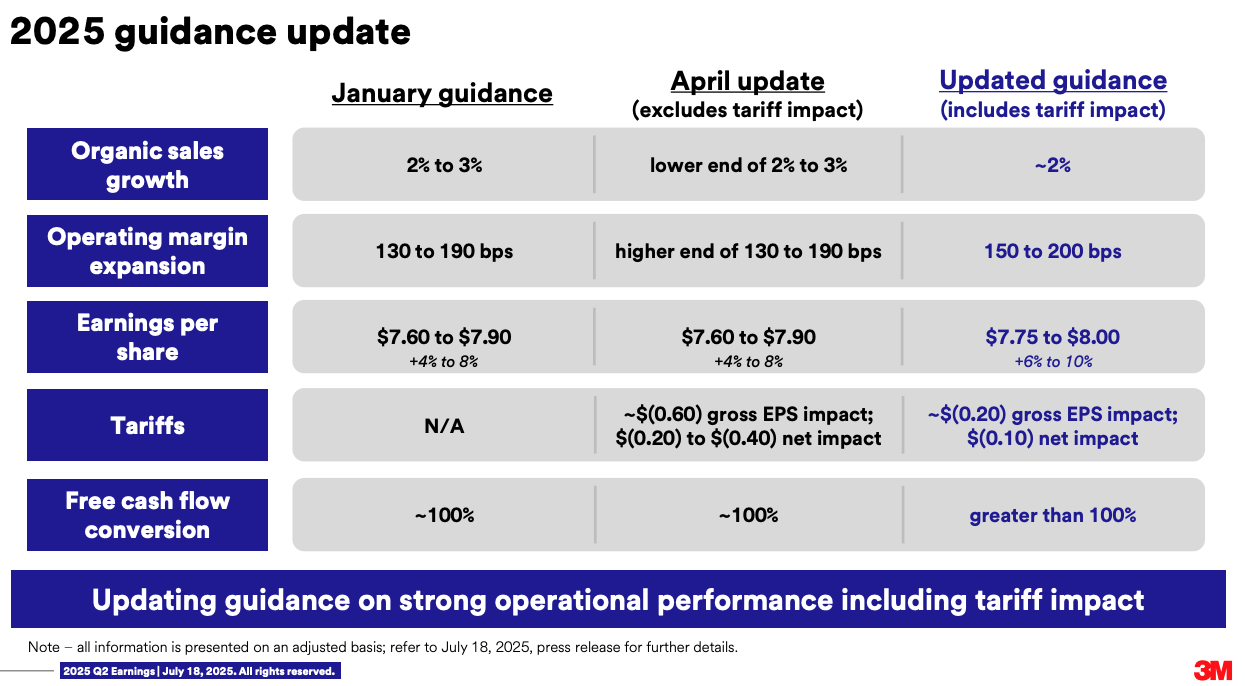
3M earnings presentation
Source: 3M earnings presentation

Now, does this hold as a general rule? That’s a little tough to disentangle (and the answer is probably not). S&P 500 2025 earnings-per-share estimates are well below where they started the year. There is a tendency for calendar-year earnings to be revised lower within the year, though. So I’m not prepared to say (nor is Rines!) that tariffs are outright positive for earnings. But based on his work, I am fairly confident in concluding that tariffs provided a kick in the rear end that catalyzed some executive teams to make decisions that are boosting the profitability of their businesses.

Rines highlights Procter & Gamble, Deere & Co., and Kimberly-Clark as some of the stocks to watch to observe how widespread this dynamic may be.

“There are plenty of companies with a tariff overhang. For some, that hangover will be warranted. But others will emerge on the other side with better outcomes,” he concluded. “It may be surprising to see who the winners are at the end of earnings season. With tariff impacts being mitigated and pricing plans to come, this earnings season could be surprisingly positive.”

(Somehow, we got through this piece without referencing the apocryphal and not quite correct quote from JFK about how the Chinese word for crisis is composed of “danger” and “opportunity.”)

More Markets

See all Markets
markets

AMD shares climb on double Citi upgrade to “buy” with $575 price target

AMD’s shares are rising in premarket trading following a double upgrade from Citi. Citi analyst Atif Malik raised AMD’s investment rating to “buy” from “neutral” and boosted the bank’s 12-month price target to $575 from $460 per share, per Barron’s.

Malik argued that the broader market currently misprices AMD by looking at it primarily as a CPU producer, underestimating its massive GPU potential. Citi says that AMD is uniquely “poised to win the lion’s share” of Meta’s customized graphics chip business. Meta is leaning into AMD’s custom MI450 chips, which deliver a lower total cost of ownership compared to buying traditional off-the-shelf merchant hardware, according to Investing.com.

Citi highlighted a massive multiyear deal between the two tech giants involving a 160 million-share common stock warrant. As the first phase ramps up through 2027, Citi expects each gigawatt of data center infrastructure to translate into roughly $15 billion in revenue. Consequently, Citi hiked its 2027 AMD AI sales forecast to $33 billion (up 137% year over year) and projects GPU sales to reach $50.8 billion by 2028.

CEO Lisa Su recently delivered an optimistic demand forecast, predicting that the global market for CPUs will grow by more than 35% annually over the next five years. The chipmaker delivered a robust Q1 earnings report back in May that beat Wall Street expectations across key data center segments.

markets

Astera Labs, CoreWeave, Nebius, Rocket Lab, Teradyne rise on Nasdaq 100 Index inclusion announcement

Tech stocks Astera Labs, CoreWeave, Nebius, Rocket Lab, and Teradyne have risen as much as 8.9% in premarket trading on Friday, thanks in part to Nasdaq’s announcement that the five companies will join its flagship Nasdaq 100 Index starting June 22.

As part of the index operator’s quarterly rebalance, which affects some $1.4 trillion in assets within the Nasdaq 100 ecosystem, the companies will replace Charter, Zscaler, Cognizant, Insmed, and Verisk — relatively slow-growth legacy businesses that have lingered around the bottom of the index in market cap terms of late. Most of those stocks slipped slightly on the news.

With CoreWeave and Nebius as two of the major players in the neocloud space, and Astera Labs and Teradyne specializing in making AI hardware and semiconductors, the latest additions reflect how the index is upping its exposure to the AI infrastructure stack. Back in December, Nasdaq also added AI data storage names Seagate Technology Holdings and Western Digital, as well as AI server manager Monolithic Power Systems, as part of its quarterly rebalance.

markets
Jon Keegan

Adobe beats on Q2 earnings, revenue; CFO to step down

Adobe reported fiscal Q2 results Thursday, beating analysts’ estimates for revenue and earnings, as its stock plumbed its lowest levels since 2019.

For Q2 2026, the creative software company posted:

  • Revenues of $6.62 billion (estimate: $6.45 billion).

  • Adjusted earnings per share of $5.96 (estimate: $5.82).

  • Annual recurring revenue of $27.1 billion (estimate: $26.6 billion).

  • Subscription revenue of $6.42 billion (estimate: $6.27 billion).

  • Remaining performance obligations of $22.27 billion (estimate: $21.86 billion).

The company also said its CFO, Dan Durn, would step down next week “to pursue a new professional opportunity.” And it boosted its full-year guidance for earnings and revenue.

Shares fell 5.5% in after-hours trading.

Adobe is feeling the pressure from AI, as the April release of Anthropic’s Claude Design threatens the company’s core design software business. Shares have tanked lately, with the stock down by nearly half over the past 12 months, putting it at levels not seen in years.

Last quarter, Adobe announced that CEO Shantanu Narayen, who had been at the company for 18 years, would be leaving after his successor was appointed. Today, Adobe announced that CFO Dan Durn would also be leaving the company — this month.

Adobe announced a $25 billion stock buyback in April, which gave the stock a boost. The company said it repurchased about 8.5 million shares during the quarter.

In a press release, Narayen said:

“Adobe delivered record revenue of $6.62 billion in Q2 reflecting strong AI-driven demand across our customer groups and we are raising our full-year fiscal 2026 revenue and non-GAAP EPS targets on the strength of that performance.”

markets

Trump says he’s called off impending strikes on Iran, sending stocks higher and oil plunging

President Trump on Thursday afternoon said he is calling off upcoming planned strikes on Iran. In a Truth Social post, Trump said “discussions with the Islamic Republic of Iran have been brought to the highest level of Iranian leadership and approved.”

Stocks broadly popped, with the S&P 500 moving from roughly flat to up 1.4% on the day, and oil plunged on the news.

“Discussions and final points have been, in both concept and great detail, approved by all parties involved, including the United States, Israel, Saudi Arabia, UAE, Qatar, Turkey, Pakistan, Bahrain, Kuwait, Jordan, Egypt, and others. The Naval Blockade will remain in full force and effect until this Transaction is finalized — Time and place of the signing to be announced shortly,” the president added.

West Texas Intermediate crude futures are down 3% on Thursday afternoon, dropping sharply following the post.

Oil-sensitive stocks reacted accordingly, with airlines including Delta Air Lines, American Airlines, United Airlines, Southwest Airlines, JetBlue, Alaska Air, and Frontier all climbing significantly. Carnival, Norwegian, and Royal Caribbean similarly jumped.

Freight companies including UPS, FedEx, XPO, and Old Dominion Freight were also up on oil’s movement.

Oil-adjacent companies including Exxon, ConocoPhillips, and Occidental Petroleum dipped.

Latest Stories

Sherwood Media, LLC and Chartr Limited produce fresh and unique perspectives on topical financial news and are fully owned subsidiaries of Robinhood Markets, Inc., and any views expressed here do not necessarily reflect the views of any other Robinhood affiliate, including Robinhood Markets, Inc., Robinhood Financial LLC, Robinhood Securities, LLC, Robinhood Crypto, LLC, Robinhood Money, LLC, Robinhood U.K. Ltd, Robinhood Derivatives, LLC, Robinhood Gold, LLC, Robinhood Asset Management, LLC, Robinhood Credit, Inc., Robinhood Ventures DE, LLC and, where applicable, its managed investment vehicles.

